Quick summary
A brushless drone soccer ball is the protective, motor-driven ball at the centre of drone soccer equipment. Inside an outer cage sits a frame, a brushless motor with propeller, a battery, an electronic speed controller (ESC) and a radio receiver. The ball flies as a self-contained rotorcraft and scores by passing through a vertical hoop. Brushless motors matter because they deliver the thrust, durability and repeatable response that brushed motors struggle to sustain across a full tournament season.
Key Takeaways
- The drone soccer ball is a complete aircraft, not an accessory: it contains propulsion, power, control and radio in one caged unit.
- Brushless motors last longer and respond more consistently than brushed equivalents, which matters when dozens of balls share a season.
- Ball diameter, hoop size, cage stiffness and battery chemistry determine whether a fleet is compatible across venues.
- Program rules usually define legal ball specifications, so confirm the rulebook before you buy any drone soccer equipment.
- Ask suppliers for written specification sheets, spare-part lists and service procedures rather than verbal assurances.
What Is a Brushless Drone Soccer Ball?
The direct answer: it is a caged drone built specifically so that the whole aircraft acts as the ball. Players do not throw or kick it. They fly it. The outer cage protects people, walls and the internal electronics from direct impacts, and it also gives the ball a roughly spherical shape that can pass through a goal ring.
Inside the cage you typically find four subsystems. The propulsion group is a brushless motor, a propeller and a matching ESC. The power group is a battery, usually a small lithium-polymer (LiPo) pack. The control group is a flight controller plus a radio receiver. The structure group is the cage, the inner frame and the mounting hardware. Each part can fail, wear or be replaced independently, which is why spare-part planning is central to running a club.
Why Brushless Motors Matter in Drone Soccer Equipment
A brushed motor uses carbon brushes and a mechanical commutator to switch current. Those contacts wear down. A brushless motor switches electronically through its ESC, so there are no brushes to replace and no commutator to erode. For a school or club fleet that may fly hundreds of short matches, that difference affects maintenance load rather than peak performance alone.
Durability and maintenance
Brushless motors generally tolerate repeated impacts and heat better than brushed designs. That does not make them indestructible. Bearings still wear, bells still bend and magnets still lose strength after enough hard hits. The practical benefit is a longer service interval and fewer mid-season replacements, which keeps more balls flyable on match day.
Throttle response and repeatability
Match play rewards predictable response. Two balls from the same production batch should behave similarly when a player gives the same stick input. Brushless motors with matched ESCs make that consistency easier to achieve, although battery condition and propeller balance also affect it. If one ball in a fleet feels sluggish, the cause may be a tired battery rather than the motor.
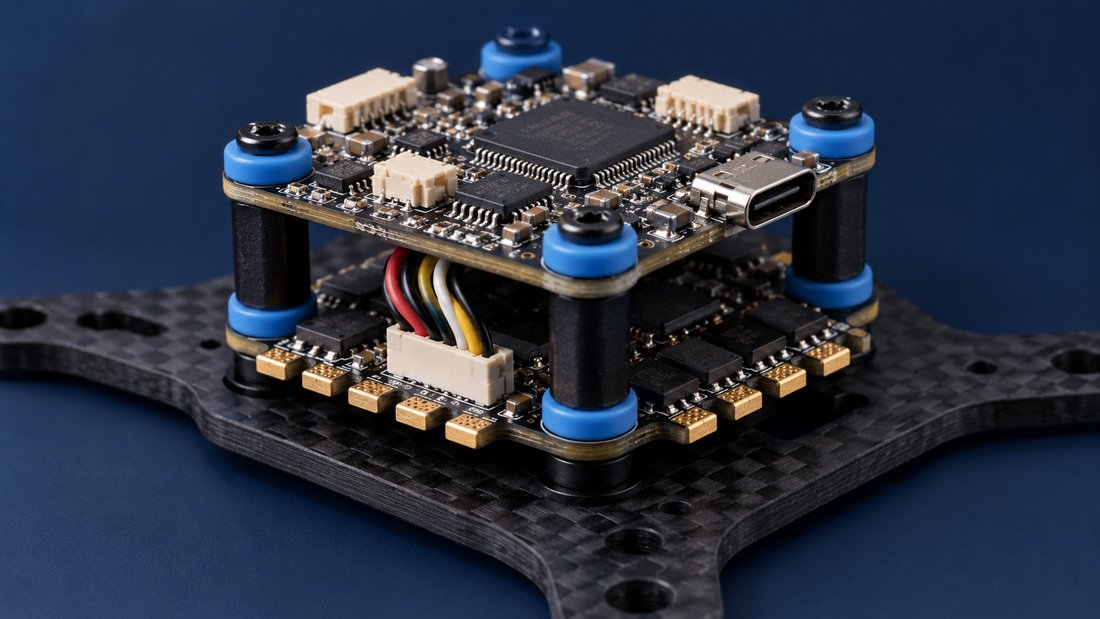
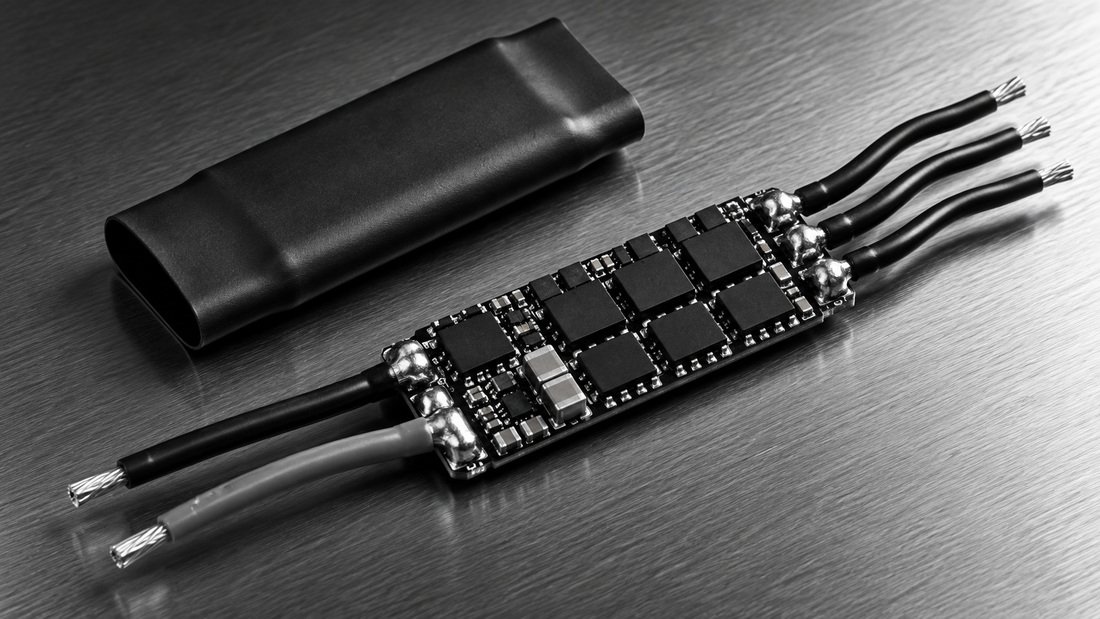
A flight controller and ESC stack is the kind of control hardware you may find inside a caged ball. DPF supplies drone soccer systems, motors and ESCs as separate categories, so clubs can plan repairs without discarding a whole ball. If your organisation is new to drone sports, the drone soccer clubs page describes the operational side of running regular sessions.
How a Brushless Drone Soccer Ball Works
The flight sequence is short and repeatable. A player switches the ball on, waits for the receiver to bind, and arms the motor. Radio commands from the transmitter reach the receiver, the flight controller interprets them, and the ESC drives the brushless motor to produce thrust. Because the motor spins a propeller inside a cage, the ball rises, tilts and translates in the direction the player steers.
Scoring mechanics
Most formats use a vertical hoop mounted at each end of the field. A goal is scored when the whole ball passes through the hoop in the correct direction. Hoop diameter, height and mounting method vary between rule sets, so a ball that fits one league’s hoop may not fit another’s. Confirm the hoop specification together with the ball specification.
Radio and safety behaviour
Radio link quality determines how much control a player has. A fail-safe that cuts or reduces motor power when the signal drops is a safety feature worth confirming in writing. So is the behaviour after a low-battery warning: some systems reduce power, others simply stop. The two behave very differently in a crowded gymnasium.
Drone Soccer Ball vs Conventional Drone Soccer Equipment: A Comparison
The table below compares the caged ball with the surrounding equipment a club usually buys. It is general guidance for planning, not a statement about any specific DPF product.
| Item | Role in play | Typical wear points | Procurement priority |
|---|---|---|---|
| Brushless drone soccer ball | The scoring aircraft itself | Cage, propeller, motor bearings, battery | Highest — you need enough to field full teams |
| Transmitter | Player control input | Gimbals, switches, battery | High — one per active player |
| Goal hoop | Scoring target and field furniture | Frame, netting, mounts | High — must match the ball and rule set |
| Barriers and netting | Spectator and player protection | Tears, anchor points | Medium to high depending on venue |
| Spare motors and ESCs | Repair stock | Storage, connector corrosion | Medium — prevents grounded balls |
| Charging and storage case | Battery logistics and transport | Latch, foam, wiring | Medium — safety and turnaround time |
Why This Matters to Clubs, Schools and Associations
Understanding the ball changes how you budget, train and schedule. A coach who knows the ball contains a motor, ESC and battery can plan repair rotations instead of cancelling sessions when one unit fails.
Fleet availability beats unit price
A cheap ball that cannot be repaired becomes expensive when it is grounded. A slightly costlier ball with documented spare parts may cost less per flying hour over a season. Ask suppliers which components are field-replaceable and which are not.
Fairness across competitions
If teams bring mixed ball types, matches can become uneven. Associations often address this by publishing an approved equipment list. That list is the document your procurement decision should follow, whatever a supplier’s brochure says.
For programmes that combine competition with classroom outcomes, STEM drone education and training explains how equipment choices connect to learning objectives. Associations planning a calendar can also review drone soccer competitions for event-level considerations.
Regulatory and Safety Context
Indoor school and club play is usually run under a programme’s own safety code, but outdoor flying may fall under national aviation rules. In the United States, the Federal Aviation Administration (FAA) explains that drones flown for educational purposes are regulated either under the Exception for Limited Recreational Operations of Unmanned Aircraft or under the Small Unmanned Aircraft Systems Rule (Part 107).
The FAA notes that drones flown for educational and research purposes may be operated under the recreational exception for qualifying educational organisations, including institutions of higher education, Junior Reserve Officers’ Training Corps (JROTC) programmes, and educational programmes chartered by an FAA-recognised Community Based Organization. It adds that educational organisations that do not qualify as institutions of higher education and are not part of a JROTC programme must be chartered by a recognised CBO to operate under that exception, otherwise they must operate under Part 107. See the FAA’s guidance for educational users at https://www.faa.gov/uas/educational_users.
This is US guidance and does not automatically apply elsewhere. If your club flies outdoors, confirm the applicable national or local rules before purchasing equipment, and confirm whether your venue qualifies for any locally available recognition or exemption.
Common Mistakes When Buying Drone Soccer Equipment
Most procurement problems come from buying before specifying. These are the recurring ones we hear about.
- Buying balls before reading the rulebook. Ball and hoop dimensions must match the format your league plays.
- Ordering no spares. A fleet without spare motors, ESCs and batteries will lose flying time.
- Ignoring battery logistics. Charging capacity and safe storage often constrain session size more than ball count.
- Assuming transmitter compatibility. Radio protocols differ; confirm that transmitters bind to the balls you plan to buy.
- Treating a brochure as a specification. Request written data sheets and compare them item by item.
- Forgetting training time. Coaches and teachers need hands-on time before the first match.
Buyer Checklist: What to Confirm in Writing
Use this checklist as a request-for-quotation template. It separates what you know from what you still need to verify.
- Ball outer diameter, mass and cage material, with a drawing or dimensioned photo.
- Motor type, mounting pattern and whether replacements use the same connector.
- ESC specification, current rating and whether it is integrated or a separate module.
- Battery chemistry, nominal voltage, capacity and connector type.
- Radio protocol and whether your existing transmitters are compatible.
- Fail-safe behaviour on signal loss and on low battery.
- Field-replaceable parts list, with part numbers and order quantities.
- Documentation language, packaging format and labelling for your region.
- Sample evaluation terms and the criteria you will use to accept a batch.
- Commercial terms: pricing validity, payment terms, shipping method and returns process.
DPF does not publish universal lead times, minimum order quantities or warranty terms in this article, because those depend on the specific configuration and order. Ask for them in writing so your school or association has a record for its own approvals process. For programmes that sit inside a wider institution, schools and training organizations outlines the typical planning questions.
Trade-offs to Discuss Before You Commit
Every equipment decision trades one benefit for another. These are the choices worth talking through with coaches and administrators.
Durability versus mass
A stiffer, heavier cage survives impacts but adds mass, which can change how the ball accelerates and how long a battery lasts. Lighter cages may fly more responsively but deform sooner.
Standardisation versus flexibility
Buying one ball model across a whole league simplifies fairness, spares and training. It also reduces your options if a supplier changes a design. Some associations hedge by approving two or three models and testing them each season.
Integrated versus modular electronics
Integrated boards save space and weight but may require replacing a larger assembly after a fault. Modular ESCs cost more in parts and connectors but can be swapped individually. There is no universally correct answer; it depends on your repair capacity.
Upfront cost versus lifetime cost
A lower unit price is not automatically lower total cost. Factor in spares, batteries, charging equipment and staff time for repairs. Ask suppliers to help you build a two-season consumables estimate.
Frequently Asked Questions
Is a brushless drone soccer ball just a small drone in a cage?
Functionally, yes. It is a self-contained rotorcraft with motor, ESC, battery, receiver and flight controller. The cage replaces a conventional airframe and protects both the electronics and the people nearby.
Do all drone soccer balls use brushless motors?
Not necessarily. Some entry-level or toy-grade units use brushed motors. Competition-grade equipment more commonly uses brushless motors because of durability and consistent response. Always check the specification rather than assuming.
How many balls does a club need?
That depends on team size, match format and how many courts you run at once. A practical approach is to count the maximum balls in play simultaneously, then add a repair reserve. Confirm reserve ratios with your league or association.
Are batteries included and are spares available?
This varies by supplier and configuration. Ask specifically whether batteries, chargers and spare motors or ESCs are included, and whether they can be reordered separately later.
Can we use the same transmitters across different ball models?
Only if the radio protocols are compatible. Compatibility is not guaranteed by physical similarity. Ask the supplier to confirm binding compatibility with your existing transmitters in writing.
Does flying indoors avoid all regulatory requirements?
Not automatically. Rules differ by country and by whether the flight is indoors, outdoors, recreational or educational. In the US, the FAA publishes guidance for educational users at https://www.faa.gov/uas/educational_users. Outside the US, check your own national authority.
What should we request before placing a first order?
Ask for a written specification sheet, a spare-parts list with part numbers, a sample evaluation offer and a clear quotation. Treat verbal descriptions as provisional until they appear in a document you can file.
Conclusion and Next Step
A brushless drone soccer ball is the core of any drone soccer equipment programme: a caged, motor-driven aircraft that scores goals rather than carrying a camera. Because the ball contains propulsion, power and control electronics, the quality of its brushless motor and ESC largely determines how often it flies and how often it sits on a repair bench.
For clubs, schools and associations, the practical priority is not a single purchase but a repeatable process: confirm the rulebook specification, request written data sheets, plan spares and batteries alongside the balls, and evaluate a sample before committing a full fleet.
When you are ready to compare configurations for your teams, Request a Team Kit Quote and tell us your format, team count and competition calendar so the discussion starts from your actual requirements.