Why we built BAYCKRC ELRS transmitter modules
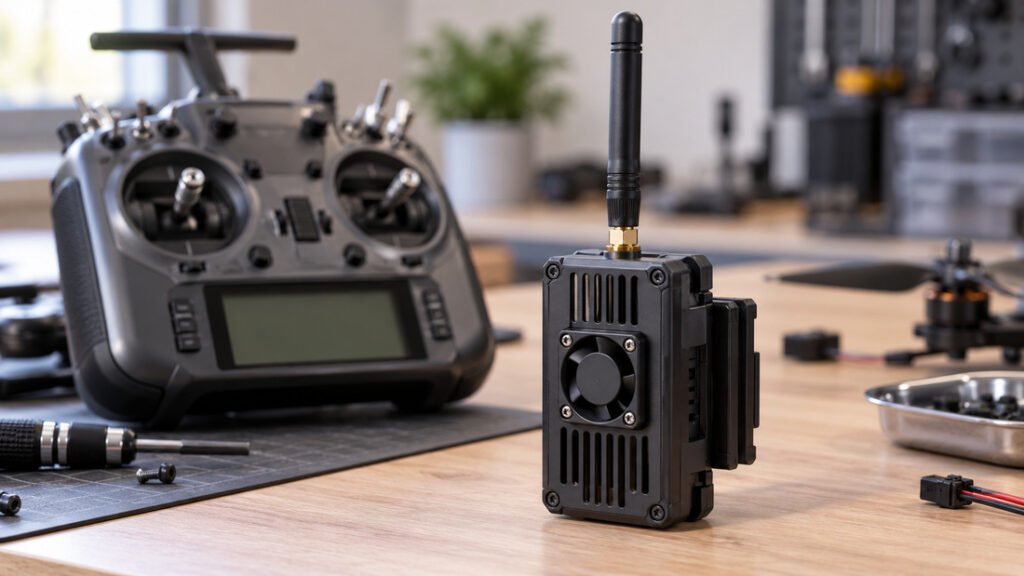
BAYCKRC ELRS transmitter modules are external ExpressLRS modules that plug into the module bay of an RC radio. The range includes three 1W dual-band modules for 868/915MHz and 2.4GHz, two of them with Gemini dual-frequency transmission, plus a Nano-to-JR adapter.
- Models
- 3 TX modules + 1 adapter
- Bands
- 868/915MHz and 2.4GHz
- Output
- Up to 1W per RF chain
- Input
- 7–30V
You have probably been here. Your 2.4GHz receivers work well for racing, but the long-range wing needs 900MHz, so you carry two radios or swap modules in the field. Your customers ask which module fits their radio, and the answer depends on a bay size nobody wrote down. Or the link fades behind a tree line exactly when you need telemetry most.
Whether you fly long-range, run a club fleet, stock a shop or build radio bundles for your own brand, you do not need another module. You need one transmitter that covers every receiver you own, fits the radios your customers already have and keeps its link when conditions get hard.
From our first days supporting model aircraft builders, one passion has driven our radio work: to make the control link the part of the system you never have to worry about. We use our own RF engineering and factory testing to help you fly further, switch bands in seconds and sell radio kits with confidence.
As a drone parts manufacturer building ExpressLRS hardware in Chengdu, we are committed to one principle: one transmitter should connect you to every receiver you fly. That is the idea behind our ELRS transmitter modules, and we help every pilot, club, distributor and brand we work with move from a patchwork of radios to one dependable link.
How we started: one radio, two bands, too many modules
It all started with a box of modules on a workbench. Customers who bought our receivers kept sending the same photo: a radio, a 2.4GHz module, a separate 900MHz module, spare antennas and a note asking which one to use for which aircraft.
We looked at how pilots and shops really used ExpressLRS. Three problems came up again and again:
- Pilots flew 2.4GHz for racing and freestyle but needed 868/915MHz for long-range and fixed-wing, and swapping modules in the field was slow and risky.
- Shops and distributors had to stock several module formats for different radio bays, and many returns were simply the wrong format.
- Long-range and event users wanted more link margin than a single frequency can give when a signal is blocked or crowded.
That is why we created the BAYCKRC dual-band module family. We did not want to just sell another ExpressLRS transmitter. We wanted one module that talks to every BAYCKRC receiver, on either band, from the radio you already own.
The turning point: Gemini
The turning point came from our long-range and event customers. They asked for a link that would not fade when one frequency was blocked or crowded. ExpressLRS Gemini made that possible: the transmitter sends every packet on two frequencies at once. We built two Gemini modules with two independent 1W RF chains, one in the Nano format and one in the Micro format, and matched them with our Gemini receivers.
From day one, your feedback has shaped every decision we make. The wide 7–30V input, the Nano-to-JR adapter and the dual-band antenna all came from customer requests.
How we make ELRS transmitter modules that solve real problems
Every model in our range answers a specific problem. Here is what we did, and what you gain.
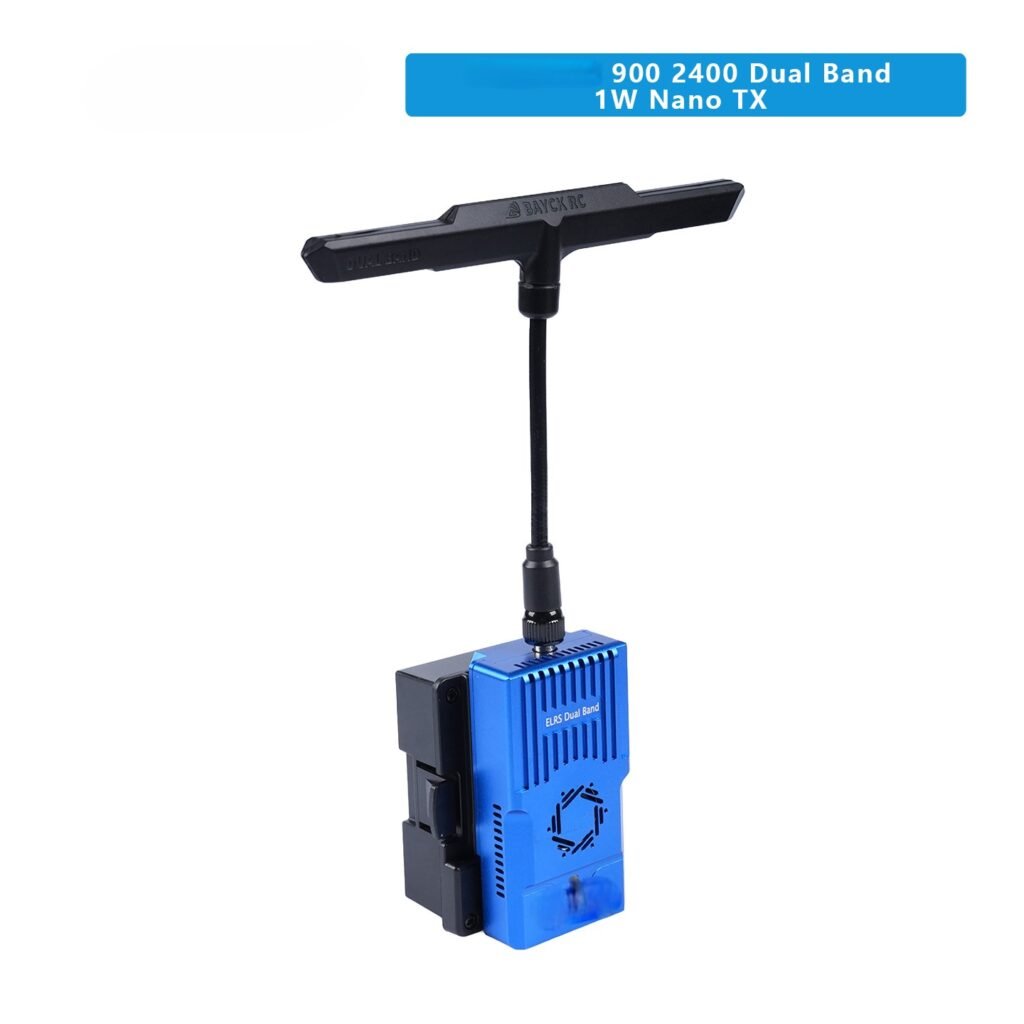
To solve the two-module problem, we built the dual-band 1W Nano TX on 868/915MHz and 2.4GHz. → One ELRS TX module binds to 900MHz, 2.4GHz and dual-band receivers, so you switch bands in the menu instead of swapping hardware. See BKT0101.
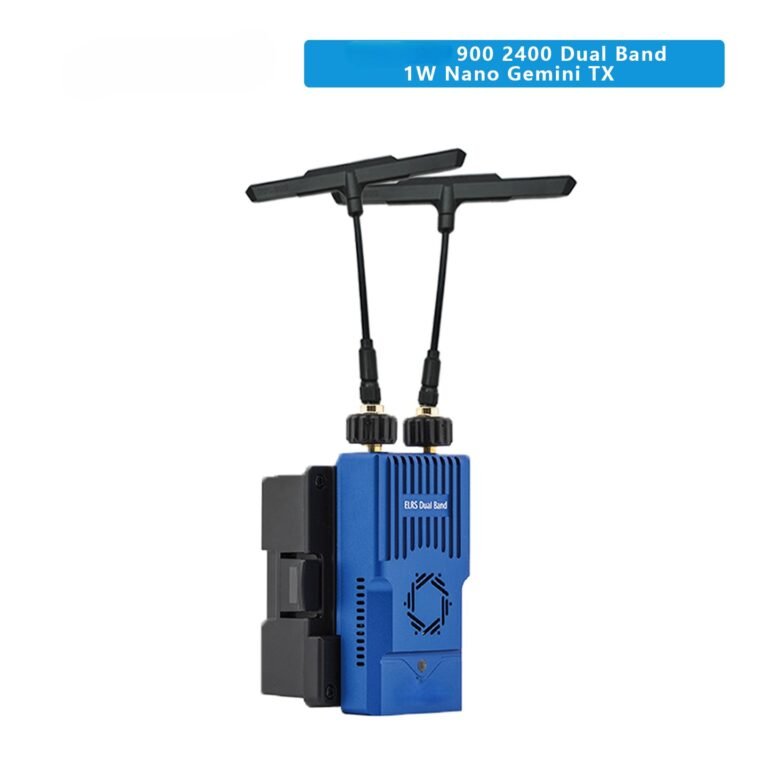
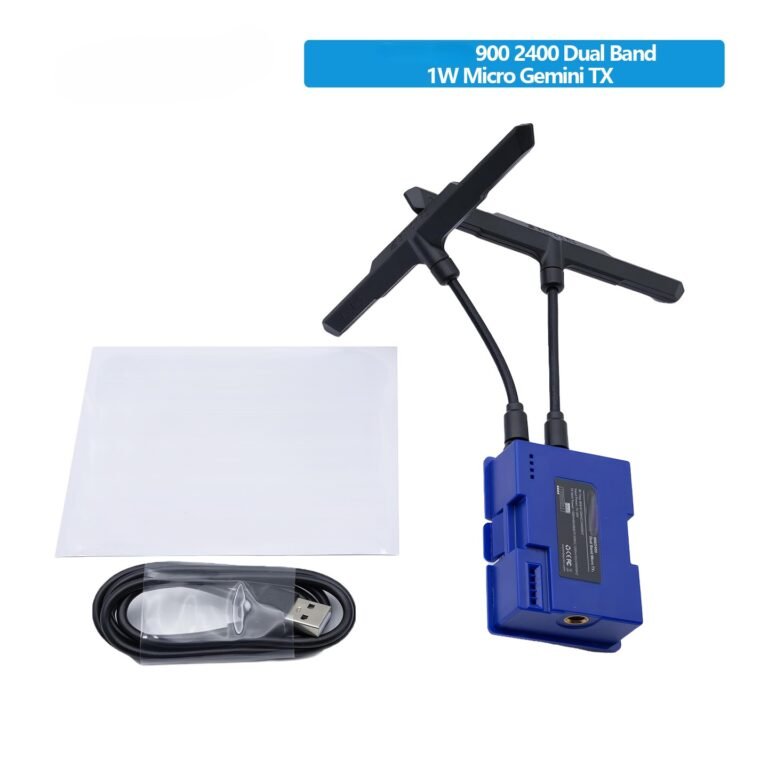
To solve fades when a signal is blocked, we designed two Gemini modules with two RF chains of up to 1W each. → Each packet travels on two frequencies at the same time, so a fade on one is covered by the other. See BKT0102 (Nano) and BKT0100 (Micro).
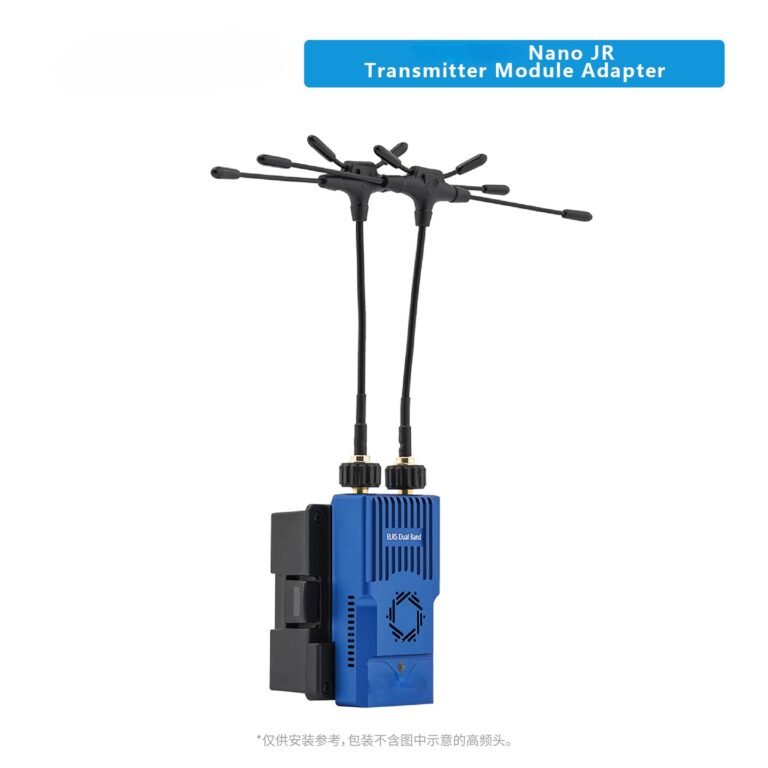
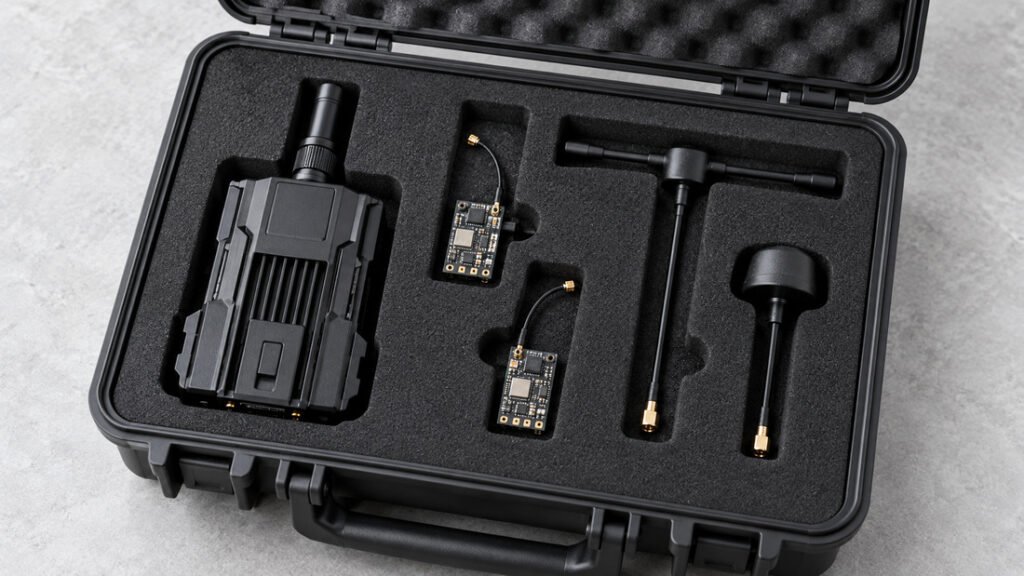
To solve radio bay confusion, we offer both the Nano and Micro formats, plus a Nano-to-JR adapter. → Distributors can stock one Nano module family and still serve customers with full-size JR-bay radios. See BKT0103.
To solve power supply limits, every dual-band module accepts a wide 7–30V input. → The module works with a broad range of radio batteries and external power setups.
To solve antenna mismatches, we matched the modules with a dual-band T antenna tuned for both bands. → You get a correct, SMA male antenna for 868/915MHz and 2.4GHz in one part. See BKA0101.
Built and checked in our own factory
Every BAYCKRC ExpressLRS transmitter is flashed with its named firmware target and checked before packing: output power setting, band switching, cooling and the connection to the radio's Lua menu. Modules ship with FCC-domain firmware by default, and OEM or regional orders can be pre-flashed for EU or AU domains.
What we have achieved so far
| Milestone | Detail |
|---|---|
| Module family | 3 dual-band 1W modules and 1 Nano-to-JR adapter |
| Bands | 868/915MHz and 2400MHz on every module |
| Maximum output | 1000mW per RF chain, adjustable in the ELRS Lua script |
| Gemini | 2 models with two independent RF chains (2 × 1000mW per band) |
| Formats | Nano (Lite) and Micro module bays, JR bays with the BKT0103 adapter |
| Matched receivers | 20 BAYCKRC ELRS receivers, including dual-band and Gemini models |
Compare our ELRS transmitter modules
The table lists every model with key data from our catalog (revision 2026-04-29). Open a model for full specifications, images and FAQs.
| SKU | Model | Format | Maximum output | Input |
|---|---|---|---|---|
| BKT0101 | Dual-Band 1W Nano TX Module | Nano (Lite) module bay | 1000mW @ 868/915MHz; 1000mW @ 2.4GHz | 7–30V |
| BKT0102 | Dual-Band 1W Nano Gemini TX Module | Nano (Lite) module bay | 2 × 1000mW @ 868/915MHz; 2 × 1000mW @ 2.4GHz | 7–30V |
| BKT0100 | Dual-Band 1W Micro Gemini TX Module | Micro module bay | 2 × 1000mW @ 868/915MHz; 2 × 1000mW @ 2.4GHz | 7–30V |
| BKT0103 | Nano-to-JR TX Module Adapter | Adapter | — | From the radio |
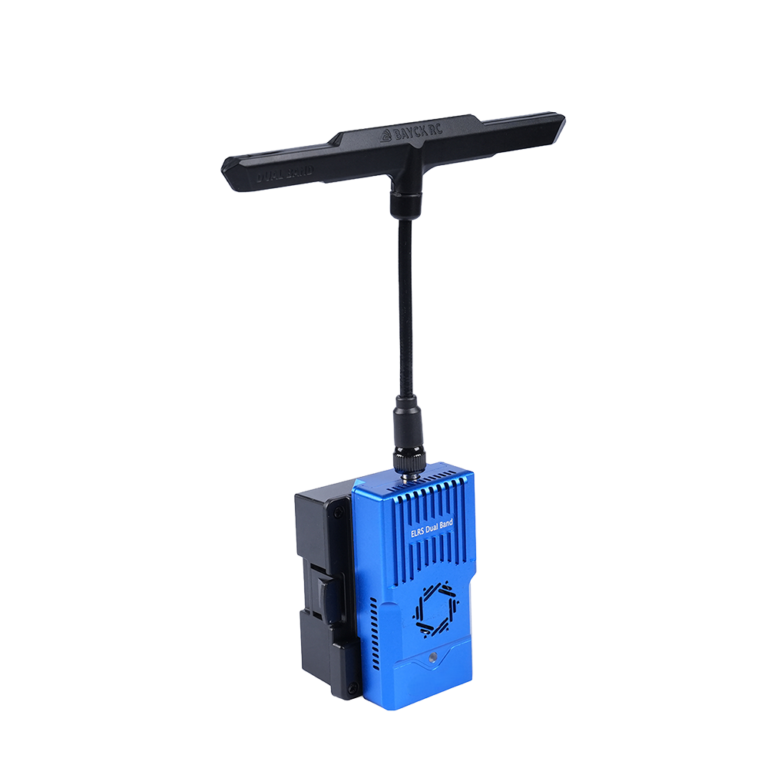
Dual-Band 1W Nano TX Module
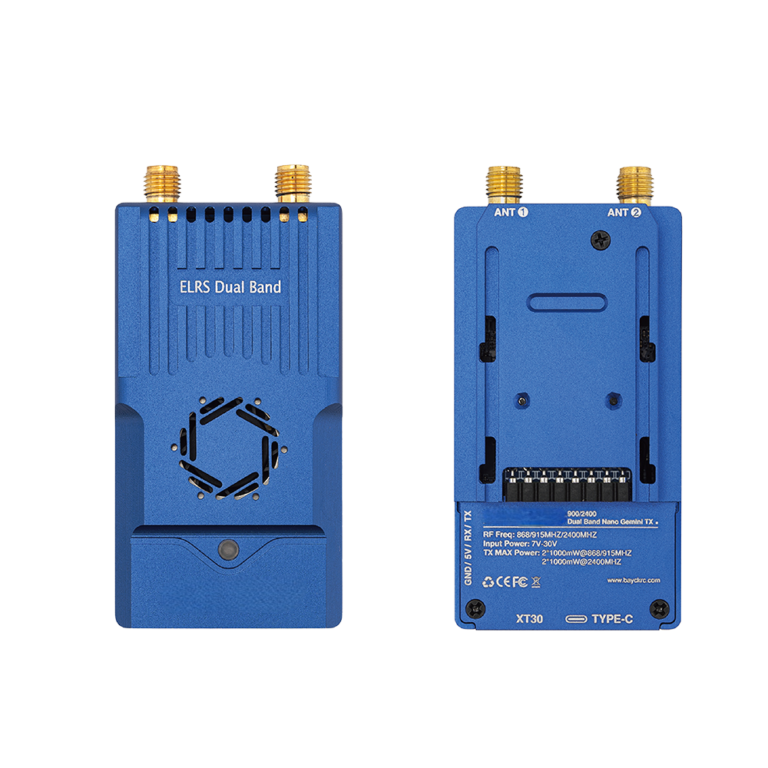
Dual-Band 1W Nano Gemini TX Module
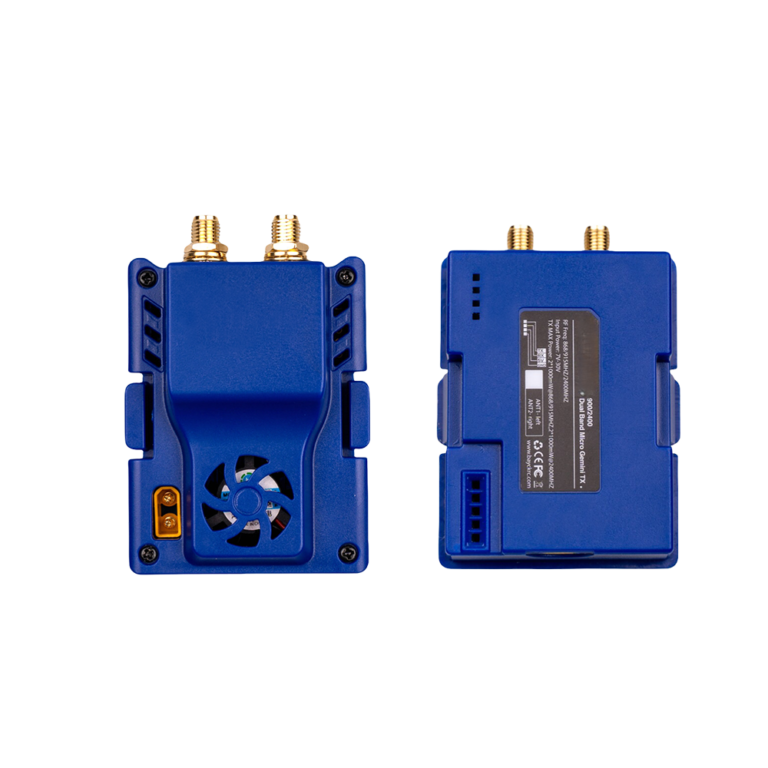
Dual-Band 1W Micro Gemini TX Module
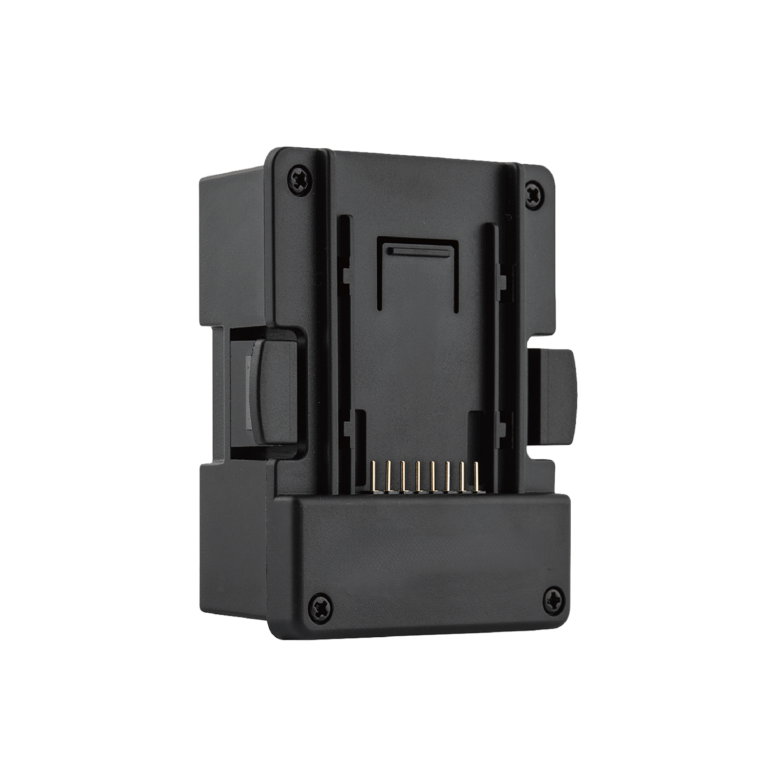
Nano-to-JR TX Module Adapter
How to choose the right ELRS TX module
Match the module to your radio bay first, then to the way you fly.
| Your situation | Recommended | Why |
|---|---|---|
| Compact radio, racing and long-range on one radio | BKT0101 Nano TX | Dual-band at up to 1W, best value |
| Compact radio, long-range or mission-critical training | BKT0102 Nano Gemini TX | Two RF chains for Gemini links |
| Radio with a Micro module bay | BKT0100 Micro Gemini TX | Gemini in the Micro format |
| Full-size radio with a JR bay | BKT0101 or BKT0102 + BKT0103 | The adapter converts Nano to JR |
| Distributor radio bundles | BKT0101 + BKA0101 antenna | One SKU serves all BAYCKRC receivers |
Single-band or Gemini? A standard dual-band ELRS module transmits on one band at a time, which you choose in the menu. A Gemini module transmits on two frequencies at once. Choose Gemini when the link must survive blocking and interference, for example long-range flights or crowded event venues. Gemini mode needs a Gemini receiver such as BKR0108 or BKR0109.
Do you need 1W? Most flights need far less. Higher power adds range margin but also heat and current draw. Set the lowest power that gives a solid link, and always stay within the legal limit for your country and band.
For receivers to pair with your module, see our ELRS receivers.
Setup, radio compatibility and legal use
BAYCKRC modules follow the open-source ExpressLRS project, so they work with radios that support the CRSF protocol, such as those running EdgeTX or OpenTX, and with any ExpressLRS receiver on a matching band and major firmware version.
- 01Fit the module
insert it in the Nano or Micro bay, or use the BKT0103 adapter in a JR bay, and attach the antenna before powering on.
- 02Enable the external module
in the radio model settings, set the external RF module to CRSF.
- 03Open the ELRS Lua script
choose the band, packet rate, output power and, for Gemini modules, the Gemini mode.
- 04Bind
use the same binding phrase on module and receiver, or bind from the Lua script.
- 05Check telemetry
confirm link quality and receiver telemetry before the first flight.
Never transmit without an antenna. Running a module without its antenna can damage the RF output stage.
Regulatory domains and power. Transmit power limits and permitted frequencies depend on your country and band. Modules ship with FCC-domain firmware; EU and AU users should flash the matching domain. You are responsible for using legal settings. See our RF certification guide.
Firmware targets. Each product page names its ELRS Configurator target. Keep the module and receivers on the same major ExpressLRS version. See TX module firmware.
Antennas, power and range: practical tips
Getting the best from ELRS transmitter modules is mostly about three things: the antenna, the power setting and the packet rate.
Use the right antenna. Dual-band modules need an antenna tuned for both 868/915MHz and 2.4GHz. Our dual-band T antenna uses an SMA male connector and fits BKT0101 and BKT0102 directly. Gemini modules use two antennas, one for each RF chain. Keep the antenna vertical and unobstructed, and replace it if the elements are cut or bent.
Set power to the job. Start at a moderate power level and raise it only when telemetry shows the link needs more margin. Many pilots use dynamic power, which lets the module raise output only when the link weakens. This keeps the module cooler and extends radio battery life.
Match packet rate to distance. High packet rates give the lowest latency for racing and freestyle. Lower packet rates give more range and a more stable link for long-range and fixed-wing flights. Change the rate in the Lua script and set the same band on every receiver in that model.
Watch the heat. A 1W ExpressLRS transmitter produces heat at full output. Allow airflow around the module, avoid covering it in hot vehicles and let it cool between long sessions.

Who uses our ELRS transmitter modules
Our ELRS transmitter modules serve very different customers, and each one gets something specific from them.
| Customer | What they use | What they gain |
|---|---|---|
| Long-range and fixed-wing pilots | BKT0102 or BKT0100 with Gemini receivers | Extra link margin when terrain or distance blocks one frequency |
| FPV racers and freestyle pilots | BKT0101 with 2.4GHz receivers | Low latency today, 900MHz range when they need it |
| Drone soccer clubs using their own radios | BKT0101 with RR2 receivers | A reliable 2.4GHz link for training aircraft and spare fleets |
| Schools and training centres | Pre-configured BKT0101 modules | Fewer setup errors across many radios and students |
| Distributors and radio brands | BKT0101 bundles and private-label modules | One SKU that serves every customer receiver |
Whatever your use case, the goal is the same: a link you can trust from the first flight to the last.
For event organisers, dual-band modules also simplify logistics. One module type covers every aircraft class at the venue, spare modules are interchangeable between radios, and pre-configured settings reduce setup time before each round.
Common module issues and quick fixes
Most problems with ELRS transmitter modules are settings, not hardware. Check these first:
- No connection — confirm the ELRS TX module and receiver use the same band, major ExpressLRS version, binding phrase and regulatory domain.
- Lua script does not open — set the external module to CRSF in the radio model settings and update the ELRS Lua script.
- Short range — check the antenna, lower the packet rate for long-range flights and review the output power setting.
- Module gets hot — reduce the maximum power or enable dynamic power, and allow airflow around the module.
- Radio shuts down at high power — check the radio battery and the current the module bay can supply.
Still stuck? Our troubleshooting guide covers more cases, and our engineers can help through technical support.
Wholesale and OEM ELRS transmitter modules
Distributors, radio brands and fleet operators buy our modules in bulk, in bundles or under their own name.
- Samples first — test a dual-band ELRS module with your radios before a volume order. Request samples.
- Radio bundles — module, dual-band T antenna and adapter packed together for your customers.
- Private label — your logo, packaging and firmware target name. See custom RF module development.
- Pre-configured fleets — regulatory domain, default power and binding phrase set at the factory for schools, clubs and events.
- Clear warranty — 12 months from delivery unless your quotation states otherwise, with RMA replies normally within 2 working days. See our Warranty & After-Sales Program.
Tell us the models, quantities and target market, and we reply with pricing, MOQ and lead time. Get a quote.
ELRS transmitter modules FAQ
ELRS transmitter modules FAQ
What are ELRS transmitter modules?
ELRS transmitter modules are external ExpressLRS radio modules that plug into the module bay of an RC radio. They send control data to ExpressLRS receivers and bring telemetry back to the radio.
Can one module control both 900MHz and 2.4GHz receivers?
Yes. All three BAYCKRC dual-band modules cover 868/915MHz and 2.4GHz. You choose the band in the ELRS Lua script, so one module works with every BAYCKRC receiver.
What is the difference between the Nano TX and the Nano Gemini TX?
The Nano TX (BKT0101) has one RF chain and transmits on one band at a time. The Nano Gemini TX (BKT0102) has two independent RF chains and can send each packet on two frequencies at once for Gemini links.
Will a Nano module fit my full-size radio?
Yes, with the BKT0103 Nano-to-JR adapter. It converts the Nano interface to a JR module bay and measures 64 × 54 × 25mm.
What input voltage do the modules accept?
The dual-band modules accept 7–30V. Check that your radio battery and module bay can supply enough current for high output power.
Do BAYCKRC modules work with receivers from other brands?
Yes. They follow the open-source ExpressLRS standard, so they work with other ExpressLRS receivers that use the same band, major firmware version and binding phrase. Gemini mode needs a Gemini-capable receiver.
Can I buy ELRS TX modules wholesale or under my own brand?
Yes. We supply samples, bulk orders, radio bundles and private-label modules with your logo, packaging, firmware target name and pre-configured settings.