Quick summary
For a 5-inch racing quad, choose propellers by matching diameter to the frame (typically 5 to 5.1 inches), then select blade count, pitch and material around your motor KV, battery voltage and track style. Use tri-blade props in the 4.3 to 5.1 inch pitch range as a baseline for most 5-inch racing builds; go lower pitch for tight technical tracks and higher pitch only if your motors and battery can supply the current. Confirm balance, hub strength and supply consistency before ordering team quantities.
Key Takeaways
- Diameter is set by your frame and motor mount pattern; a 5-inch prop must physically clear the frame arms and stack.
- Blade count and pitch trade acceleration against top speed, current draw and battery flight time.
- Material and hub design affect crash survivability and vibration; a 0.1 g imbalance is noticeable on a racing quad.
- Props cannot be selected in isolation. Treat motor, propeller and battery as one propulsion system.
- For clubs and schools, standardising one or two prop specs simplifies spares, repairs and safety briefings.
What makes a propeller suitable for 5-inch racing?
Three physical variables decide most of the answer: diameter, pitch and blade count. Everything else, including material, hub geometry and weight, tunes how those three behave in the air and in a crash.
Racing quads are flown hard, often within metres of gates and other pilots. That makes consistency and predictability more valuable than chasing the single fastest combination.
Diameter: the constraint you cannot change
A 5-inch class frame accepts propellers nominally 5 inches or slightly larger (for example 5.1 inch), depending on arm clearance and motor position. If the prop fouls the frame, the flight controller will fight vibration and your tune will never settle.
Measure clearance with the prop fitted and the motors rotated by hand. Also check clearance to the camera, antenna mounts and battery strap. This is the first item on any team’s acceptance check for a new frame.
Pitch: the main speed-versus-control dial
Pitch describes how far the blade would advance in one rotation in a perfect fluid, expressed in inches. Higher pitch pushes more air per revolution, demanding more current from the motor and battery. Lower pitch accelerates faster from low throttle and draws less current, which suits tight, technical courses and smaller practice halls.
If your motors run hot or your battery sags under full throttle, reducing pitch is usually a more effective fix than changing the motor.
Blade count: thrust density and feel
Two-blade props are generally lighter and more efficient at cruising throttle. Three-blade props are the common racing baseline because they deliver smoother thrust and better grip in corners. Four and five-blade props add thrust and grip further, at the cost of current draw and drag.
For school and drone soccer programs, a tri-blade prop is usually the simplest starting point because it behaves predictably across a wide throttle range.
How do blade count, pitch and material trade off?
There is no single best propeller, only a combination that suits a track, a pilot and a power system. The table below summarises the general behaviour most builders observe. Treat it as directional guidance to test, not as measured data for a specific product.
| Variable | Lower / less | Higher / more | Typical racing choice |
|---|---|---|---|
| Pitch (inches) | Faster throttle response, lower current, easier in tight gates | Higher top speed, higher current, more heat | Roughly 4.3 to 5.1 in, adjusted for motor KV |
| Blade count | 2 blades: efficient, light, lower grip | 3 to 5 blades: more grip and thrust, more draw | 3 blades as a baseline |
| Material | Softer blends flex and absorb impacts but lose shape | Stiffer blends hold shape and transmit vibration | Glass-fibre reinforced polycarbonate is common |
| Weight and balance | Lighter props spin up faster | Heavier props may survive contact better | Prefer consistent, well-balanced sets |
Material and durability
Most 5-inch racing props use a glass-fibre reinforced polycarbonate or similar engineering polymer. The blend controls how the blade flexes under load and how it fails in a crash. A prop that bends is often reusable; a prop that shatters can send fragments toward people or equipment.
For organised events, inspect props after every heat and replace anything with visible cracks, whitening at the hub or bent blades.
Balance, moulding quality and vibration
Balance matters more on a racing quad than on a camera drone because the flight controller reacts to vibration at high loop rates. Poor moulding, uneven hub thickness or flashing on the leading edge all show up as noise in the gyro.
When evaluating a new supplier, buy a small sample set first and check hub fit, blade finish and consistency between units from the same batch.
How do you match props to motors, ESC and battery?
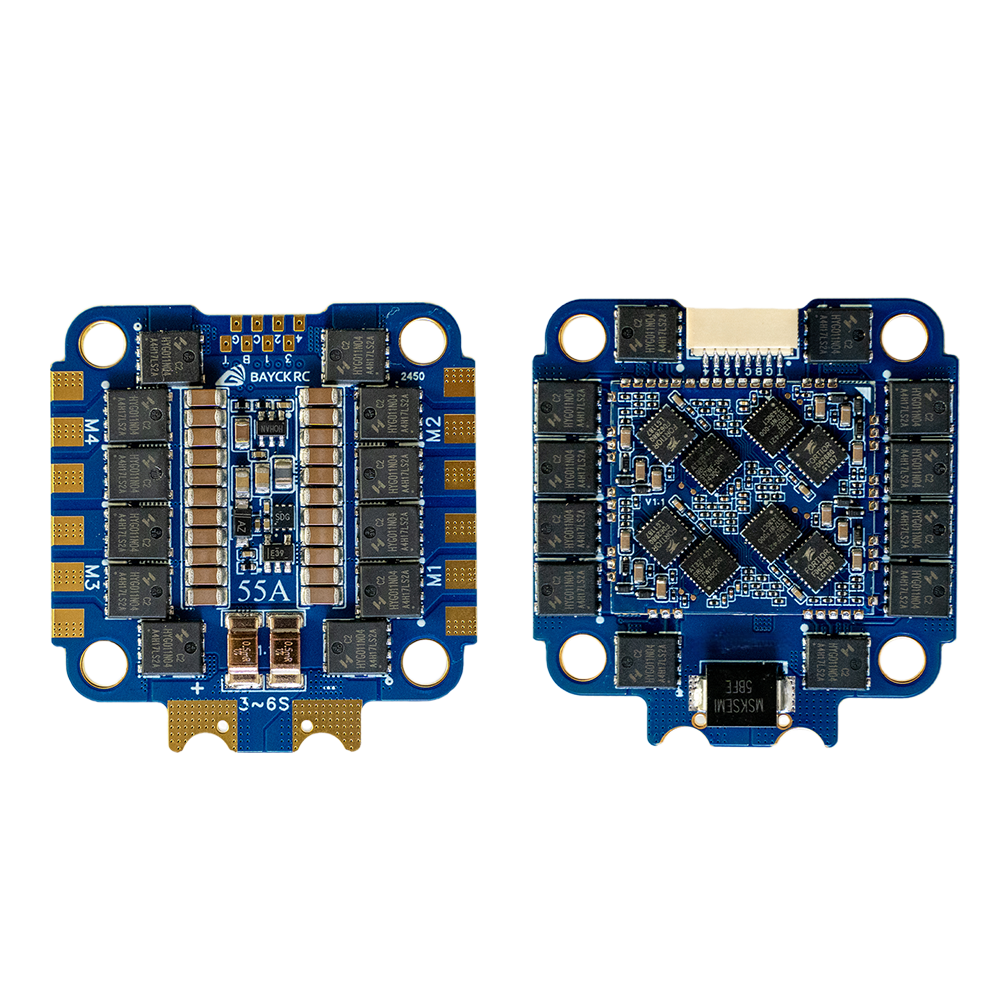
Propeller choice is the last step in a propulsion decision, not the first. The motor’s KV rating, the battery’s cell count and the ESC current rating together define how much prop the system can safely spin.
As a rule of thumb, higher KV motors suit lower pitch and lower blade counts, while lower KV motors can turn more aggressive props on higher cell counts. Exceeding the ESC’s current rating or the battery’s discharge capability produces heat, sag and, in the worst case, component failure.
This is where motor, propeller and battery matching becomes a procurement exercise rather than a bench experiment. Ask a supplier to explain how their recommended combination was validated, and request the test conditions in writing.
A practical matching sequence
- Fix the frame and confirm maximum prop diameter.
- Choose motor KV for your intended battery cell count.
- Confirm ESC continuous and burst current ratings.
- Select blade count and pitch for the track style.
- Test under controlled conditions, logging motor temperature and battery sag.
- Only then commit to a team-wide standard.
Where DPF product lines fit
If you are standardising a fleet, it can be simpler to source the propulsion group together. Drone Parts Factory lists FPV motors and propulsion combo kits that can be specified as a matched set. For drone soccer (BKZ) programs, which run repeated, structured flights in enclosed spaces, a consistent motor and prop combination reduces the variables coaches have to manage.

Common mistakes when buying racing props
- Buying on blade count alone. Five blades are not automatically faster; they change the power demand and the feel.
- Ignoring KV and cell count. The same prop can be mild on one build and destructive on another.
- Mixing batches. Props from different production runs may differ slightly in weight and stiffness, which shows up as inconsistent handling.
- Skipping sample testing. Ordering season quantities before testing one pack risks a whole stock of unusable props.
- Overlooking storage. Props stored loose in a box deform and chip; flat, protected storage keeps a team’s spares usable.
A note on batteries in transit
If your club travels to events with spare lithium batteries, note that aviation rules restrict how they may be carried. The US Federal Aviation Administration states that spare (uninstalled) lithium ion batteries must be carried in carry-on baggage only, with terminals protected from short circuit, and that lithium ion batteries are limited to 100 watt hours per battery unless additional approval applies (FAA, PackSafe: Lithium batteries). These are US-origin rules described by that source; always check the rules of every jurisdiction and airline on your route.
Buyer checklist for clubs, schools and distributors
- Frame maximum prop diameter measured, not assumed.
- Motor KV, ESC current rating and battery cell count documented per aircraft.
- One or two approved prop specs agreed for the whole fleet.
- Sample pack tested for balance, hub fit and crash behaviour before bulk order.
- Written confirmation of material, dimensions, weight and packaging.
- Spares ratio agreed (racing clubs typically need a multiple of one set per pilot per event).
- Storage and inspection routine written into team procedures.
- For distributor or OEM/ODM orders, colour, branding and packaging requirements stated in writing.
Commercial terms vary by supplier and order type. Ask for confirmation in writing on quantity breaks, packaging, labelling, tolerances and inspection criteria rather than relying on a catalogue description.
Planning a fleet standard for your club or program? Share your frame, motor KV and battery configuration with our team and we will help you narrow the options. Request a Team Kit Quote.
Frequently asked questions
What pitch should I use for 5-inch racing drone propellers?
Most 5-inch racing builds sit between roughly 4.3 and 5.1 inches of pitch. Choose the lower end for tight, technical courses and lower-KV-friendly efficiency, and the higher end for open courses with long straights, provided your motors, ESC and battery can handle the extra current.
Are tri-blade props better than bi-blade for racing?
Neither is universally better. Tri-blades are the common racing baseline for grip and smooth thrust; bi-blades are lighter and more efficient but offer less grip in corners. Test both on your own build and track.
How do I know if my props are too aggressive for my motors?
Warning signs include motors that run noticeably hotter than usual, battery voltage sag under full throttle, shortened flight time and reduced throttle resolution. These suggest reducing pitch or blade count, or reassessing motor KV and battery cell count.
Do I need to balance racing propellers?
Production quality varies. Checking balance on new props is good practice, particularly for club fleets where vibration affects tune consistency. If a set is consistently out of balance, raise it with the supplier as a quality issue rather than correcting every prop by hand.
How many spare props should a team carry?
There is no universal figure. It depends on crash rate, event length and venue. Many teams take several sets per pilot per event. Track your own consumption over a season and set a reorder point based on that data.
Can I use the same props for drone soccer and FPV racing?
Only if the frame, motor and safety requirements align. Drone soccer (BKZ) aircraft operate in enclosed spaces under specific competition rules, so prop selection should follow the class rules and the frame manufacturer’s limits rather than FPV racing norms.
What should I confirm with a supplier before a bulk order?
Confirm material and dimensions, unit weight and balance expectations, packaging, labelling, quantity breaks and inspection criteria in writing. Also ask how to raise a quality complaint and what documentation accompanies the shipment.
Does a longer or more detailed product page affect search visibility?
Content quality supports buyer understanding, but no page length, keyword density or structural technique guarantees search rankings or inclusion in AI-generated answers. Focus on accurate specifications and genuine testing.
Conclusion
Choosing drone propellers for 5-inch racing comes down to matching diameter to the frame, then tuning blade count and pitch to your motor KV, battery and track. Buy a small sample, test it under controlled conditions, and only then standardise a spec across your team or program.
If you are equipping a school, club or drone soccer squad, or sourcing for distribution, the fastest route is to share your existing motor and battery configuration with us. We can help you compare compatible options and confirm the commercial details in writing.
Next step: Request a Team Kit Quote and include your frame size, motor KV, battery cell count and expected season quantity.
For OEM or ODM requirements, you can also review our motor and propulsion matching service to discuss a customised propulsion package.