Quick summary
Short answer: T antennas and dipole antennas are both linear, omni-directional designs used on drones and radio links, but they differ in physical construction, radiation pattern shape, and practical mounting. A dipole is a straight half-wave element, often used where a clean, balanced pattern is needed. A T antenna adds a perpendicular top section that can improve bandwidth and adjust the pattern, but it is more sensitive to orientation and nearby conductive parts. For drone sports teams, the choice affects range consistency, durability, and how easily the antenna fits on small airframes.
Key Takeaways
- Both are linear and omni-directional, but a dipole is typically a straight element while a T antenna has a top hat that changes pattern and bandwidth.
- Polarization matters: keep transmit and receive antennas aligned (both vertical) for best range; mismatches cause signal loss.
- Mounting and ground plane affect performance more than the name; test on your actual airframe and receiver.
- Durability and size often decide for school and club use; T antennas can be more fragile if not protected.
- Always confirm specifications (gain, VSWR, connector, frequency) and request test data or samples before bulk orders.
What is a T antenna?
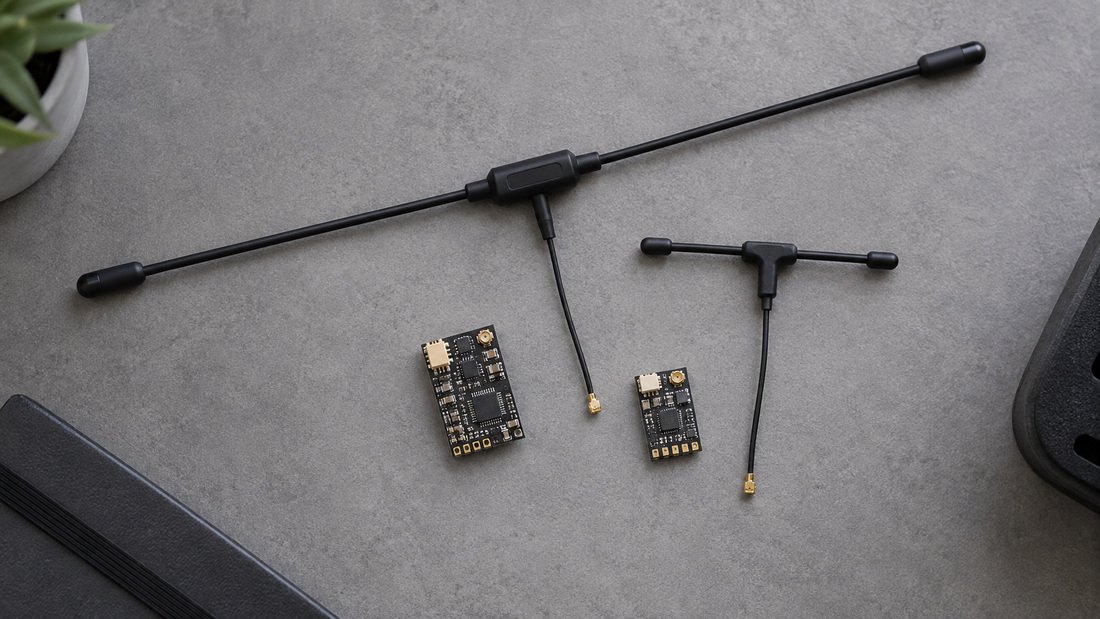
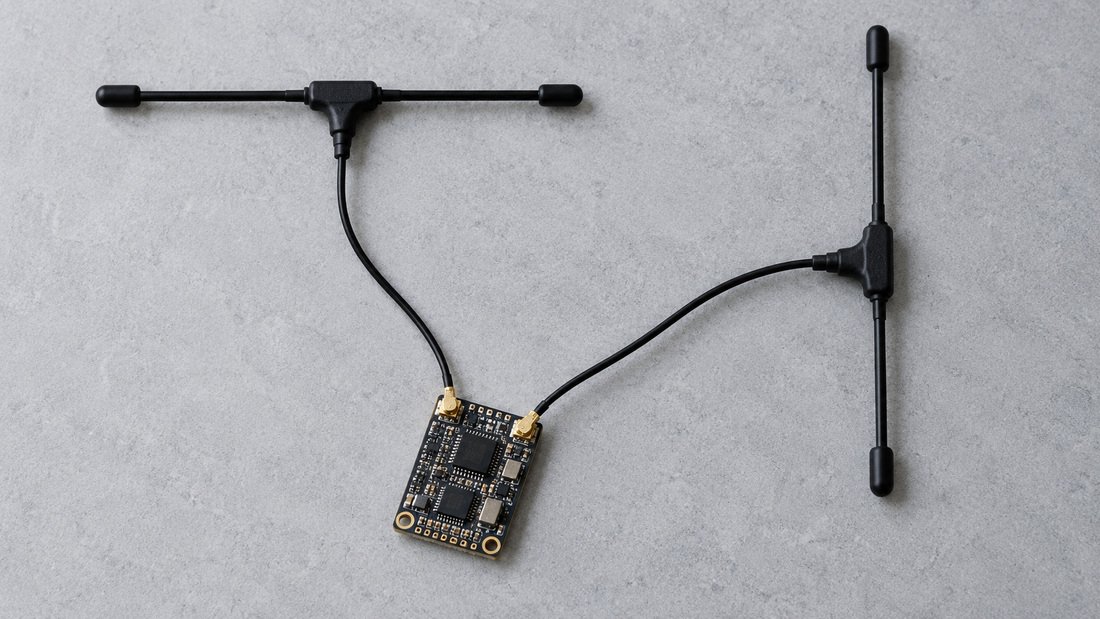
A T antenna (sometimes called a T-matched or top-loaded antenna) consists of a vertical radiator with a horizontal top section forming a T shape. The top section acts as a capacitance hat, which can shorten the required vertical length for a given frequency and may broaden bandwidth. It remains linearly polarized, usually vertical when mounted upright. Because the top section is perpendicular to the main element, the radiation pattern can become slightly more directional or asymmetric compared to a simple dipole, depending on the ground plane and mounting. T antennas are common in compact receivers and transmitters where space is limited.
What is a dipole antenna?
A dipole antenna is a balanced antenna made of two conductive elements fed at the center. The classic half-wave dipole has a well-known doughnut-shaped radiation pattern and is linearly polarized along the axis of the elements. In drone radio systems, dipoles are often used as straight whip antennas on transmitters and receivers. They generally offer a predictable pattern and are less affected by the feed cable when properly balanced. Many ELRS receivers and transmitter modules use dipole or similar linear antennas; see ELRS receivers for examples.
Key differences between T antennas and dipole antennas
The table below compares typical characteristics. Actual performance depends on design, frequency, and installation; use it as a starting point for questions, not as a guarantee.
| Feature | T antenna | Dipole antenna |
|---|---|---|
| Construction | Vertical element with horizontal top section | Two straight elements fed at center |
| Typical polarization | Linear (usually vertical when upright) | Linear along element axis |
| Radiation pattern | Can be adjusted by top hat; may be less symmetrical | Classic doughnut shape, symmetrical |
| Bandwidth | Often broader due to top loading | Narrower, depends on element diameter |
| Size | Can be shorter vertically for same frequency | Length determined by frequency (half-wave) |
| Mounting sensitivity | More sensitive to nearby conductive parts and orientation | Generally more forgiving when kept clear |
| Durability | Top section can be fragile; needs protection | Simple straight element; can be robust |
| Common use | Compact devices, space-constrained installations | Transmitters, receivers, general-purpose whips |
How antenna choice affects drone soccer and youth programs
In drone soccer, matches are fast and often indoors or in busy venues with reflective surfaces. Consistent radio link is critical for control and safety. Both T and dipole antennas can work, but the practical differences matter for teams:
- Space and mounting: Small drone soccer airframes have limited real estate. A T antenna may fit in tighter spots, but its top section can snag or break. A dipole may be easier to mount vertically with a zip tie or 3D-printed holder.
- Durability: Youth programs need antennas that survive crashes and handling. Consider flexible materials or protective covers.
- Polarization alignment: Ensure all drones and the transmitter use the same polarization (typically vertical). Mixing orientations reduces range.
- Interference: Indoor venues with Wi-Fi and other radios benefit from antennas with good filtering or diversity; see RF antennas for options.
For more on ELRS system components, visit ELRS and RF systems.
Practical procurement checklist for teams and distributors
Before ordering antennas for a team kit or resale, gather the following information. Where DPF commercial terms are not listed here, request them in writing.
- Frequency band: Confirm the exact operating frequency (e.g., 2.4 GHz, 900 MHz) matches your radios.
- Connector type: Verify connector (SMA, RP-SMA, U.FL, etc.) and gender; mismatches are common.
- Polarization: Decide on vertical or horizontal and keep consistent across the fleet.
- Gain and pattern: Ask for gain (dBi) and radiation pattern data; higher gain is not always better for omni-directional coverage.
- VSWR: Request typical VSWR across the band to assess matching.
- Physical size and weight: Check dimensions and weight, especially for small drones.
- Durability: Ask about materials, flexibility, and any protective casing.
- Mounting: Confirm mounting style (e.g., bulkhead, cable, adhesive) and included hardware.
- Compliance: Ask for relevant documentation if required by your venue or region.
- Samples: Request samples to test on your actual airframes before bulk purchase.
- Warranty and lead time: Confirm warranty terms and lead times in writing.
- MOQ: Clarify minimum order quantities for custom or OEM versions.
For ELRS receiver compatibility, see ELRS receiver compatibility.
Common mistakes when choosing drone radio antennas
- Ignoring polarization: Using a vertical antenna on the drone and horizontal on the transmitter drastically reduces range.
- Mounting near conductive parts: Placing antennas close to carbon fiber, batteries, or metal can detune them and distort the pattern.
- Overlooking connector gender: SMA and RP-SMA are not interchangeable; check before ordering.
- Assuming higher gain is always better: High-gain omni antennas can have narrower vertical coverage; for aerobatics, a lower-gain antenna may be more consistent.
- Neglecting strain relief: Antenna cables and connectors are frequent failure points; use proper strain relief and test after crashes.
Testing and verification steps
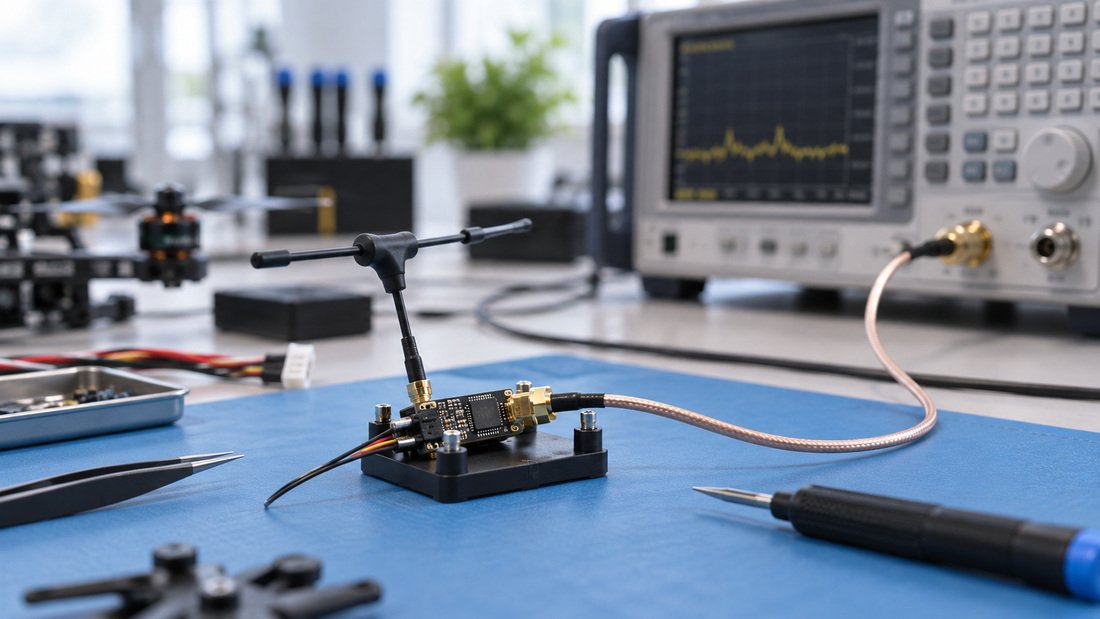
Antenna performance is installation-dependent. Before committing to a design, perform simple range checks in a controlled environment. Compare antennas under identical conditions: same transmitter power, same location, same orientation. Use a receiver with telemetry or a signal strength indicator if available. Document results. For teams, keep a log of which antenna types work best on each airframe. This is especially useful for ELRS transmitter modules with different output power levels.
For a personalized recommendation based on your fleet and venue, contact our team.
Frequently asked questions
1. Which antenna is better for drone soccer: T or dipole?
There is no universal better; it depends on your airframe, mounting, and venue. Dipoles are often simpler and more predictable. T antennas can be more compact but may be more sensitive to installation. Test both if possible.
2. Can I mix T and dipole antennas on the same drone?
You can, but ensure both are the same polarization and tuned for the same frequency. Mixing types can cause pattern differences but is not inherently unsafe; test range.
3. Does a T antenna require a ground plane?
Like most antennas, a T antenna benefits from a ground plane, but its top-loading can reduce dependence on a large ground plane compared to some other designs. Always follow the manufacturer’s mounting recommendations.
4. How do I know if my antenna is compatible with my ELRS receiver?
Check the connector type and frequency band. ELRS typically uses 2.4 GHz or 900 MHz; ensure the antenna is designed for that band and has the correct connector. See the ELRS receiver compatibility page.
5. What does VSWR mean and why does it matter?
VSWR (Voltage Standing Wave Ratio) indicates how well the antenna is matched to the radio. Lower VSWR means less reflected power and better efficiency. Ask for typical VSWR values.
6. Are T antennas more fragile?
The top section can be a snag point and may break in a crash. Choose models with flexible materials or add protection. Dipoles are generally simpler and more robust.
7. Can I get custom antennas with my team’s logo?
Some suppliers offer OEM/ODM options. Ask about minimum order quantities, tooling costs, and lead times. Confirm all terms in writing.

Conclusion and next step
Choosing between T antennas and dipole antennas for drone radio systems comes down to your specific airframe, mounting constraints, and operating environment. Both are linear and omni-directional, but T antennas offer compactness at the cost of installation sensitivity, while dipoles provide predictable performance and durability. For drone sports teams and educational programs, prioritize polarization consistency, durable construction, and thorough testing on your actual equipment. To equip your team with the right antennas, receivers, and modules, Request a Team Kit Quote and tell us about your fleet and venue.