Quick summary
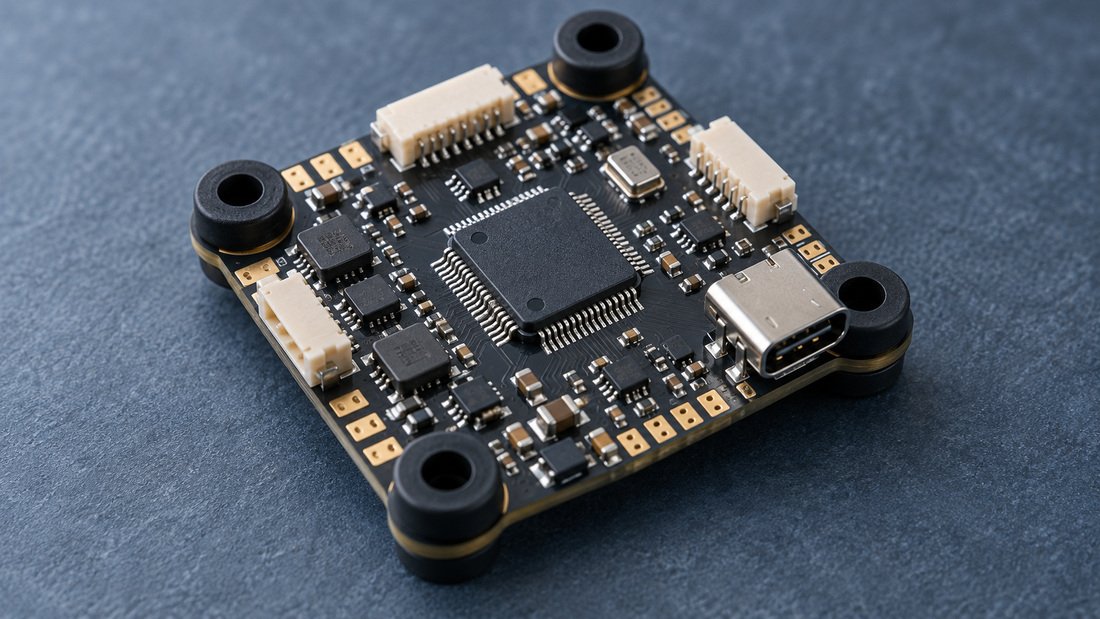
An AT32F435 flight controller is an FPV flight controller built around the Artery AT32F435 microcontroller (MCU), a 32-bit chip that runs flight-control firmware such as Betaflight. It reads sensors, calculates stabilisation commands and sends motor signals to the electronic speed controllers (ESCs). For schools, drone soccer teams and clubs, the AT32F435 matters mainly as a host platform: the board layout, firmware target support and connector set determine whether it suits a team fleet, not the chip name alone.
Key Takeaways
- The AT32F435 is the processor on the flight controller, not the flight controller type or a firmware version.
- Flight controller firmware support is board-specific; manufactures publish the target for each board.
- Drone soccer and youth programs should choose boards for repairability, connector durability and consistent firmware across the fleet.
- Confirm board target, sensor set, input voltage range and spare-parts availability in writing before ordering.
- No chip name guarantees flight performance; tuning, ESC compatibility and build quality matter more.
What an AT32F435 flight controller actually is
A flight controller is the small computer at the centre of an FPV drone. It reads a gyroscope and accelerometer, sometimes a barometer, magnetometer or GPS, and calculates how fast each motor must spin. It then sends commands to the ESC. Betaflight’s documentation describes this role clearly: the flight controller reads sensors, computes desired actions and sends commands to the ESC to control motors and keep the quadcopter in the air, and can also manage peripherals such as video transmitter (VTX) control, radio telemetry and LEDs (Betaflight Getting Started).
The AT32F435 is the MCU on which that software runs. Artery’s AT32F435 family is a 32-bit ARM Cortex-M4 class microcontroller. In FPV, it appears on boards marketed as an alternative or successor to older STM32 F4/F7-based designs. The important point for buyers is that the MCU is one part of the board: the gyro, power regulation, pads, connectors and firmware target all shape how the controller behaves in a team environment.
Why the chip name appears in product listings
FC listings often lead with the MCU because it signals processing headroom and firmware compatibility. Betaflight supports a wide range of flight controller hardware from many manufacturers, and support for each board comes from its manufacturer (Betaflight Getting Started). That means an AT32F435 board is only useful to your team if the vendor publishes a working firmware target and keeps it updated.
AT32F435 vs STM32-based FPV flight controllers
AT32F435 and STM32 boards can run the same class of firmware, but they are not interchangeable at the purchasing level. The table below summarises practical differences teams should weigh. It is general guidance, not a statement about any specific DPF product.
| Consideration | AT32F435-based board | STM32-based board |
|---|---|---|
| Firmware target | Must have an explicit Betaflight target from the board maker | Long-established targets, but age and variant matter |
| Processor headroom | Often positioned for modern feature load | Varies by F4/F7/H7 class |
| Spare availability | Check with supplier; newer platforms may have shorter histories | Often widely stocked, but model-specific |
| Team familiarity | Check whether coaches already know the configuration tool | Coaches may have existing setup notes |
| Repair strategy | Confirm pad/connector layout before buying fleet quantities | Same discipline applies |
For a club, the deciding question is rarely raw clock speed. It is whether every drone in the fleet can be flashed, tuned and repaired with the same process. A mixed fleet of AT32F435 and STM32 boards increases training and spares complexity.
Why drone soccer and youth programs should care
Drone soccer is a team sport with repeated impacts, tight build tolerances and rapid turnaround between matches. The flight controller is one of the most frequently handled components during repairs. A sensible programme treats the FC as a standardised, documented part rather than a one-off performance upgrade.
Fleet consistency beats peak specification
If half the squad flies AT32F435 boards and half flies older controllers, coaches need two sets of configuration files, two spare inventories and two tuning routines. Standardising on one board family, with a written firmware and tuning baseline, reduces downtime and makes it easier to train student technicians.
Repairability and connector durability
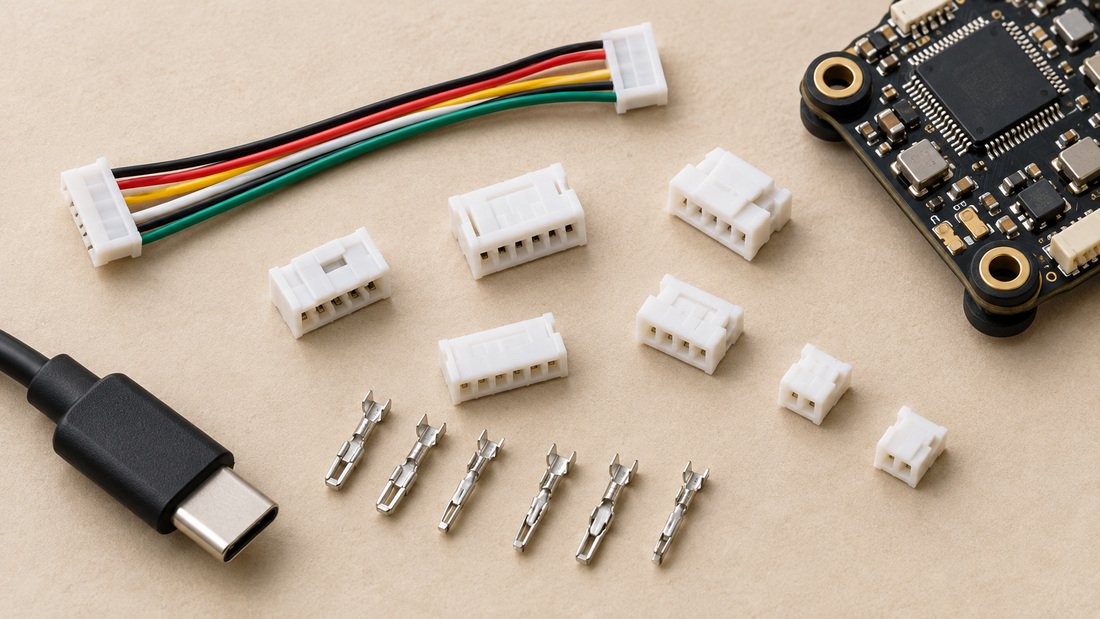
School and club drones are plugged and unplugged constantly. USB connectors, motor pads and receiver plugs take abuse. Inspect connector style and solder-pad size on any candidate board, and buy spare cables and connectors with the first order. Our FPV electronics range is organised so programmes can source compatible parts together.
How an AT32F435 FC fits into a complete drone
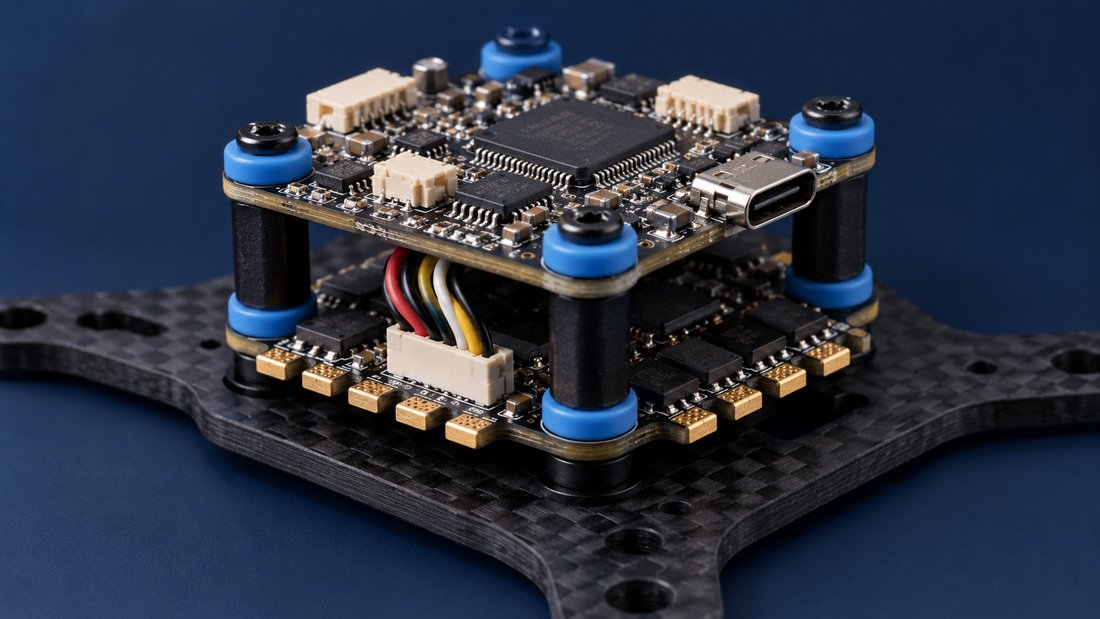
The FC does not fly the drone alone. It works with ESCs, a radio receiver, a video transmitter and often a GPS or buzzer. Betaflight documents support for receiver protocols including CRSF, Ghost, FPort, SBUS and Spektrum, and ESC protocols such as DShot, Oneshot and Multishot (Betaflight Getting Started). Confirm that your chosen receiver and ESC protocol are supported by the specific board and firmware target.
Matching the flight controller to the ESC
Check the signal protocol, mounting pattern and wiring harness. A stack is usually sold as FC plus ESC, but replacements are often bought separately after a crash. Keep the ESC and FC documentation together. If your programme builds or repairs stacks, review electronic speed controllers alongside the flight controller listing.
Video, OSD and team telemetry
Betaflight supports on-screen display (OSD) for analog and digital video systems and can show battery voltage, current draw, GPS data, timers and flight-mode status (Betaflight Getting Started). For coaching, a consistent OSD layout across the fleet helps students read battery and status information quickly. Video receivers and recording devices are separate purchases; see FPV video receivers if you are specifying a viewing setup.
Procurement checklist for clubs and schools
Use this checklist before committing to a fleet purchase. Ask the supplier to confirm each point in writing, because commercial terms and technical support vary by vendor and are not implied by the chip name.
- Exact board model, MCU and gyro part number.
- Published firmware target name and the Betaflight version it is tested against.
- Input voltage range and recommended battery chemistry for your class.
- Receiver and ESC protocols supported on the board.
- Connector and pad layout, including USB type and motor signal pads.
- Mounting hole pattern and stack compatibility.
- Spare parts, replacement cables and connector kits available for the same batch.
- Documentation language and availability of a wiring diagram.
- Warranty, return and DOA (dead on arrival) policy, confirmed in writing.
- Lead time and minimum order quantity for the quantity your programme needs.
Common mistakes in FC procurement
- Buying by chip name only. A chip does not tell you the gyro, layout or firmware support status.
- Mixing board revisions in one fleet. Small layout changes can confuse student repairers.
- Forgetting consumables. Cables, connectors and spare props should arrive with the boards.
- Assuming firmware support is permanent. Ask how long the vendor expects to publish targets and updates.
- Skipping the test build. Order one sample, build it, flash it and document the process before scaling.
For a broader view of compatible components, browse our flight controllers category and compare board documentation before choosing a fleet standard.
Where an AT32F435 FC may or may not be the right choice
An AT32F435 board can be a good fit when the supplier provides a clear firmware target, a stable connector layout and reliable spares, and when your coaches are comfortable documenting configuration. It may be a poorer fit for a programme that already runs a well-supported STM32 fleet and cannot absorb a second configuration process, or for a group that needs long field-proven repair histories above all else.
Performance claims should be treated cautiously. Betaflight’s own documentation notes that support for each board comes from its manufacturer, and that tuning and filter presets give a starting point rather than a guaranteed result (Betaflight Getting Started). A chip does not replace tuning, build quality or pilot skill.
Frequently asked questions
Is AT32F435 the same as a flight controller model?
No. It is the microcontroller on the board. Two boards with the same AT32F435 chip can have different gyros, layouts, connectors and firmware targets.
Does an AT32F435 flight controller run Betaflight?
It can, if the board manufacturer publishes a Betaflight target for that exact board. Check the target name and supported version before buying.
Is AT32F435 better than STM32 for FPV?
Not automatically. It depends on the board design, firmware support and your team’s ability to configure and repair it consistently. Compare documentation, not just the chip.
Can I use an AT32F435 board for drone soccer?
Yes, if the board suits your class rules, frame, ESC and receiver, and your programme can standardise on it. Confirm class-specific equipment requirements with your league.
What should schools ask suppliers before ordering?
Ask for the firmware target, sensor part numbers, input voltage, connector diagram, spare-part availability, warranty terms, lead time and minimum order quantity in writing.
Do I need a different receiver for an AT32F435 FC?
No specific receiver is required by the chip. The board and firmware must support your receiver protocol; Betaflight lists CRSF, FPort, SBUS, Spektrum and others (Betaflight Getting Started).
How many spare flight controllers should a team keep?
That depends on fleet size and crash rate. Many programmes keep at least one spare per active build and a small pool of shared spares; confirm your own needs with coaches and your supplier.
Conclusion and next step
An AT32F435 flight controller is an FPV controller built on Artery’s 32-bit MCU. For schools and drone soccer clubs, the chip is only the starting point: firmware target support, stable connectors, spares and fleet consistency decide whether it works in practice. Start with a documented sample build, confirm technical and commercial terms in writing, and standardise only after your coaches have tested the workflow.
If you are specifying a team fleet or club kit, tell us your class, fleet size and repair process, and we will help you compare options. Request a Team Kit Quote.