Quick summary
RF interference at events is best handled as a planning problem, not a troubleshooting problem. Before the event, organisers should survey the venue with a spectrum analyser, map the 2.4 GHz and 900 MHz bands, agree a channel and power plan per team, standardise ELRS receiver and transmitter hardware, and write a fallback protocol. On the day, keep transmitters powered down until flights, stagger team warm-ups, and assign one person to monitor link quality. This article explains each step and what to confirm in writing with suppliers.
Key Takeaways
- Interference is usually predictable: Wi-Fi access points, spectators’ phones, video transmitters, lighting and other teams’ radios all occupy the same spectrum.
- A pre-event spectrum survey and a written channel plan remove most chaos on competition day.
- Standardising on one or two ELRS receiver and transmitter families makes link behaviour easier to diagnose across teams.
- Antenna choice and placement often matter more than raw transmit power for short, indoor team-drone flights.
- Ask suppliers for written confirmation of specs, compatibility and support terms; do not rely on assumptions.
Interference at a team-drone event rarely comes from one dramatic source. It is the sum of many small ones: a venue Wi-Fi mesh, dozens of phones, LED and DMX lighting controllers, camera crews streaming footage, and every team arriving with its own transmitters. The practical goal is not a perfectly clean spectrum, which no organiser can guarantee, but a predictable, documented plan that every team follows and a known fallback if a link degrades.
What causes RF interference at events?
Most event interference on shared bands comes from Wi-Fi, spectator devices, video links and other teams’ radios. Understanding the sources tells you what you can control, what you can negotiate with the venue, and what you must simply plan around.
Venue infrastructure
Indoor venues often run several Wi-Fi access points, ticketing systems, point-of-sale terminals and broadcast equipment. Some of this is on channels you cannot change. Ask the venue for its Wi-Fi channel plan and access-point locations before you finalise anything, and treat that information as a boundary your drone plan must work inside.
Spectators and teams
Every phone, smartwatch and tethering hotspot in the stands is a small radio. Add team transmitters, video receivers, and lap-timing or scoring systems, and the density rises sharply. You cannot control spectators, but you can control when and where team radios transmit.
Event production
Cameras, wireless microphones, intercom systems, LED walls and lighting desks all need spectrum. Production teams are usually reasonable partners if you bring a spectrum plan to the first planning meeting rather than raising it on the day.
How do you run a pre-event spectrum survey?
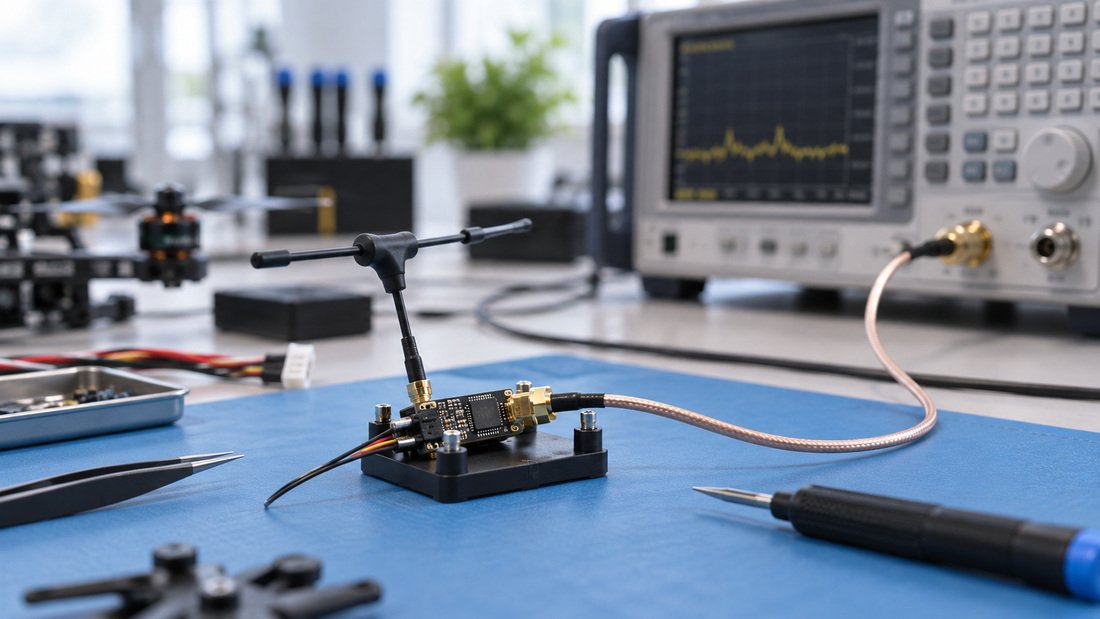
Walk the venue with a spectrum analyser at the times of day the event will run, record the bands you intend to use, and repeat the survey on setup day. A survey turns guesswork into a documented baseline you can share with teams and the venue.
What to record
- Occupied channels and approximate signal strength at the pilot positions, team benches and grandstand.
- Transient spikes during a test flight of one team drone.
- Wi-Fi SSIDs and channels visible from each zone, if the analyser supports it.
- Whether 900 MHz ELRS is viable as a fallback at the venue or blocked by other services.
Who should do it
Ideally a volunteer or staff member with RF experience, using a calibrated analyser and a documented method. If nobody on the organising team has that skill, ask your supplier whether technical guidance or training support is available and confirm exactly what is included in writing.
Band and hardware choices that reduce interference risk
Choosing bands, receivers and antennas deliberately is the single largest lever an organiser has. The right choice for a team-drone event is usually not the highest-power option, but the most predictable and best-documented one.
2.4 GHz versus 900 MHz
| Factor | 2.4 GHz operation | 900 MHz operation |
|---|---|---|
| Typical coexistence | Shared with Wi-Fi, phones, cameras | Often quieter indoors, but region-specific |
| Antenna size | Small, easy on micro drones | Larger antennas, harder to fit |
| Venue restrictions | Generally the default band for team events | Must be checked against local rules |
| Team familiarity | High | Usually lower |
This table describes general trade-offs only. Whether 900 MHz is permitted or practical at your venue depends on local regulation and venue conditions. Confirm both with the venue and your supplier rather than assuming either band is available.
Receivers, transmitters and antennas
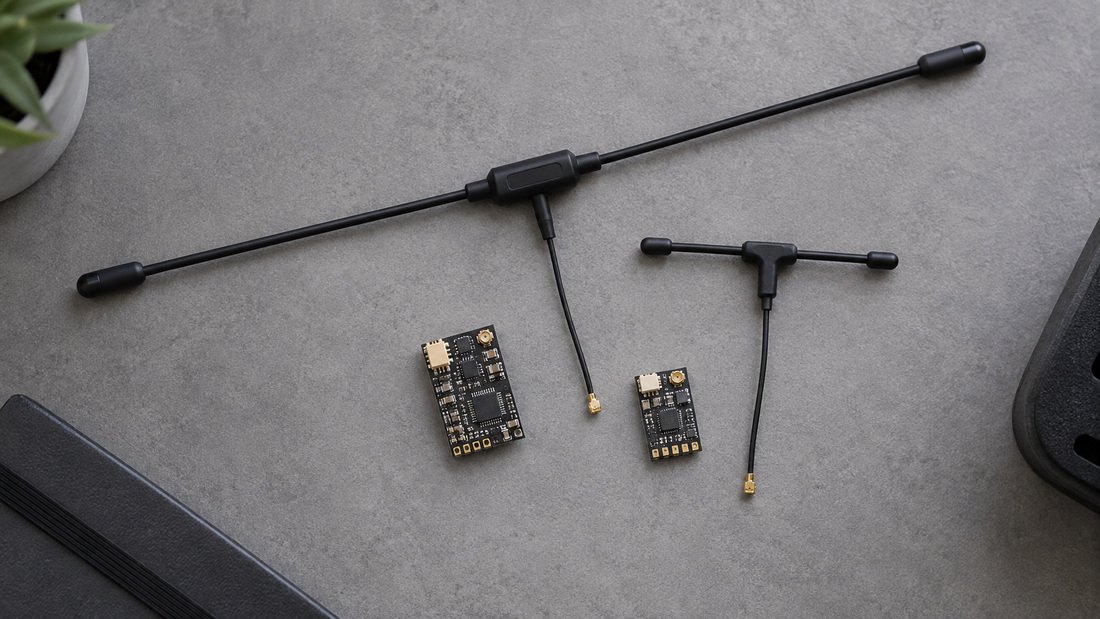
ELRS (ExpressLRS, an open-source radio link protocol) is widely used in team drone formats because receivers are small and firmware behaviour is consistent across a product family. Organisers should standardise on a small number of ELRS receivers and ELRS transmitter modules so that a fix or setting discovered on one drone applies to all.
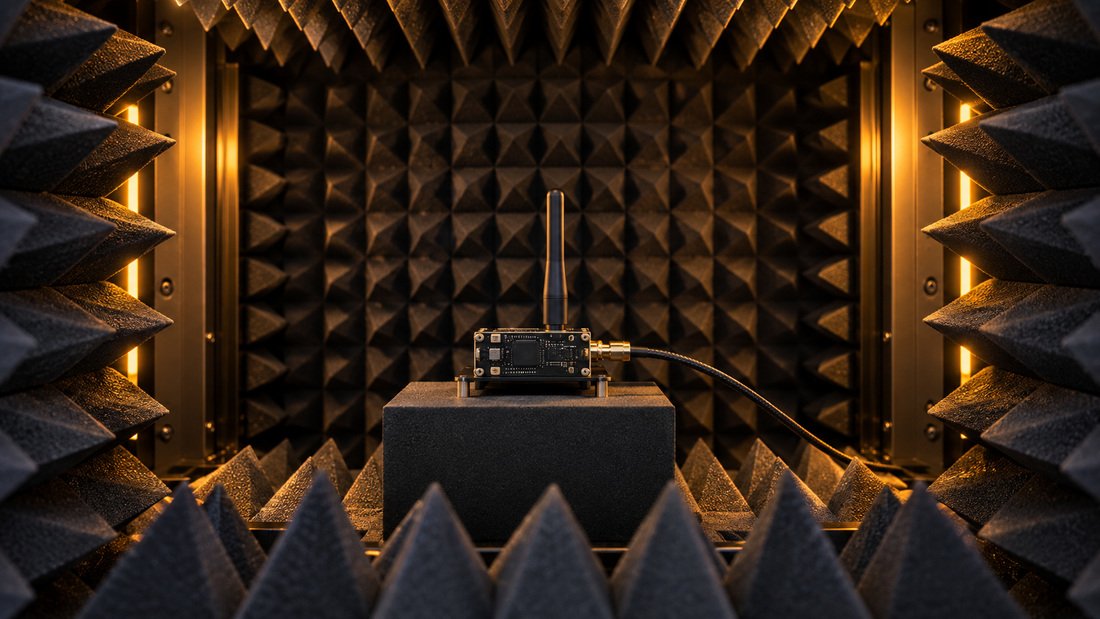
Antenna selection and placement often dominate outcomes indoors. A well-placed, correctly oriented antenna on the receiver and a sensible external module setup on the ground will typically outperform simply increasing output power. See the wider range of RF antennas for options, and check ELRS receiver compatibility before mixing brands or firmware versions across teams.
Build a team frequency plan
A team frequency plan assigns each team a band, channel and power setting, and says when radios may transmit. It should be a one-page document included in the team pack, not a verbal briefing.
What goes in the plan
- Approved bands and channel ranges for the event.
- Transmit rules: radios off in the pit lane until a marshall confirms the slot.
- Maximum output power settings agreed for all teams.
- Warm-up and practice windows, staggered by team.
- Reporting chain for link-loss incidents, so data is collected rather than lost.
Power and duty cycle discipline
High transmit power increases the noise floor for everyone nearby, including your own teams. For short indoor courses, a lower, consistent power setting across all teams is usually easier to manage than a mix of different settings. The exact figure depends on venue size and must be tested on site; do not adopt a number from another event without checking.
Planning a league season or a multi-day event? Our team can review your RF layout questions, help you choose between ELRS receiver and transmitter module families, and discuss equipment support for organisers. Talk to us about event equipment support.
Common mistakes organisers make
Most interference failures at team-drone events trace back to a handful of repeatable process errors rather than exotic RF problems.
- No spectrum survey before committing to a venue or band plan.
- Letting teams arrive with mixed firmware versions and no compatibility check.
- Allowing radios to transmit in the pit lane, saturating the floor for everyone.
- Solving problems with more power instead of better antenna placement.
- No written incident log, so recurring issues cannot be diagnosed between events.
- Assuming a supplier’s default settings suit competition conditions.
Event procurement checklist
Use this checklist when specifying equipment for a team-drone event or league. It separates what you should decide internally from what you must confirm in writing with a supplier.
| Item | Internal decision | Confirm with supplier in writing |
|---|---|---|
| Receiver family | Number of teams, spare ratio | Spec sheet, firmware range, compatibility notes |
| Transmitter modules | Ground-unit standard, power ceiling | Supported protocols, module form factors |
| Antennas | Polarisation and mounting approach | Connector types, frequency range, dimensions |
| Support | Spares pool, technical contact | Warranty terms, repair or replacement process, response channel |
| Commercial terms | Budget and delivery date | MOQ, lead time, payment and shipping terms |
Do not accept verbal assurances on lead time, minimum order quantities, warranty length or customisation options. Ask for them on the quotation or a signed specification, and keep the document with your event records.
Choosing an equipment partner for event work
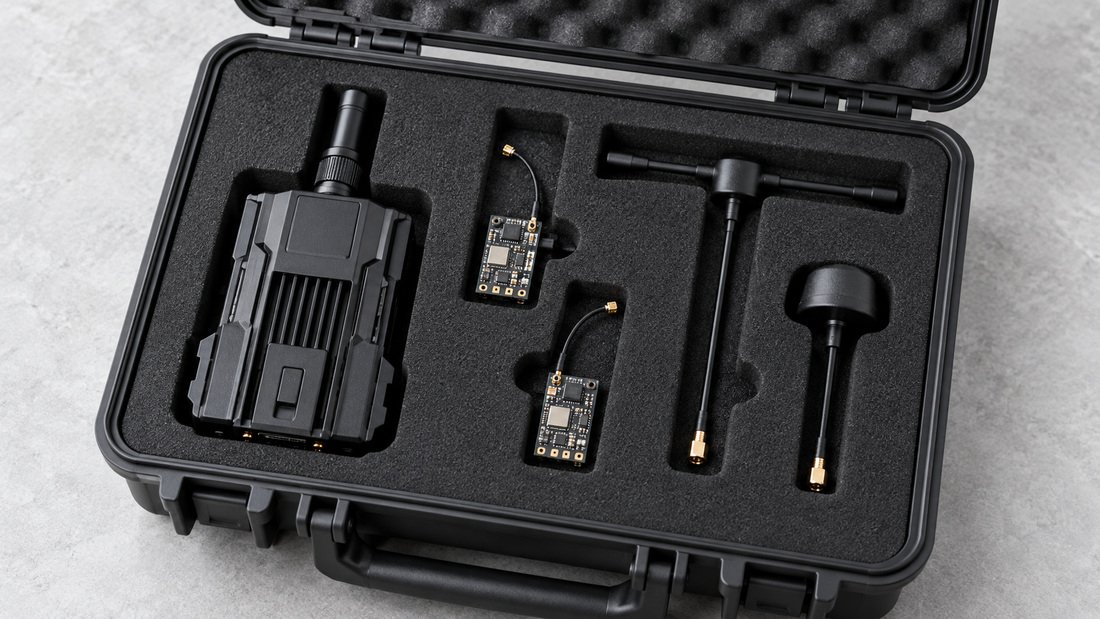
An event supplier should behave like a technical partner: answering compatibility questions, documenting specifications, and being clear about what they can and cannot confirm. The ELRS and RF systems range is one place to start comparing families, but the deciding factor is usually documentation quality and support responsiveness.
For OEM, ODM and distributor relationships, ask how custom firmware, labelling or packaging requests are handled and whether those processes are formalised. If a requirement is not written into your agreement, treat it as unconfirmed.
Frequently asked questions
Can I eliminate RF interference at an event entirely?
No. You can reduce predictable interference with a survey, a written channel plan and disciplined transmit rules, but spectators’ devices and venue infrastructure are outside your control. Plan for graceful degradation rather than assuming a clean spectrum.
Is 900 MHz always better than 2.4 GHz indoors?
Not necessarily. 900 MHz may be quieter at some venues, but antenna size, regional permissions and venue restrictions all matter. Test before you commit and confirm local requirements rather than assuming either band is available.
Should every team fly the same ELRS hardware?
It is strongly preferable. A single receiver and transmitter family simplifies firmware management and troubleshooting. If mixed hardware is unavoidable, check compatibility and firmware versions before the event, not during it.
Does higher transmit power improve reliability?
Often not for short indoor courses. High power raises the noise floor for everyone and can make problems worse. Antenna placement and a consistent power setting across teams are usually more effective levers.
What should I ask a supplier before ordering event equipment?
Ask for written specifications, compatibility documentation, warranty terms, lead times and MOQ. Also ask what technical support is available to organisers and whether training or setup guidance is offered, and get the answer confirmed in writing.
How should we log interference incidents?
Record the time, team, drone, band, channel, power setting, symptoms and what resolved it. A consistent log across several events turns anecdotal complaints into usable engineering data for the next season.
Do we need a dedicated RF role on the organising team?
It helps. A single named RF coordinator who owns the survey, channel plan and incident log prevents conflicting decisions. Where no one has the skills, ask suppliers about available guidance and confirm scope in writing.
Conclusion
Managing RF interference at events is a process discipline: survey the venue, agree a channel and power plan, standardise hardware, and record what happens. Organisers who document their RF plan once will find each subsequent event easier, because the plan becomes a template and the incident log becomes evidence.
Start by defining your receiver, transmitter and antenna standards, then get the commercial and technical details confirmed in writing. When you are ready to specify equipment for a league or event, Request Event Equipment Support and share your venue type, team count and timeline so support can be scoped accurately.