Quick summary
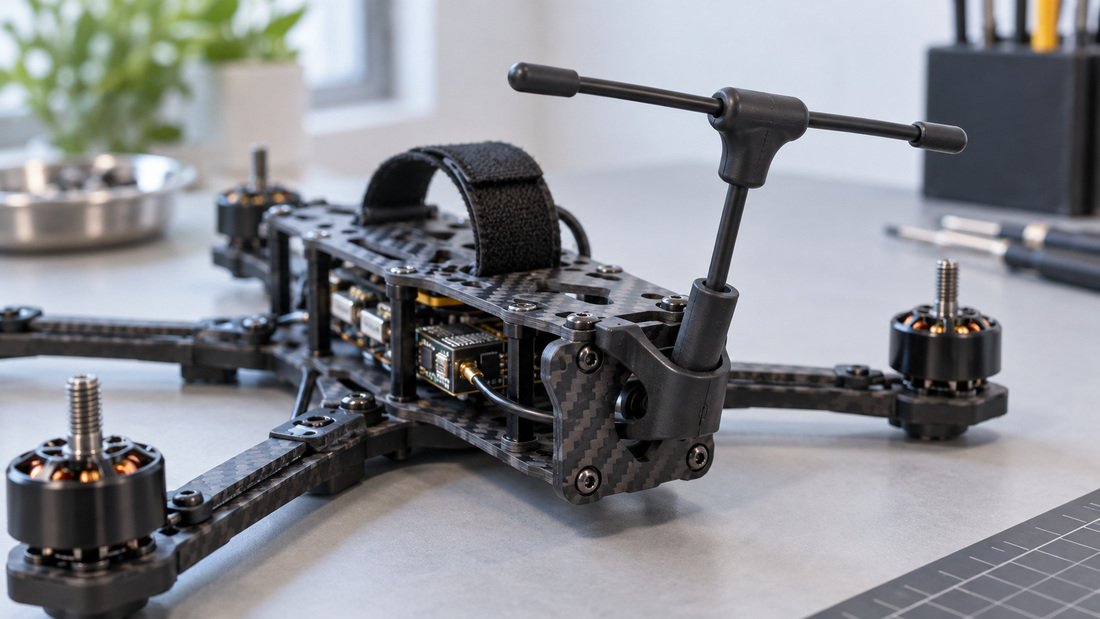
A drone soccer ball is a small, caged quadcopter. Its flight controller (FC) is usually a compact 20×20 mm or smaller board running Betaflight firmware — the same open-source software used across FPV quadcopters. The FC reads a gyroscope and accelerometer, computes motor commands, and sends throttle signals to an electronic speed controller (ESC) to keep the ball flying. Some purpose-built drone soccer (BKZ) airframes, such as those sold by Drone Parts Factory under the BKZ line, pair a BKF flight controller with BKR ELRS receivers and the rest of the drone soccer ball electronics in one integrated assembly. Verify the exact board, firmware target and protocols with your supplier before ordering.
Key Takeaways
- Nearly all drone soccer balls use a Betaflight‑compatible flight controller — Betaflight has become the de‑facto standard, and virtually every FC on the market has a Betaflight target (Betaflight getting-started guide).
- The FC is the computer that reads the gyro, accelerometer and other sensors, computes the desired actions, and commands the ESC to control the motors and keep the craft in the air (same source).
- Receiver protocol support matters for team radios — Betaflight supports CRSF, Ghost, FPort, SBUS, Spektrum and more, which is why many teams standardise on ELRS or CRSF‑capable receivers (same source).
- ESC protocol is normally DShot, but Oneshot, Multishot and PWM remain available for older or specialist hardware (same source).
- When procuring for a club, ask for the exact board model, Betaflight target, firmware version, connector type and any documented test record — do not assume “Betaflight compatible” means identical behaviour across batches.
What is a drone soccer ball, and why does the FC matter?
A drone soccer ball is a small, caged drone used in drone soccer (also called drone ball or BKZ in some markets). Teams fly it through hoops to score, so the ball must be robust, predictable and easy to repair between matches.
The flight controller sits at the centre of that behaviour. According to Betaflight’s documentation, a flight controller is “basically a computer that reads the sensors (gyro, accelerometer, GPS, etc…), computes the desired actions to take, sends the commands to the ESC to control the motors, generate thrust, and keep the quadcopter in the air” (Betaflight getting-started). In a drone soccer ball, that same role applies: stabilise the cage, respond to stick input, and keep the ball airborne during contact.
FC vs ESC vs receiver: roles in the ball
- Flight controller (FC): sensor fusion, PID loop, motor mixing, OSD, LED control, receiver input handling.
- ESC: converts the FC’s digital commands into motor phase currents. Betaflight’s main ESC protocol is DShot, with Oneshot, Multishot and PWM also supported (Betaflight).
- Receiver: the radio link from the pilot’s transmitter to the FC. Betaflight supports CRSF, Ghost, FPort, SBUS and Spektrum among others (Betaflight).
For a wider view of the category, see our FPV electronics range.
Which flight controller does a drone soccer ball use?
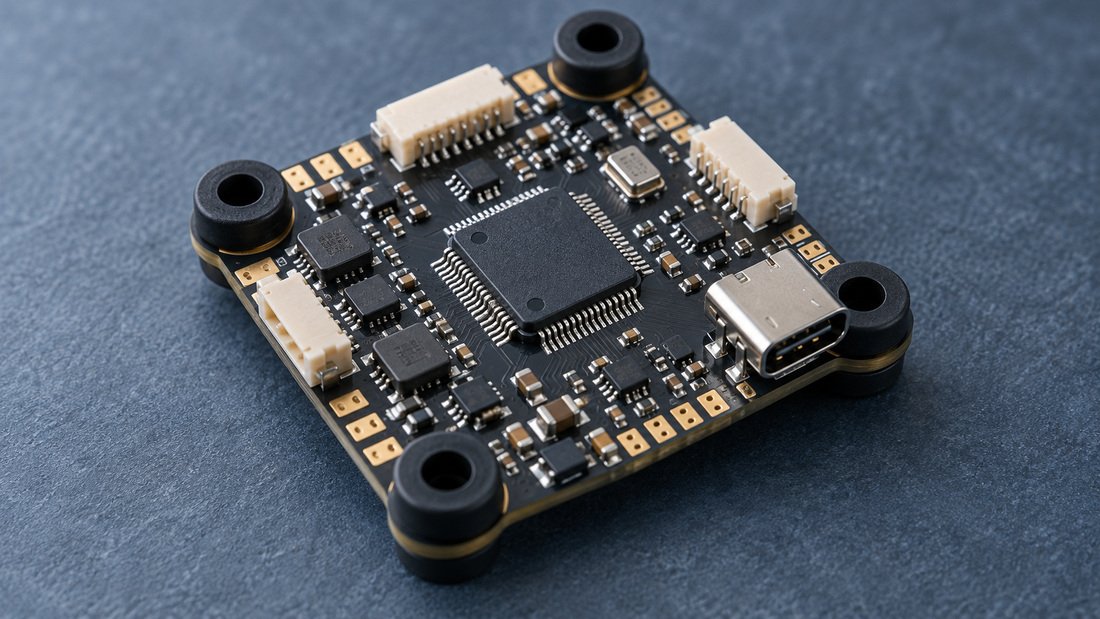
In practice, a drone soccer ball uses a small Betaflight‑class flight controller. There is no single mandated part number across the sport, but the electronics pattern is consistent: a compact FC sized to the cage, an ESC or 4‑in‑1 ESC, a receiver for the team’s radio protocol, and a video/telemetry path for the pilot and coach.
Betaflight’s documentation notes that “nearly every flight controller out there has a Betaflight target” and that the project is the most popular flight controller software (Betaflight getting-started). That is why clubs can usually source replacement FCs from multiple suppliers, provided the target and pinout match.
Purpose-built drone soccer platforms — such as the BKZ line offered by Drone Parts Factory — typically pair a BKF flight controller with BKR ELRS receivers. These are product-line names rather than universal standards; check the exact board revision and firmware target with your supplier.
Why Betaflight dominates drone soccer FCs
Betaflight was forked from Cleanflight in 2015 to explore cutting-edge features, and has since overtaken Cleanflight in popularity (Betaflight). Its main focus is high-performance flight, but it also supports multiple aircraft types. For a drone soccer ball — essentially a high‑performance, impact‑tolerant quadcopter — that combination of aggressive tuning, active development and broad hardware support is exactly what clubs need.
Betaflight also supports on-screen display (OSD) for analog or digital video, including battery voltage, current draw, flight timers and artificial horizons (Betaflight). For a coach watching a match or a technician diagnosing a fault, OSD is often the fastest feedback channel.
Sensor and tuning implications for cage flight
Betaflight can use a gyroscope for basic acro flight, an accelerometer for self-levelling, a magnetometer for heading, a barometer for altitude, and GPS for rescue and information (Betaflight). Drone soccer balls typically rely on gyro and accelerometer, with self-levelling modes helping younger or newer pilots.
Tuning matters because the cage changes the aerodynamics and mass distribution. Betaflight offers tune and filter presets as a starting point (Betaflight), but clubs should still validate any preset on their own ball before a tournament.
Anatomy of drone soccer ball electronics
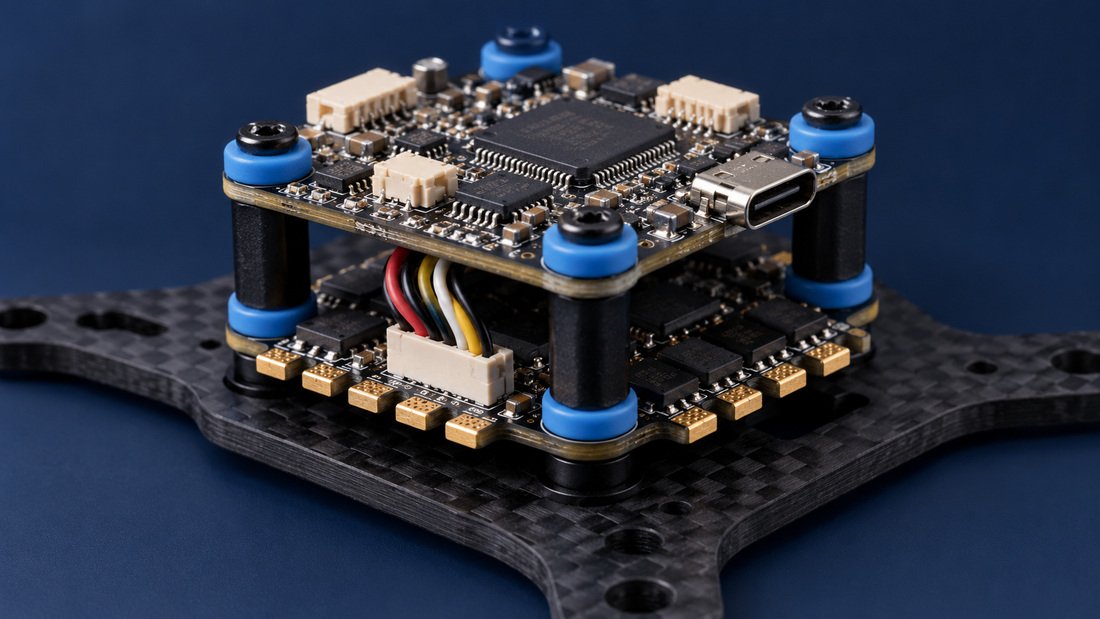
A drone soccer ball’s electronics set is small, but each block has a procurement consequence. The table below summarises typical roles, common technical choices and what to confirm with a supplier.
| Block | Role | Typical technical choice | What to confirm in writing |
|---|---|---|---|
| Flight controller (FC) | Sensor fusion, PID loop, motor mixing, OSD, LED control | Compact Betaflight‑target board, 20×20 mm class or smaller | Exact model, Betaflight target name, firmware version, connector pinout |
| ESC | Drives the motors from FC commands | 4‑in‑1 or individual ESC running DShot; Oneshot, Multishot, PWM possible | Continuous/burst current rating, DShot capability, firmware compatibility |
| Receiver | Radio link from pilot transmitter to FC | ELRS or CRSF‑capable receiver; SBUS/FPort/Spektrum possible | Protocol, frequency band, binding procedure, antenna connector |
| Video / OSD path | Pilot view and on‑screen telemetry | Analog or digital VTX; Betaflight OSD overlay | Video standard, OSD chip compatibility, channel plan |
| LED / status | Team colour, status and battery warnings | WS2811 addressable LED strip | Voltage, data pin assignment, firmware LED configuration |
Betaflight supports WS2811 LED strips for colour and status display, including battery warnings and flight mode (Betaflight). That is useful for clubs that want visual team identification within a cage.
How to choose an FC for a club or school programme
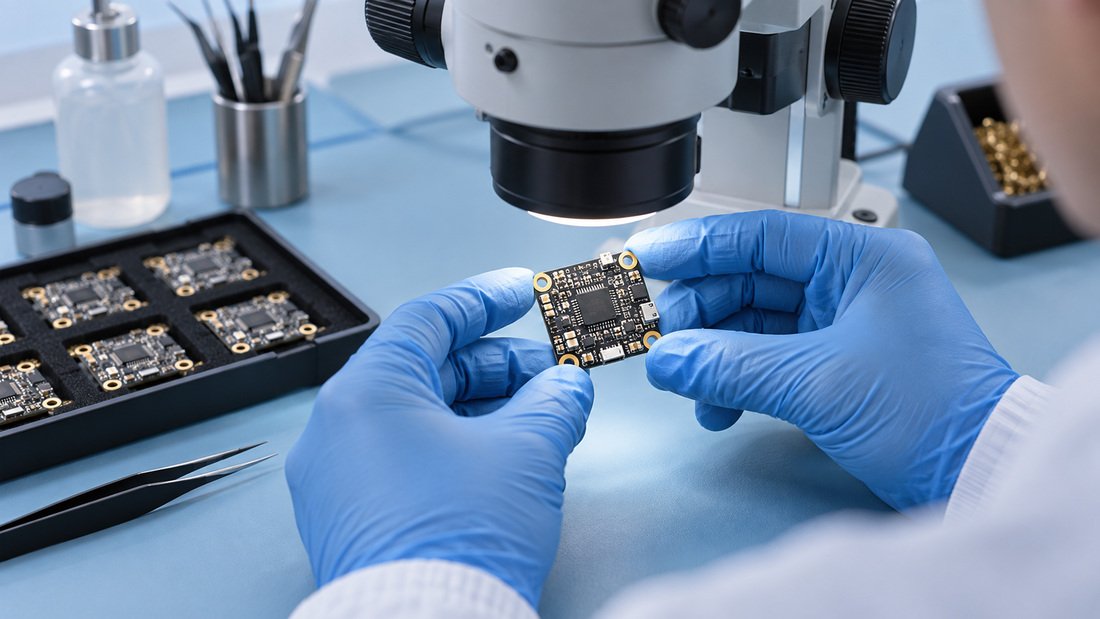
Choose for repairability and consistency, not peak specifications. A club may fly dozens of balls per session; the winning FC is the one you can replace quickly at a predictable cost. Start with the radio protocol your team already uses, then match the FC, ESC and receiver as a set.
If your programme is building its own balls, our flight controllers and electronic speed controllers pages show the component categories. If you are buying complete electronics sets, ask for a matched FC + ESC + receiver bundle so you are not debugging compatibility in a gym.
Comparison: integrated stack vs separate FC and ESC
| Criterion | Integrated FC + ESC stack | Separate FC and ESC |
|---|---|---|
| Repair speed | Replace the whole stack; fewer connectors to reseat | Replace only the failed board |
| Cost per repair | Higher unit cost per swap | Lower if you stock individual boards |
| Weight and space | Generally compact, suited to small cages | Requires more mounting volume and wiring |
| Compatibility risk | Lower if supplied as a matched set | Higher; pinout and firmware must be checked |
| Spares strategy | Stock complete stacks | Stock FCs and ESCs separately |
Neither option is universally better. Schools often prefer stacks for simplicity; competitive clubs with a technician may prefer separate boards for granular repair.
Common mistakes when specifying drone soccer ball electronics
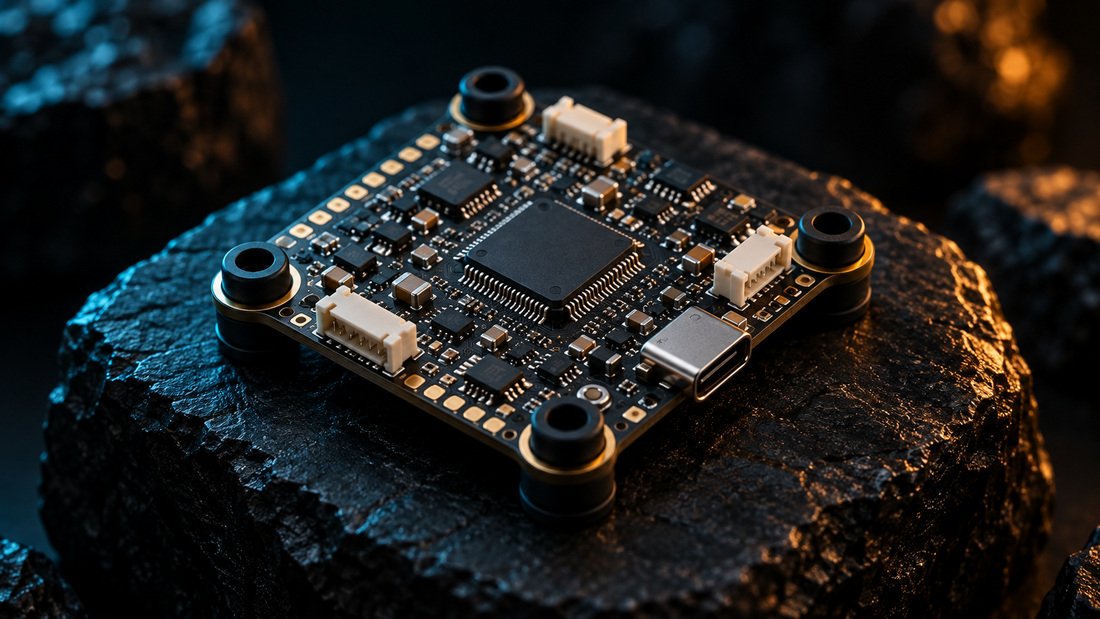
- Assuming all Betaflight boards behave the same. Targets, sensor sets and pin mappings differ. Confirm the target name before buying spares.
- Mixing receiver protocols. Betaflight supports CRSF, Ghost, FPort, SBUS and Spektrum (Betaflight), but your transmitter only speaks one of them at a time. Match the club’s radios.
- Ignoring ESC protocol. DShot is the mainstream choice, but older hardware may need Oneshot, Multishot or PWM (Betaflight).
- Forgetting OSD and LED wiring. These features are supported, but they need correct pads and configuration (Betaflight).
- Ordering one-off parts. Clubs should standardise on one FC family so that spare boards and tuning profiles transfer between balls.
Planning a multi-ball order for a school or league? Request a Team Kit Quote and we will help you align FCs, receivers and ESCs for your programme.
Buyer checklist for drone soccer ball electronics
Use this list before confirming a purchase order. It separates general guidance from commercial terms you should have in writing.
- ☐ Confirm the exact FC model, board revision and Betaflight target.
- ☐ Confirm firmware version shipped and whether it can be updated by the club.
- ☐ Confirm receiver protocol and frequency band match your transmitters.
- ☐ Confirm ESC protocol (DShot, Oneshot, Multishot, PWM) and current rating.
- ☐ Confirm connector types and pinout for FC, ESC, receiver, VTX and LEDs.
- ☐ Confirm whether the FC supports OSD and WS2811 LED output (Betaflight features).
- ☐ Request sample units before a large order, and test bind, arm and hover.
- ☐ Ask for the supplier’s defect handling process in writing.
- ☐ Ask about spare-part availability for the season, not just the initial shipment.
- ☐ Clarify warranty, return and lead-time terms in writing — do not rely on verbal assurances.
For teams also using video, review our FPV video receivers and FPV DVR options so the whole electronics chain is planned together.
FAQ
1. Is there one official flight controller for drone soccer?
No single globally mandated FC exists. In practice, most drone soccer balls use a compact Betaflight‑compatible board, because Betaflight has become the de‑facto standard and nearly every FC has a Betaflight target (Betaflight).
2. Can I use any FPV flight controller in a drone soccer ball?
Often yes, if the size, mounting, pinout, ESC protocol and receiver protocol fit your ball. But “Betaflight compatible” does not guarantee identical sensor sets or tuning behaviour, so verify the exact target and revision.
3. Which receiver protocol should a team choose?
Choose the protocol your existing transmitters support. Betaflight handles CRSF, Ghost, FPort, SBUS and Spektrum, among others (Betaflight). ELRS is a common modern choice for club fleets, but confirm band and binding procedure with your supplier.
4. What ESC protocol does Betaflight use?
DShot is the main protocol used on nearly everything, with Oneshot, Multishot and PWM also available (Betaflight).
5. Do drone soccer balls need GPS or a barometer?
Not normally for match play. Betaflight supports GPS rescue, barometers and magnetometers for other use cases (Betaflight), but adding sensors increases cost, weight and configuration complexity.
6. Can students update the firmware themselves?
Betaflight is actively developed and updated with new features (Betaflight). Whether a school allows in-house updates is a policy decision; ask your supplier whether updates are supported and how to restore a known-good configuration.
7. What should I request in writing before ordering team kits?
Board model and Betaflight target, firmware version, receiver and ESC protocols, connector pinouts, sample availability, spare-part plan, defect handling, warranty and lead times. Treat any verbal claim as unconfirmed until it appears in the order documentation.
Conclusion
A drone soccer ball’s flight controller is, in almost all cases, a compact Betaflight‑compatible board that reads the gyro and accelerometer, computes motor commands and drives the ESC — the same architecture described in Betaflight’s own documentation (Betaflight getting-started). For clubs and schools, the practical decision is not “which brand”, but “which matched set of FC, ESC and receiver can we standardise on and repair quickly?”
Confirm the exact board, target, firmware version and protocols with your supplier before committing. If you are equipping a team, a league or a school programme, start by requesting a team kit quote so the electronics are specified as one compatible system.
Next step: Request a Team Kit Quote.