Quick summary
For most indoor drone soccer, the 2.4 GHz ELRS band is the practical starting point: it offers low latency, compact antennas, and worldwide licence-free use in most regions. The 900 MHz band can help where long range or obstacle penetration matters, but indoors its larger antennas and regional duty-cycle rules add complexity. The best choice is the band that matches your venue, regulator, and existing club gear. Confirm exact receiver, module, and antenna combinations with your supplier in writing before a full team order.
Key Takeaways
- 2.4 GHz ELRS is usually the default for indoor drone soccer because antennas are small, latency is low, and many club radios already operate there.
- 900 MHz is a secondary option for larger halls or obstructed indoor spaces, but check local radio regulations and antenna size first.
- Band choice is only one variable: receiver placement, antenna type, and transmitter module power matter just as much indoors.
- Ask for a written compatibility statement covering your exact receiver, transmitter, firmware version, and region.
- Buy one or two test units before committing a club or school program to a standardised kit.
What ExpressLRS basics mean for indoor drone soccer
ExpressLRS (often shortened to ELRS) is an open-source radio control link. It connects a transmitter module in the coach’s handset to a small receiver on each drone. In drone soccer, the ball must be seen, steered, and struck quickly, so the control link must be responsive and stable inside a hall full of metal structures, Wi-Fi, and other teams’ radios.
“ExpressLRS basics” for a club buyer come down to three practical questions: which frequency band, which receiver format, and which firmware version. The band is the first decision because it affects antenna size, range behaviour, and how the equipment is registered in your country. If you are new to the category, start with our overview of ELRS and RF systems.
Why band choice is not the same as “best”
There is no single best band in isolation. A 2.4 GHz link behaves differently in a school gym than a 900 MHz link does. What works for one club may underperform for another if the venue has different metal content, ceiling height, or spectator Wi-Fi. Treat band selection as a testable venue decision, not a fixed rule.
Comparing 2.4 GHz and 900 MHz ELRS for indoor drone soccer
Both bands can run ExpressLRS firmware. The differences below are general engineering trade-offs; exact performance depends on the specific hardware, firmware version, antenna, and venue.
| Factor | 2.4 GHz ELRS | 900 MHz ELRS |
|---|---|---|
| Typical indoor use | Common default for small and medium halls | Sometimes chosen for larger or obstructed spaces |
| Antenna size | Small, easy to mount on lightweight drones | Larger, can complicate compact airframes |
| Latency feel | Generally very low with modern ELRS firmware | Also low, but implementation dependent |
| Regulatory notes | Widely used licence-free band in many regions | Rules and duty-cycle limits vary by country |
| Indoor interference | Shares spectrum with Wi-Fi and Bluetooth | Can be less crowded in some venues |
| Club standardisation | Easier to source and share across teams | More niche, so spares may be harder to standardise |
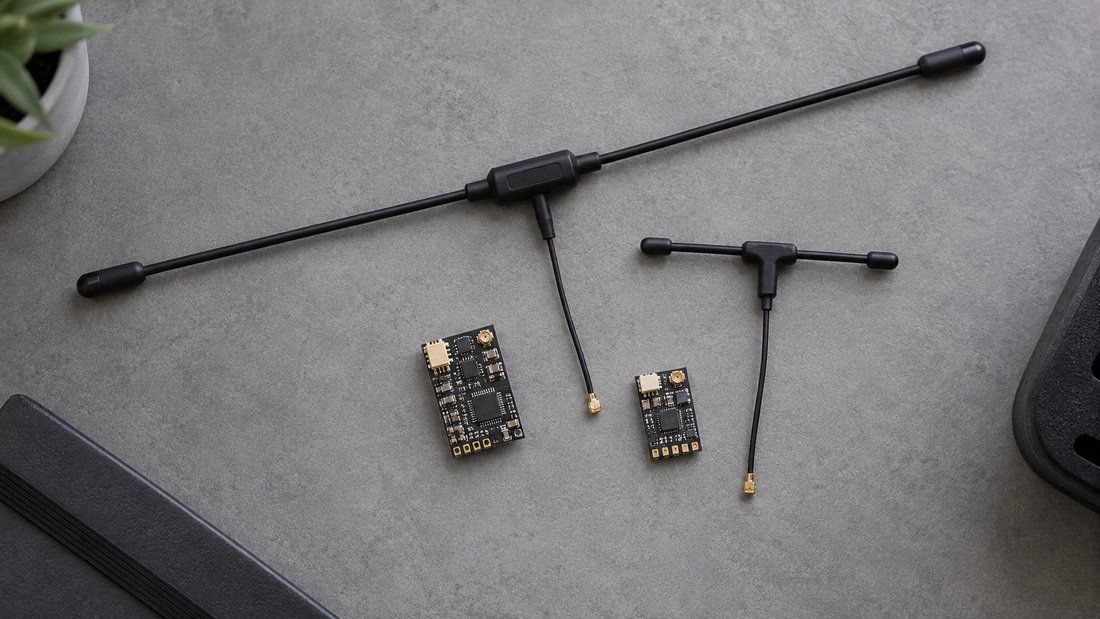
For a visual reference of how band and antenna selection interact, see the figure below.
Why 2.4 GHz is usually the indoor drone soccer default
2.4 GHz ELRS is popular in youth programs because the hardware ecosystem is broad, antennas are compact, and many coaches already own compatible transmitters. In a typical school gym, the link distance is short, so raw range is rarely the limiting factor. The bigger challenges are interference, antenna placement, and consistent setup across many drones.
Small antennas make it easier to keep the receiver and antenna away from carbon fibre, battery cables, and motor wiring. That matters because indoor airframes are tight, and a poorly placed antenna can degrade the link even when the band itself is fine.
When 2.4 GHz can struggle indoors
Dense Wi-Fi, crowded spectator areas, and multiple teams flying at once can all raise the noise floor on 2.4 GHz. If your venue already hosts many wireless devices, plan a test session before standardising. A quick bench and hall test can reveal whether channel planning or a different band is needed.
When 900 MHz ELRS makes sense indoors
900 MHz is often associated with longer range and better penetration through obstacles. In a large indoor venue with concrete walls, metal seating, or a complicated layout, that can be attractive. However, the larger antennas are harder to protect on a small drone soccer airframe, and regional rules for the 900 MHz band are not universal.
Before choosing 900 MHz, ask your supplier and your national regulator whether the band and power level are permitted for your use. Also check that your transmitter module and receiver support the same 900 MHz variant; “900 MHz” covers different sub-bands in different regions.
A decision rule for clubs
Start with 2.4 GHz if your venue is a standard school gym, your team is new, and you want easy spares. Consider testing 900 MHz only if you have a specific indoor range or penetration problem that 2.4 GHz testing cannot solve. Document the test results so the decision is based on your venue, not on forum opinion.
If you are matching receivers to existing radios, use the ELRS receiver compatibility guidance as a starting point and confirm the exact firmware target with your supplier.
Hardware that affects indoor link quality more than band
Band is only one part of the system. In indoor drone soccer, the following often matter more than the frequency label on the box.
Receiver format and antenna
Choose a receiver that fits the drone’s weight and mounting constraints. A receiver with a well-placed antenna can outperform a theoretically superior band with a poor installation. Browse ELRS receivers to see the range of formats available, then match the antenna to the airframe.
Transmitter module and power setting
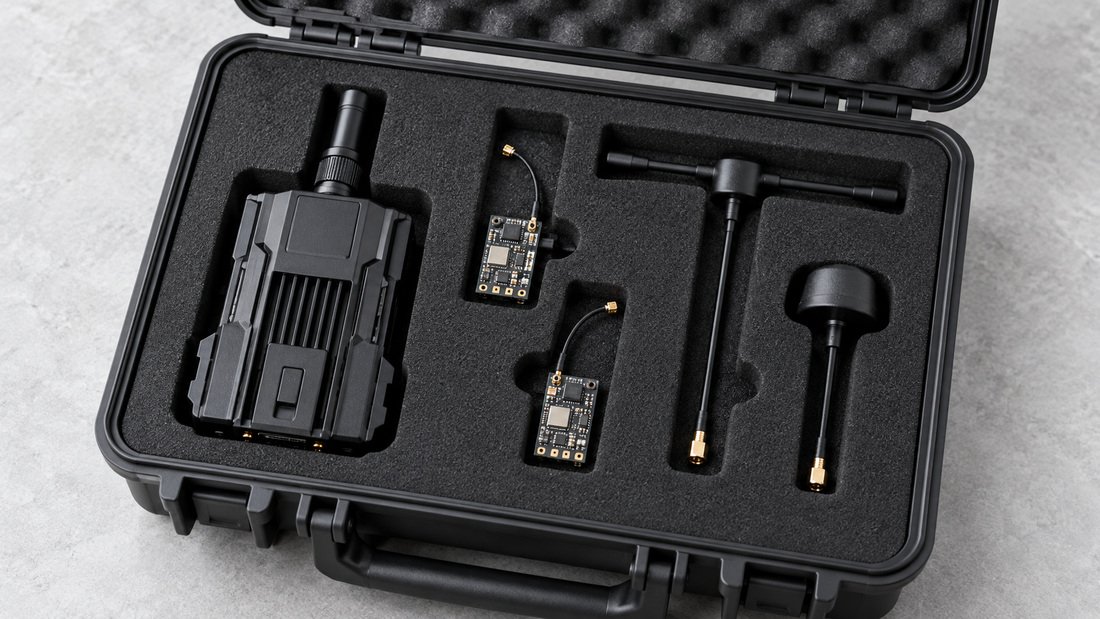
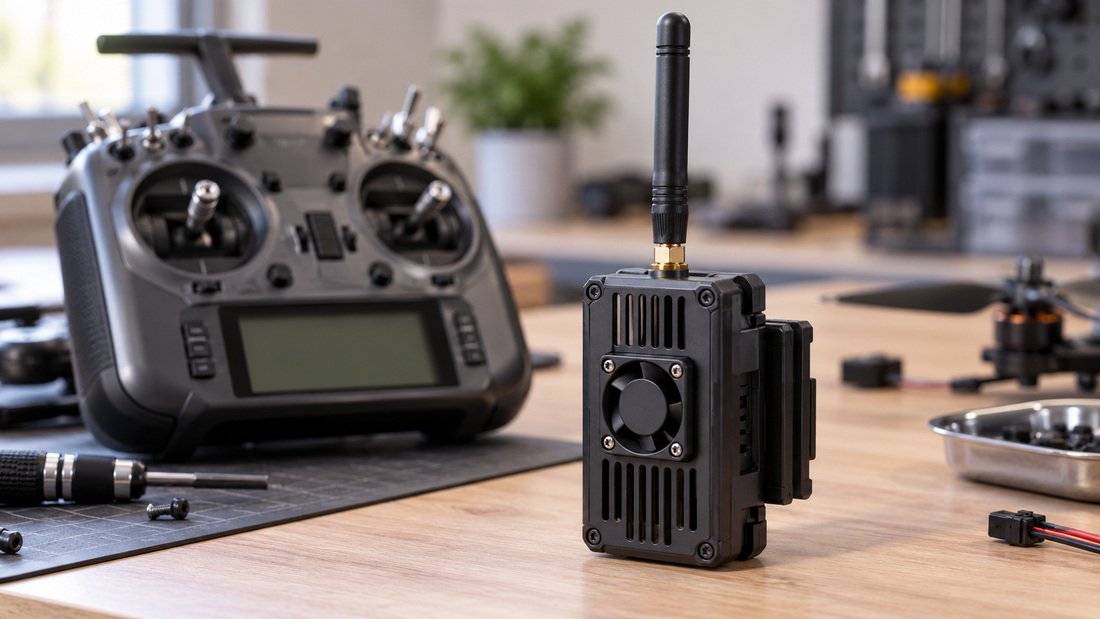
The transmitter module in the coach’s handset determines how much control authority the link has. More power is not always better indoors: it can increase interference for nearby receivers. Many clubs use lower power settings for indoor play and reserve higher settings for outdoor events. See ELRS transmitter modules for the available formats.
Antenna type and placement
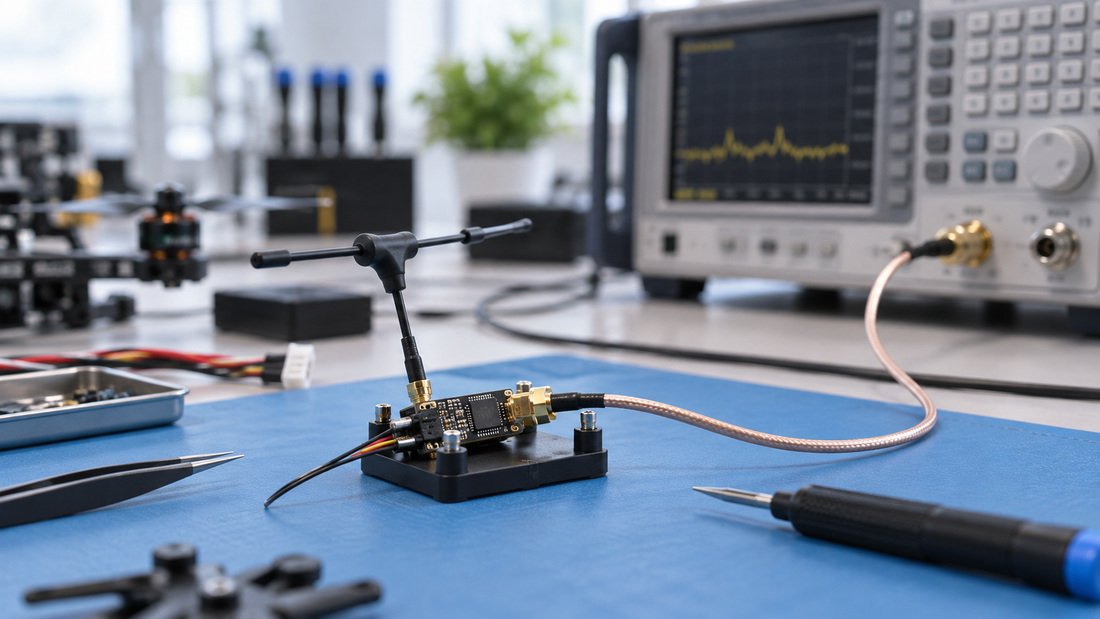
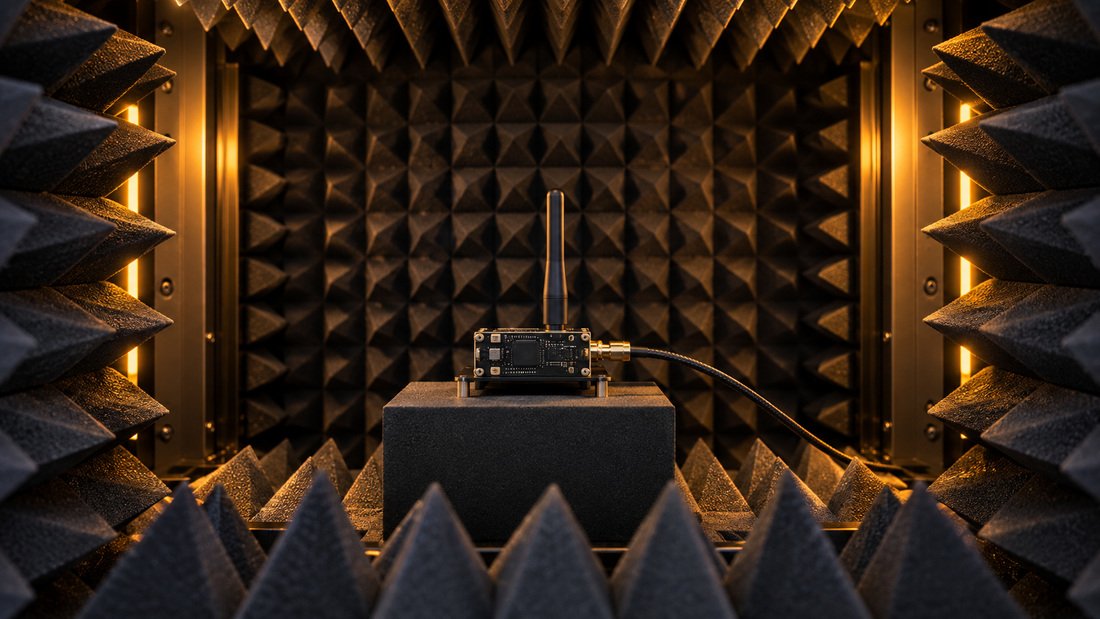
Antenna choice is closely tied to band. A 2.4 GHz antenna is physically smaller, while a 900 MHz antenna is larger. Either way, keep the active element away from conductive materials and orient it consistently across the fleet. Our RF antennas page lists common options, and the image below shows a controlled antenna evaluation setup.
Practical procurement checklist for schools and clubs
Use this checklist before you place a team-sized order. It is written for club organisers, coaches, and school procurement staff.
- Confirm your region’s radio rules. Check which bands and power levels are allowed for your venue and event type.
- List existing radios and modules. Note the make, model, and firmware family so you can match receivers.
- Decide on one standard band for the fleet. Mixed bands complicate coaching and spares.
- Request a compatibility statement in writing. It should cover receiver, transmitter, firmware version, and region.
- Order one or two test units first. Fly them in your actual hall before committing to a full kit.
- Ask about spares and replacement parts. Antennas, receivers, and cables are consumables in youth programs.
- Check documentation and support. Confirm what setup guides, firmware notes, and technical support are included.
- Confirm shipping, warranty, and MOQ terms in writing. These vary by supplier and order size.
Common mistakes when choosing an ELRS band for indoor drone soccer
- Choosing range over venue reality. Indoor drone soccer is a short-range sport; interference and antenna placement usually matter more than maximum range.
- Ignoring regional rules. A band that is easy to buy online may not be legal to operate at your event.
- Mixing firmware versions across a team. Inconsistent firmware can cause binding and setup confusion during practice.
- Reusing outdoor power settings indoors. High power can cause unnecessary interference in a confined hall.
- Standardising before testing. Buying 30 identical receivers without a venue test is a common and avoidable risk.
If your club is preparing a budget or grant application, request a team kit quote so you can compare options with documented specifications.
Frequently asked questions
Is 2.4 GHz or 900 MHz better for indoor drone soccer?
For most standard school gyms, 2.4 GHz is the practical default because hardware is widely available, antennas are small, and the band is commonly licence-free. 900 MHz can be worth testing in large or obstructed venues, but check local rules and antenna fit first.
Does ELRS band affect latency?
Both bands can deliver low latency with modern ELRS firmware. The bigger indoor factors are receiver setup, antenna placement, and interference. Ask your supplier for the specific latency behaviour of the hardware you are considering rather than assuming one band is always faster.
Can I use the same transmitter module for both bands?
Not usually. Most transmitter modules are built for one band or use a band-specific RF section. Confirm with your supplier whether a module supports the band you need and whether it is compatible with your handset and firmware.
How many receivers should a club buy?
Plan for at least one receiver per active drone plus spares for repairs and diagnostics. The exact ratio depends on your team size, practice schedule, and how often drones are damaged. Ask your supplier about spare-part pricing and availability before finalising.
What should I check before standardising a team kit?
Test the chosen band and hardware in your actual venue, confirm regional rules, verify firmware compatibility across all units, and get written confirmation of warranty, shipping, and support terms.
Do I need a licence to use ELRS indoors?
Rules vary by country and by band. Some bands are licence-free at certain power levels, while others require registration or have duty-cycle restrictions. Check with your national regulator or a qualified local advisor before operating.
Can DPF supply receivers and modules for school programs?
DPF supplies ELRS receivers and transmitter modules through its RF systems line. Availability, minimum order quantities, lead times, and warranty terms depend on the specific items and order size. Request a written quote and confirm these details before purchase.
Conclusion
For most indoor drone soccer programs, 2.4 GHz ELRS is the sensible starting band: it is widely used, easy to equip, and well suited to short-range indoor flying. 900 MHz remains a valid option for specific venues, but it should be tested against local rules and airframe constraints. Whichever band you choose, the quality of the receiver, antenna, and setup will shape the experience as much as the frequency itself.
Before ordering for a whole club, test one or two units in your hall, document the results, and ask your supplier for written compatibility and support details. When you are ready to compare options for your program, Request a Team Kit Quote and confirm the specification that fits your venue.