Quick summary
Drone soccer balls are built around small, brushless outrunner motors — typically in the 1104 to 1404 size range with low KV ratings — paired with matching electronic speed controllers (ESCs) and propellers inside a protective cage. Motor selection matters because it sets thrust, response speed, current draw and crash durability for every collision the ball takes. Because most school and club programs buy drone soccer equipment as a complete kit rather than loose parts, motors are usually matched to a specific airframe, ESC and battery by the manufacturer. If you are sourcing for a team, confirm the exact motor specification and spare-parts availability with your supplier before ordering in volume.
Key Takeaways
- Drone soccer balls use small brushless motors, usually in the 1104–1404 size class, chosen for low weight and high thrust-to-weight ratio.
- Motors, ESCs, propellers, battery voltage and airframe weight form one system — a motor swap is rarely a standalone upgrade.
- Durability and repairability usually matter more than peak performance for school and club programs.
- Kits are commonly sold as matched sets, so ask for the motor spec sheet, spare parts list and replacement pricing in writing.
- Regulatory context for school programs differs from general FPV use; check the FAA educational users guidance for US-based programs.
What motors are inside a drone soccer ball?
Short answer: small brushless outrunner motors mounted inside a spherical cage, one per propeller, with KV ratings low enough to spin larger-than-usual props efficiently at moderate RPM.
Drone soccer is played with a caged, ball-shaped aircraft designed to survive repeated collisions. That design constraint drives every motor decision. The motor has to produce enough thrust to lift the cage, battery, flight controller, ESC and propeller assembly — while staying light enough that the ball remains agile enough to fly through a goal ring.
Typical geometry for a drone soccer ball is a quadcopter layout, meaning four motors. The exact stator size, KV rating and propeller pairing vary by manufacturer and by class. Rather than assume a number, ask your supplier for the motor datasheet: stator dimensions, KV, recommended propeller, maximum current and thrust figures at your intended battery voltage.
Why the motor spec is a system decision, not a parts decision
Short answer: the motor determines current draw, which determines the ESC rating, which determines the battery and wiring that can safely feed it.
If a team increases motor KV or propeller size without re-checking the ESC and battery, the result is usually overheating, desync or a failed ESC. For clubs running multiple balls in a training session, that failure mode is expensive and disruptive. Treat motor, ESC, propeller and battery as one matched unit when you specify or replace parts.
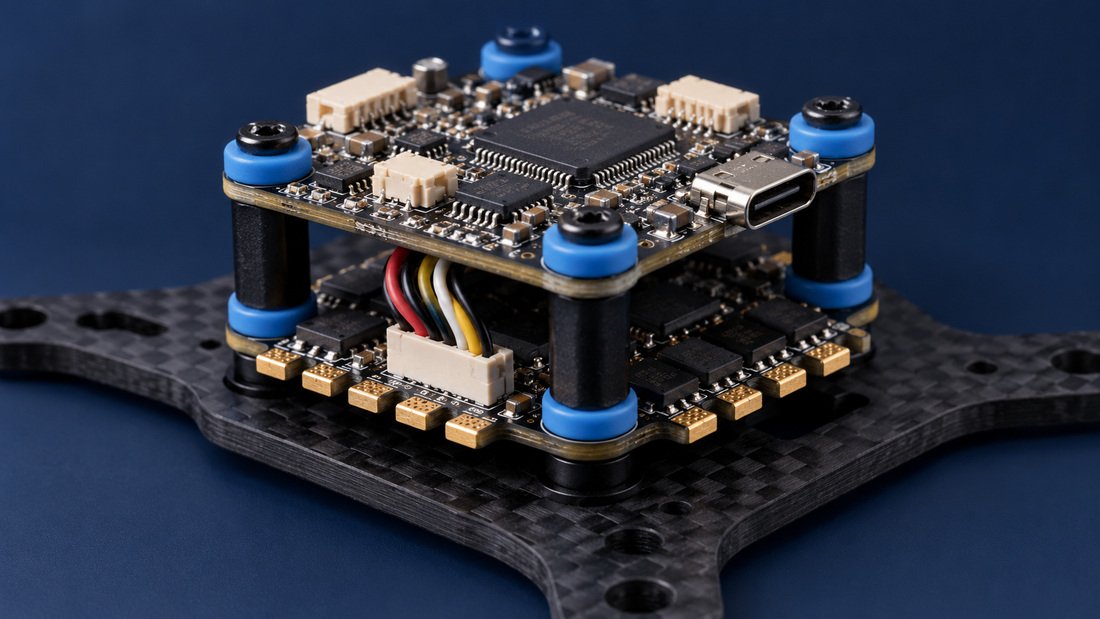
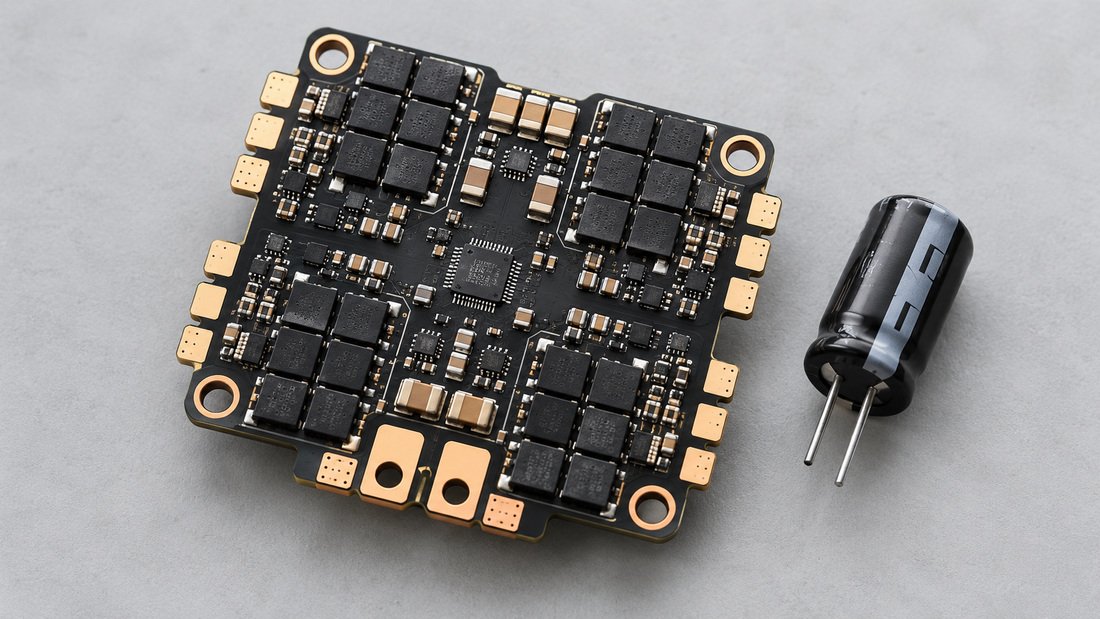
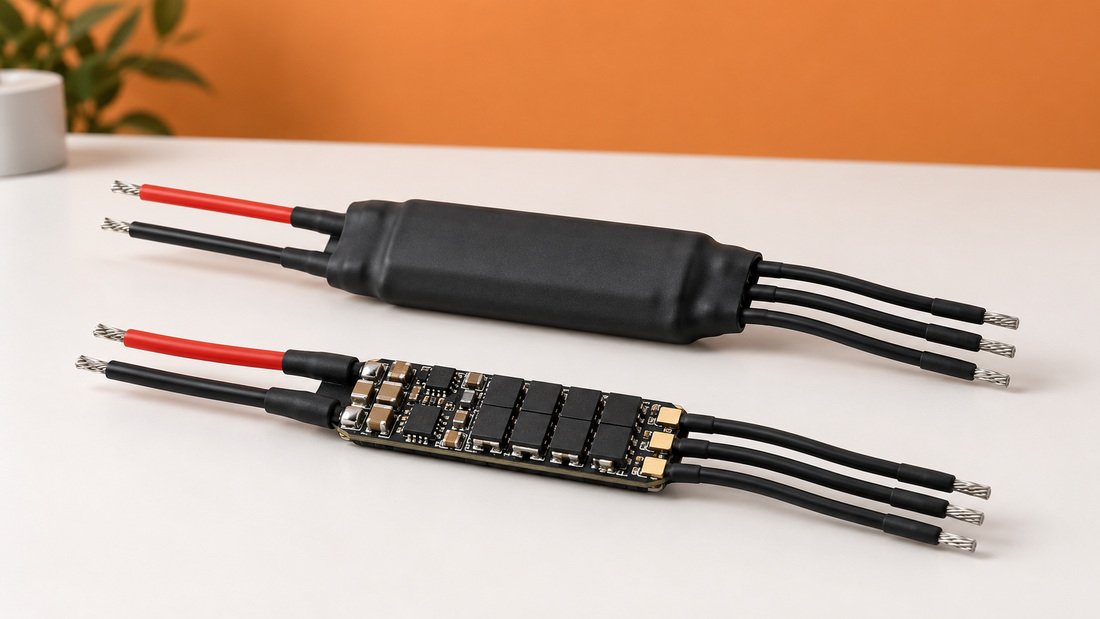
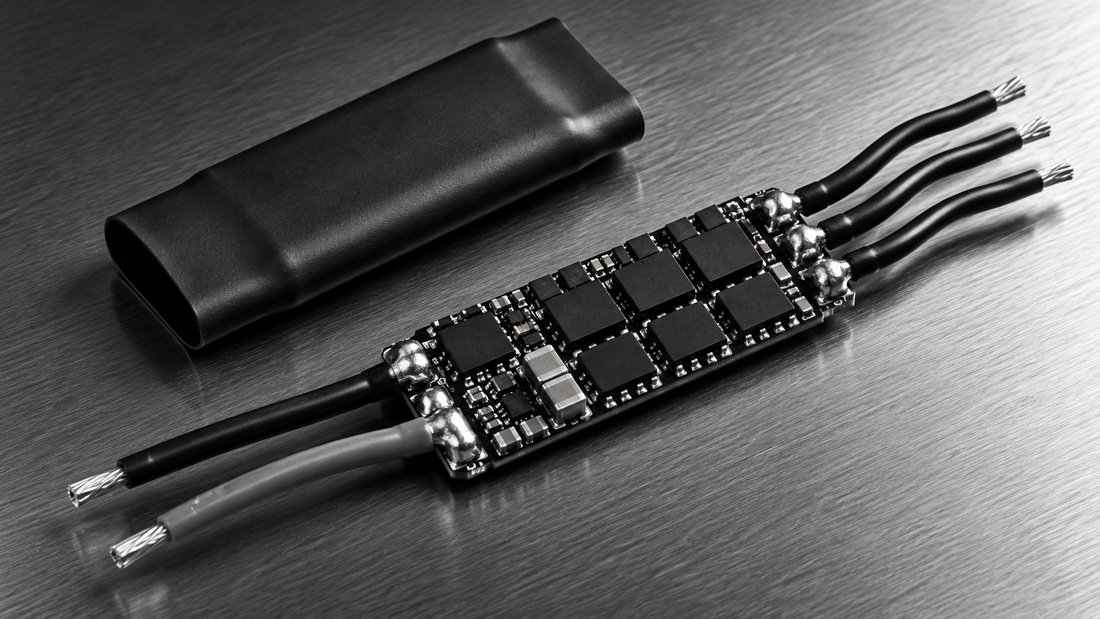
The ESC is the component that translates flight-controller commands into motor RPM. In a drone soccer ball, the ESC and motors are usually integrated into a compact stack or board to save weight and simplify repairs. That is why replacing a motor often means understanding the ESC it is wired to.
Which drone soccer equipment specs should clubs compare?
Short answer: compare the motor and ESC as a matched set, then compare what happens when one part fails.
The table below is a comparison framework, not a product recommendation. Fill in actual values from supplier datasheets for the systems you are considering.
| Specification | Why it matters for drone soccer | What to ask the supplier |
|---|---|---|
| Motor stator size | Indicates torque and thrust potential relative to weight | Exact stator dimensions and unit weight |
| KV rating | Sets RPM per volt; affects response and current draw | KV value and recommended battery cell count |
| ESC continuous and burst current | Must exceed motor current draw with headroom | ESC rating and whether it is matched to the motor |
| Propeller pairing | Determines thrust efficiency and impact forces | Recommended propeller size and pitch |
| Cage and mount design | Affects crash survivability and repair time | Whether motor mounts are replaceable individually |
| Spare parts availability | Sets long-term cost per team per season | Whether motors are sold separately and in what pack sizes |
For a broader view of how these parts fit together, see our overview of drone soccer systems.
Performance motors versus durable, repairable motors
A higher-KV motor with a lighter propeller may feel sharper in flight. A lower-KV, more robust motor with a slightly heavier stator may survive more collisions. For competitive teams, the trade-off is usually speed versus parts cost and downtime.
Schools and youth programs typically prioritize the second column — how fast a ball can be repaired between sessions and how predictable the parts supply is. Programs focused on competition may accept higher wear rates in exchange for responsiveness. Neither choice is universally correct; it depends on how the balls are used.
For curriculum-driven programs, the motor is also a teaching object. Understanding why a given motor draws a given current at a given voltage is a genuine STEM lesson, and it connects naturally to STEM drone education and training.
How motors fit into a complete drone soccer team kit
Short answer: a usable kit includes the ball airframe, matched motors, ESCs, propellers, flight controller, battery, charger, radio and a documented spare-parts list.
When clubs compare kits, the motor spec is only one line item. The bigger question is whether the kit is designed for institutional use — multiple users, repeated crashes, shared storage and a rotating roster of students.
That means asking about things like whether individual motors can be replaced without discarding an entire ESC board, whether propellers are standard sizes that can be reordered, and whether the kit ships with any diagnostics or configuration guidance.
Common mistakes when specifying drone soccer motors
- Upgrading the motor alone. A new motor without a matching ESC and propeller often causes overheating or desync.
- Ignoring battery voltage. KV and voltage together determine RPM; changing one changes the other’s effect.
- Buying on peak thrust only. Peak thrust figures rarely reflect how a caged ball behaves in collisions.
- Not checking spare-part packaging. If motors are only sold in large packs, a single failure becomes an inventory problem.
- Assuming one kit fits every program. A competition team and a classroom need different durability and cost profiles.
Procurement checklist for drone soccer motors and equipment
Use this list when requesting quotes from any supplier, including DPF. Items marked as supplier-confirmed must be verified in writing on your quotation.
- Motor datasheet with stator size, KV, weight and recommended propeller — confirm in writing.
- ESC rating and whether it is factory-matched to the motor — confirm in writing.
- Whether motors are available as individual spares and in what pack quantity — confirm in writing.
- Recommended battery chemistry, cell count and connector type — confirm in writing.
- Assembly and replacement procedure documentation for student technicians — request a sample.
- Any applicable lead time, minimum order quantity and warranty terms — confirm in writing before payment.
- Compliance and flight-regulation guidance relevant to your jurisdiction — see the FAA educational users page for US context.
In the United States, the FAA notes that drones flown for educational purposes are regulated either under the Exception for Limited Recreational Operations (49 U.S.C. § 44809) or under the Small Unmanned Aircraft Systems Rule, Part 107 — and that some educational organizations must be chartered by a recognized community-based organization to operate under § 44809. Rules also differ by jurisdiction and change over time. FAA educational users guidance is the correct starting point for US-based school programs; do not treat it as global advice.
Where drone soccer equipment is used
Drone soccer programs appear in schools, after-school clubs, district leagues and competitive associations. Each setting stresses equipment differently.
Competition environments stress response and repeatability, and are covered in more detail under drone soccer competitions. Classroom and after-school environments stress durability and repairability, which is closer to how schools and training organizations evaluate equipment.
For club-level purchasing, where multiple balls are maintained by a small number of coaches, see drone soccer clubs.
Sourcing for a program? Tell us how many balls you need, how they will be used and what your repair capacity looks like. We will help you match motors, ESCs and airframes to your program. Request a Team Kit Quote.
Frequently asked questions
Are drone soccer motors the same as FPV drone motors?
They come from the same broad family of small brushless motors, and some drone soccer designs use components that overlap with FPV parts. The selection criteria differ, though: drone soccer motors are chosen for thrust-to-weight ratio inside a heavy protective cage and for crash survivability, not for the flight envelope of a freestyle FPV quad. Ask your supplier whether a given motor is specified for caged applications.
How many motors does a drone soccer ball have?
Most designs use four. The count follows from the cage geometry and the flight-controller configuration. Some designs differ, so confirm the number and layout for the specific model you are buying rather than assuming.
Can we replace motors ourselves?
Often yes, which is one of the practical advantages of drone soccer as a teaching platform. Whether a specific ball allows field replacement depends on how the motor mounts and ESC are assembled. Ask for the replacement procedure and required tools before you commit to a fleet.
What KV rating should a drone soccer motor have?
There is no single correct KV. KV interacts with battery cell count, propeller size and airframe weight. A better question is what thrust and current the motor produces at your intended voltage with the recommended propeller. Request that data from the supplier.
How do we estimate spare motor needs for a club?
Base it on your session frequency, number of balls and observed failure rate over your first season. Suppliers who cannot tell you how motors are packaged as spares are harder to plan around, so treat spare packaging as a procurement criterion.
Does buying motors separately save money?
Sometimes, but only if the motors are genuinely compatible with your existing ESC, propeller and battery combination. Mismatched parts generate failures that erase any unit-price saving. Confirm compatibility in writing before ordering loose motors.
Are there regulations specific to school drone programs?
Yes, and they vary by jurisdiction. In the US, the FAA publishes guidance for educational users covering both the limited recreational exception and Part 107. Check the current rules for your location and confirm with your institution before flying.
Conclusion: specify the system, not just the motor
Drone soccer balls use small brushless motors, usually four, chosen for low weight, adequate thrust inside a protective cage and tolerance for repeated impacts. The specific stator size, KV rating and ESC pairing depend on the airframe, so the right approach is to buy a matched system and confirm the motor, ESC, propeller and battery specifications together in writing.
For clubs, schools and associations buying at fleet scale, the durable advantage comes from spare-part availability and repairability — not from the highest thrust figure on a spec sheet. Start by defining your usage pattern, then request a quotation that lists exact motor and ESC specifications, spare part packaging and commercial terms.
Next step: send us your program size and usage profile, and we will help you configure the right drone soccer equipment. Request a Team Kit Quote.