Quick summary
There is no single “best” ELRS receiver for every drone soccer ball. The right choice depends on your ball’s frame size, weight budget, flight controller mounting, antenna clearance, radio band and how many units your club or program must keep flying. For most school and club programs, a compact 2.4 GHz ELRS receiver with a rigid or shielded antenna and a connector that matches your existing spares is the practical default. Verify link behaviour, failsafe and antenna fit on your own ball before committing to a large order.
Key Takeaways
- ELRS receiver selection for drone soccer is usually driven by size, weight, antenna clearance and spare-part logistics — not by headline range figures.
- 2.4 GHz is the common starting point for club and school programs; confirm whether your region and event rules allow other bands before buying.
- Antenna type and connector style matter more than brand claims for a small, crowded indoor ball.
- Diversity receivers can help in difficult RF environments, but they add size, weight and cost that a small ball may not tolerate.
- Buy a small sample batch, test failsafe and range in your actual venue, then standardise on one receiver family for easier spares.
What is an ELRS receiver, and why does it matter for drone soccer?
ELRS stands for ExpressLRS, an open-source radio control link protocol used between a transmitter module and a receiver. In drone soccer, the ball is a small, protected drone that must respond quickly and predictably inside a bounded court. The receiver is the component that turns your transmitter’s commands into control signals for the flight controller.
Because the ball is small and often flown close to other balls, people and venue structures, receiver behaviour — not maximum advertised range — is what players feel. A receiver that holds a clean link at short range, recovers quickly after a brief obstruction and enters a predictable failsafe is more useful than one marketed for long-distance flights.
How do you choose an ELRS receiver for a drone soccer ball?
Start from constraints, not from a product list. Work through these in order: weight and size, radio band, antenna type, connector, voltage and telemetry needs, then spares availability. Each choice narrows the next.
1. Weight and physical size
Drone soccer balls are weight-sensitive. A receiver that is a few grams heavier than another may change how the ball handles, and may push a build closer to a competition weight limit. Check your event or league rules for any weight or size requirements, and confirm them in writing with the organiser rather than assuming.
Measure the space where the receiver will sit. Many compact receivers are designed for tight builds, but “compact” varies between suppliers. Ask for a dimensioned drawing or sample before you commit to a full order.
2. Radio band: 2.4 GHz, 900 MHz or dual-band
2.4 GHz equipment is widely used in club and school settings, and antennas are small. Lower-frequency bands can offer different propagation characteristics but usually need larger antennas, which is awkward on a small ball. Dual-band receivers can add flexibility but also add size, cost and configuration complexity.
Before choosing a band, confirm what your transmitter modules support, what your venue allows and what your event rules permit. If you are building a mixed fleet, standardising on one band simplifies training and spares.
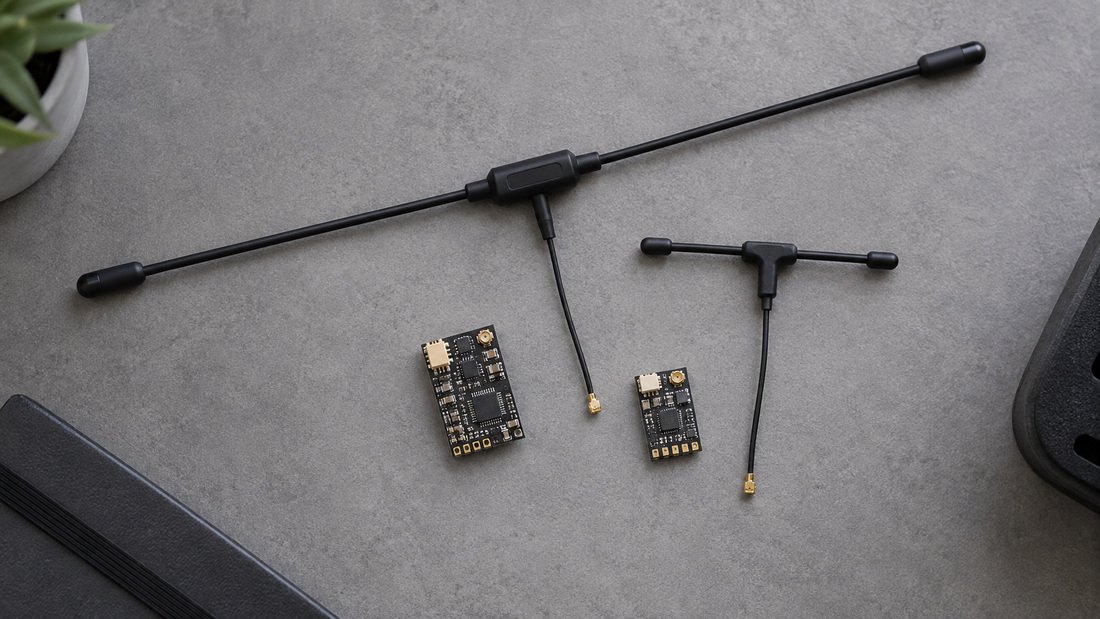
3. Antenna type and placement
Antennas are often the weakest point in a small ball build. A rigid antenna can survive handling better than a thin wire, but it needs clearance from carbon fibre, battery wiring and the ball’s protective frame. Carbon fibre can shadow or detune an antenna, so placement matters as much as the antenna itself.
A T-style antenna can be easier to orient consistently across a fleet, which helps when coaches and students are repairing balls between matches. Whatever you choose, test it in the assembled ball — not on the bench — because the frame and battery change the RF environment.
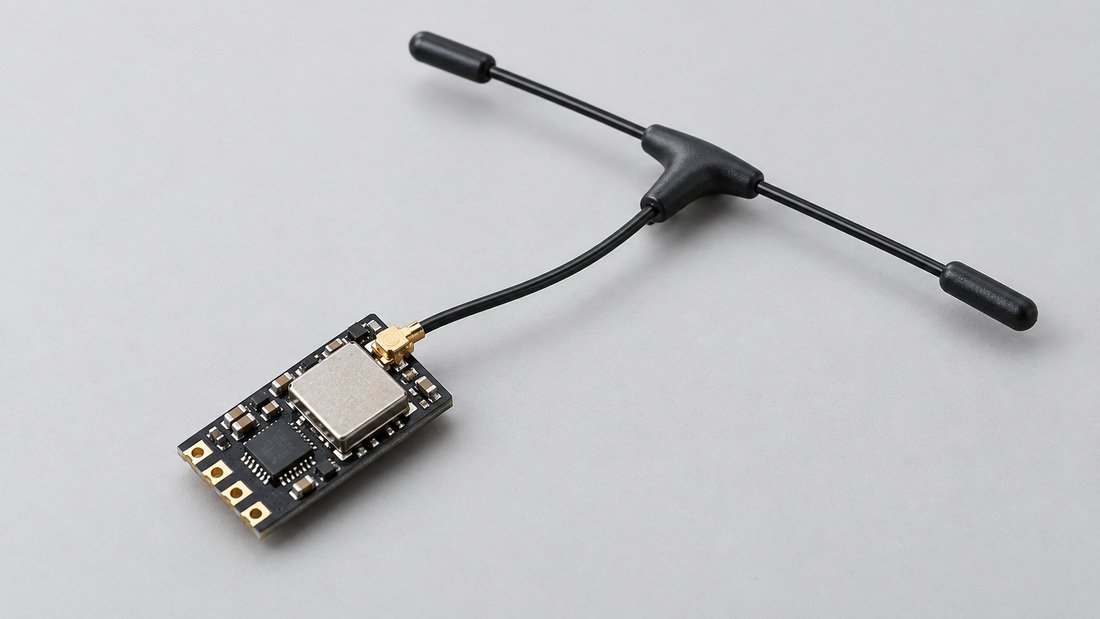
4. Connectors and repairability
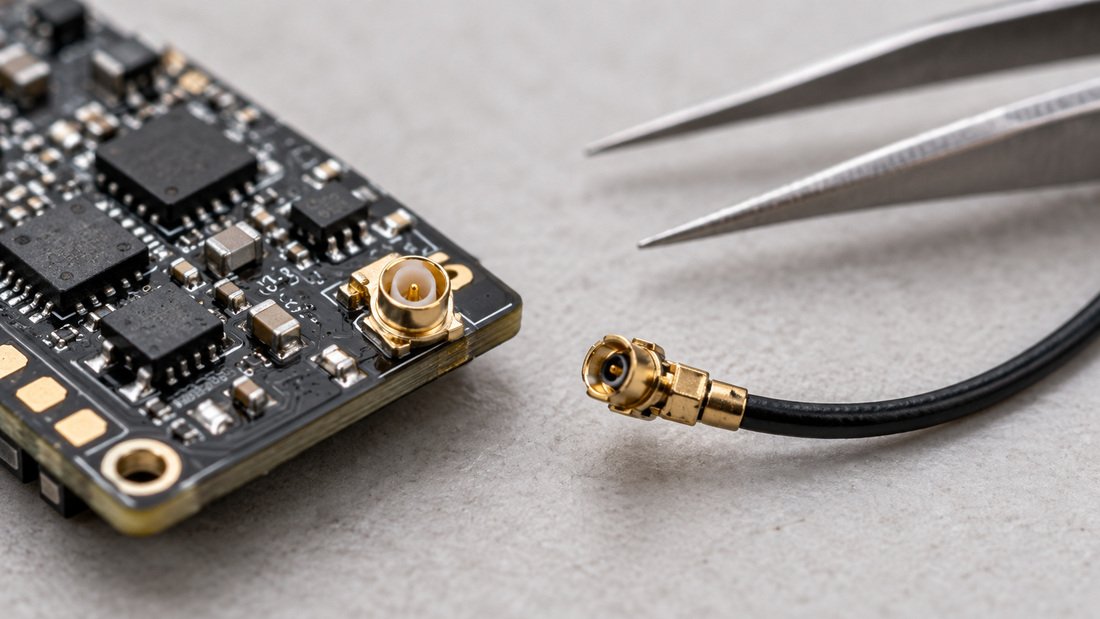
Antenna connectors (for example U.FL/IPEX-style or SMA-style) affect how easy a receiver is to repair and how much space it needs. Small board-level connectors save weight but are easier to damage during rushed repairs. Larger connectors are more robust but occupy more room.
Pick a connector standard that your club can actually service. If your repair bench already stocks one type of antenna and pigtail, staying with it reduces downtime and mis-ordered parts.
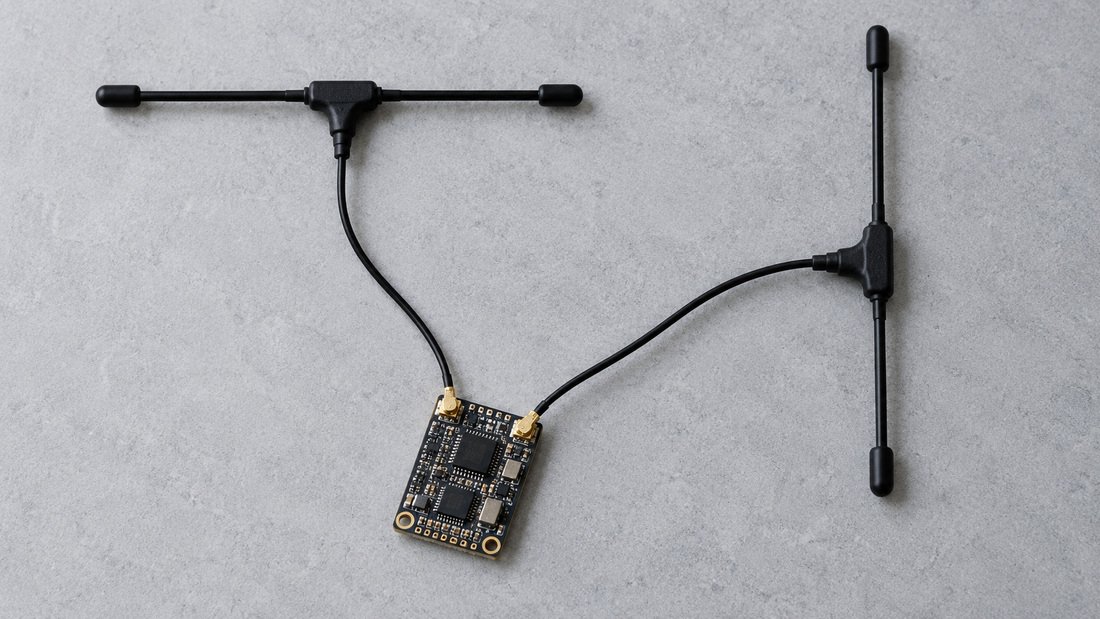
5. Diversity or single antenna?
A diversity receiver uses two antennas and selects or combines signals. In a busy indoor venue with many balls, people and metal structures, this can help maintain a link when one antenna is shadowed. The trade-off is extra size, weight, cost and another antenna to mount and protect.
For a small drone soccer ball, a well-placed single antenna is often enough. Diversity is worth considering if your team repeatedly sees link warnings in a specific venue, or if your rules allow a slightly heavier ball. Treat it as a problem-solving option, not an automatic upgrade.
6. Voltage, telemetry and firmware
Confirm the receiver’s supported input voltage against your ball’s power system, and check whether you need telemetry back to the transmitter. Telemetry can be useful for coaching and troubleshooting, but it adds configuration work. Also confirm which ELRS firmware targets and versions the receiver supports, and whether your transmitter module can match them.
If you run a mixed fleet, firmware mismatches are a common source of “dead” receivers on competition day. Keep a written configuration record for each ball type.
Comparison: receiver options for drone soccer balls
The table below compares common receiver approaches at a general level. It is guidance, not a specification for any particular product. Confirm exact dimensions, weight, voltage and firmware support with the supplier before ordering.
| Approach | Typical strength | Typical trade-off | Best suited to |
|---|---|---|---|
| Compact single-antenna 2.4 GHz receiver | Low weight and small footprint; simple install | Antenna placement is critical; less redundancy | Most school and club balls where weight is tight |
| Single-antenna receiver with rigid/T antenna | More consistent antenna orientation; easier fleet standardisation | Slightly more space needed; can be damaged if poorly mounted | Programs with many student repairs and shared balls |
| Diversity receiver | Can improve link stability when one antenna is shadowed | Extra weight, size, cost and another antenna to protect | Venues with heavy RF congestion or metal structures |
| Lower-band receiver | Different propagation characteristics | Larger antennas; harder to fit on a small ball | Specific venue or rule environments that permit it |
| Dual-band receiver | Flexibility across transmitter setups | More configuration and cost; more to teach | Programs supporting multiple radio standards |
Common mistakes in ELRS receiver selection
- Choosing by advertised range. A drone soccer ball flies in a small court; short-range link quality, recovery and failsafe behaviour matter more.
- Ignoring antenna clearance. Carbon fibre, battery cables and the ball frame can all affect antenna performance. Test in the assembled ball.
- Mixing firmware and targets. Unmatched firmware versions cause confusing failures. Record and label every configuration.
- Buying a full fleet before testing. Order samples, fly them in your actual venue, then commit.
- Forgetting spares. Receivers and antennas are consumables in a busy program. Plan spares per team, not per ball.
For a broader view of how receivers, transmitter modules and antennas fit together, see our overview of ELRS and RF systems.
Before you order a fleet, it also helps to read a compatibility reference. Our ELRS receiver compatibility page is a good starting point for checking firmware and module pairings.
Procurement checklist for clubs, schools and programs
- Confirm your event or league rules on weight, size and permitted radio bands — in writing.
- Measure the receiver bay in your ball frame and note the maximum dimensions.
- Decide your standard band and antenna connector before buying, so spares stay interchangeable.
- Request a sample batch and test failsafe, range and recovery in your own venue.
- Ask the supplier for: dimensions, weight, input voltage range, supported firmware targets, connector type and antenna gain.
- Ask what is covered by warranty and how returns are handled — get the answer in writing.
- Ask for the minimum order quantity, lead time and price breaks in writing before planning a budget.
- Plan spares: antennas and pigtails often fail before receivers do.
- Label and record each ball’s receiver model and firmware version.
Trade-offs to weigh before you standardise
Standardising on one receiver model simplifies training, spares and firmware management. It can also lock you in if that model becomes hard to source. A practical compromise is to standardise on a receiver family and connector type, while allowing one or two alternatives that fit the same mounting and antenna pattern.
If your program is growing, ask suppliers about OEM or ODM options — including custom labelling, connector choices or antenna configurations — and confirm what is feasible before designing around it.
Want to discuss a fleet-sized order or an OEM/ODM project for your club, school or association? Discuss your OEM project with our team and we will help you scope the right configuration.
FAQ
Is 2.4 GHz always the best band for a drone soccer ball?
No. 2.4 GHz is common because its antennas are small and equipment is widely available, but the right band depends on your transmitter modules, venue and event rules. Confirm what is permitted before buying.
Do I need a diversity receiver?
Not automatically. Diversity can help when one antenna is shadowed in a crowded venue, but it adds weight and size. Test a single-antenna receiver first and only move to diversity if you see repeatable link problems.
How many spare receivers should a club keep?
There is no universal number. Base it on how many balls you field, how often students handle them and how quickly you can restock. Track failures over a season and adjust. Antennas and connectors are usually the first items to fail.
Will any ELRS receiver work with my transmitter module?
Not necessarily. ELRS devices must match on band, firmware target and version. Check compatibility documentation and confirm with your supplier before ordering a fleet.
Can I mount the receiver anywhere in the ball?
Antenna placement affects performance. Keep the antenna clear of carbon fibre and battery wiring, and test the assembled ball rather than a bare frame. Follow your frame manufacturer’s guidance where available.
What should I ask a supplier before ordering?
Ask for dimensions, weight, input voltage, supported firmware targets, connector type, antenna gain, warranty terms, minimum order quantity, lead time and return process. Request samples and confirm all commercial terms in writing.
Does a more expensive receiver always perform better in a drone soccer ball?
Not always. Fit, antenna placement and firmware matching often matter more than price. A well-installed mid-range receiver can outperform a poorly installed premium one.
Conclusion
For most drone soccer programs, ELRS receiver selection comes down to four practical questions: does it fit and weigh little enough, does its band and firmware match your radios, does its antenna survive handling and placement inside the ball, and can you keep spares on the shelf? Answer those first, test a sample batch in your own venue, and standardise only after it works in a real match.
Ready to equip a team, school or league? Request a Team Kit Quote and tell us your ball type, fleet size and venue so we can help you plan receivers and spares.