Quick summary
There is no single best ExpressLRS (ELRS) receiver for every 5-inch freestyle drone. For most freestyle pilots, a 2.4GHz ELRS receiver with a single external antenna or a compact ceramic antenna offers the best balance of range, latency, size and price. Choose a 900MHz receiver only if your team consistently flies behind obstacles or at very long range. Match the receiver’s antenna connector and mounting footprint to your frame, and confirm firmware targets and regulatory limits before ordering in volume.
Key Takeaways
- For typical 5-inch freestyle, 2.4GHz ELRS gives excellent range with small, light receivers and low latency.
- Antenna type (dipole, T-antenna, ceramic) matters more than brand claims for real-world link reliability.
- Diversity receivers add a second antenna path but also add weight, cost and mounting complexity.
- Always confirm the receiver’s RF band, firmware target and antenna connector before buying in bulk.
- For clubs, standardize one or two receiver SKUs so spares, firmware and training stay simple.
How to Choose an ELRS Receiver for a 5-Inch Freestyle Drone
Start with how and where your team actually flies. A 5-inch freestyle quad flown in open fields, parking lots or a sports hall has very different RF needs than one flown through trees, buildings or around a race gate. The receiver is the weakest link in the control link, so its antenna and placement usually decide whether you keep control at the far end of the field.
This guide covers the practical selection factors: RF band, antenna type, diversity, connector, firmware target, power and mounting. It is written for drone sports clubs, school programs and teams buying in small batches, as well as distributors supporting them.
Step 1: Decide the RF band (2.4GHz vs 900MHz)
ELRS runs on different RF bands, most commonly 2.4GHz and 900MHz (the exact frequencies depend on your region’s rules). For most 5-inch freestyle, 2.4GHz is the default choice because the hardware is smaller and lighter, and modern ELRS links are very capable at typical freestyle distances.
900MHz can penetrate obstacles and vegetation better in many setups, but receivers and antennas are larger, and regional frequency rules must be respected. If your club flies mostly in open air, choose 2.4GHz and focus your effort on antenna placement and receiver quality instead.
Step 2: Check regional rules before you buy
RF band availability and allowed transmit power vary by country. Before ordering a batch, confirm which bands and power levels are legal where you operate. Ask your supplier to state the band and target region in writing, and keep that record with your club’s equipment log. This is a procurement question your team should verify, not assume.
Antenna Options and What They Mean in Practice
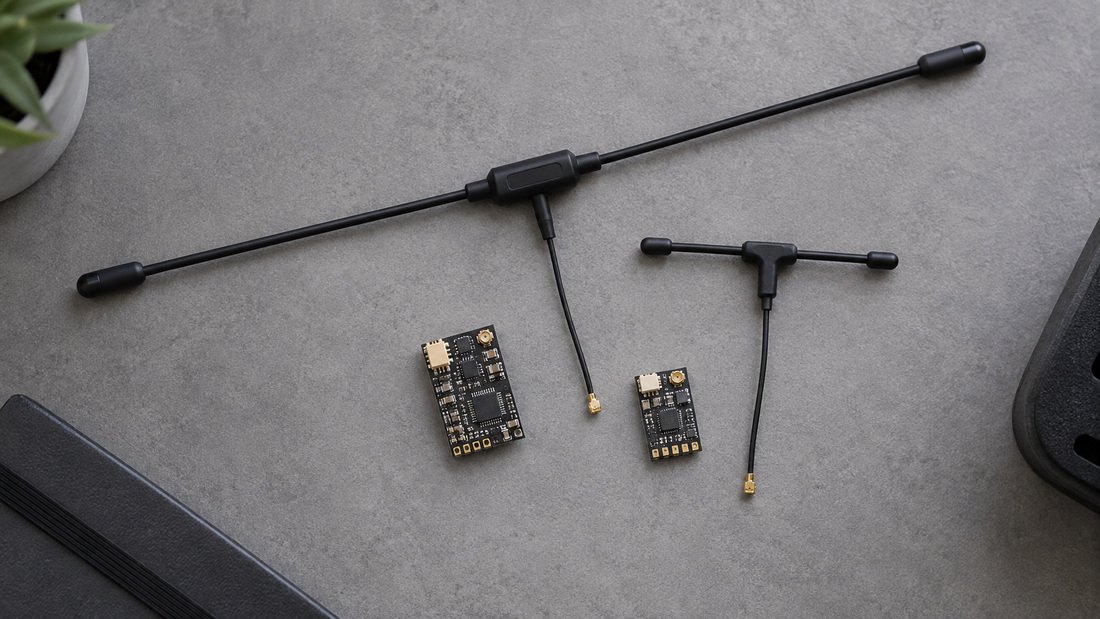
The antenna is the part of the receiver most exposed to crashes and the part that most affects link quality. The table below compares common options for 5-inch freestyle, using general guidance rather than specific product claims.
| Antenna type | Typical use | Strengths | Trade-offs |
|---|---|---|---|
| Single wire/dipole | Lightweight freestyle | Low cost, simple, easy to mount | Can be shadowed by frame or battery |
| T-antenna | General freestyle, tighter builds | Compact, often more consistent orientation | Placement still critical |
| Ceramic chip antenna | Very small builds, whoops, tight frames | Small, protected, no exposed wire | Performance depends heavily on mounting position |
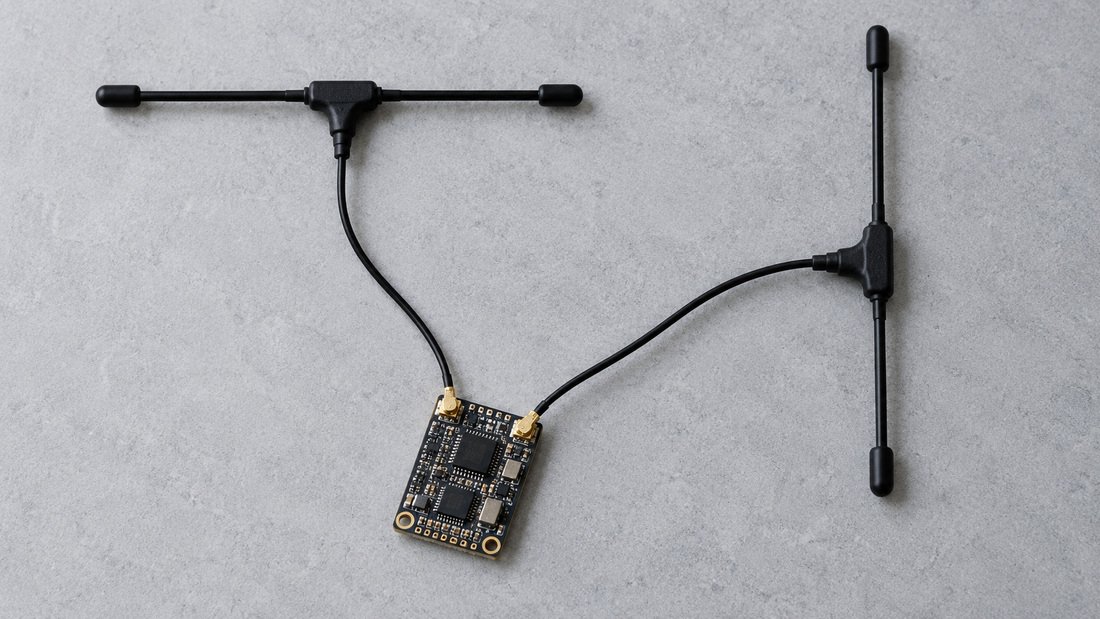
| Diversity (two antennas) | Longer range, obstacle-heavy sites | Two independent paths can improve reliability | More weight, cost and mounting work |
When diversity is worth it
Diversity receivers use two antennas so the receiver can select or combine signal paths. In open fields, a well-placed single antenna is often enough. Diversity becomes more interesting when your team flies behind obstacles, at longer distances or in venues with lots of RF noise from other pilots.
The cost is real: extra weight, extra antenna to mount and protect, and more points of failure in a crash. For a school fleet, simpler single-antenna receivers may be easier to maintain and replace.
Mounting, Connectors and Reliability
Receiver placement decides whether a good receiver performs well. Keep antennas away from carbon fibre, battery packs, motors and the video transmitter (VTX), which can all block or interfere with the control link. Antennas should be clear of conductive materials and oriented so at least one is unobstructed in normal flight attitudes.
Connector types to confirm
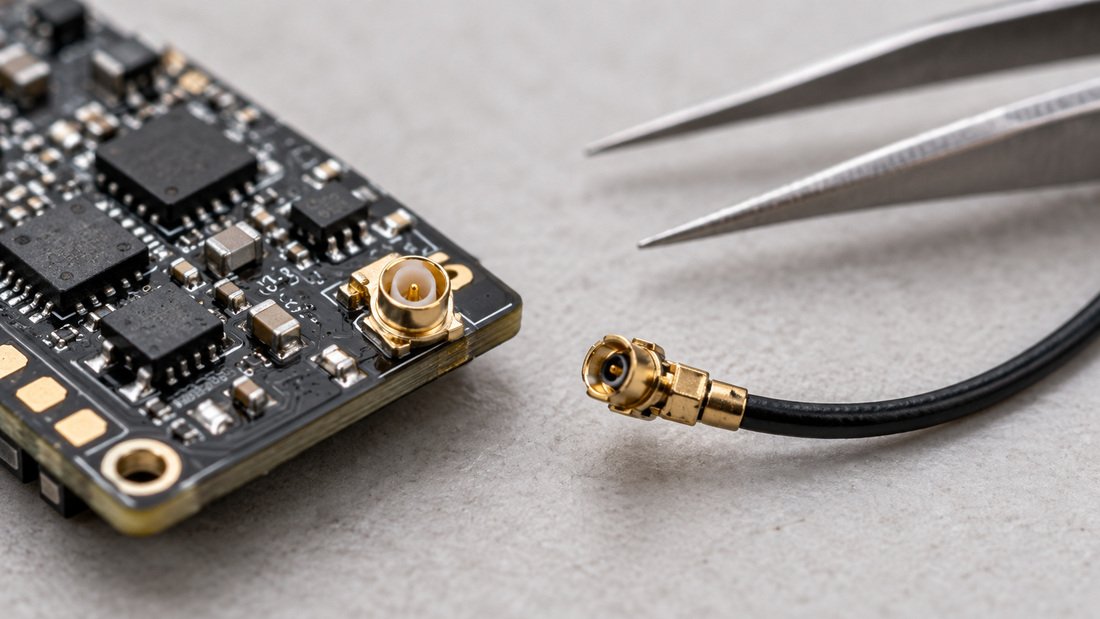
Antenna connectors must match exactly. Common small connectors include U.FL/IPEX-style and SMA/RP-SMA on larger hardware. A mismatch means the receiver cannot be used without an adapter, which adds loss and a failure point. Confirm the connector on both the receiver and the antenna before ordering.
Firmware target and protocol compatibility
ELRS receivers must run a firmware target that matches the receiver hardware and work with your transmitter module’s ELRS version. Confirm the firmware target name and supported ELRS major version with your supplier before bulk purchase. If your club mixes hardware generations, test one unit first and document the working firmware and settings.
You can review receiver options and compatibility guidance in our ELRS receiver compatibility centre, and compare hardware in the broader ELRS and RF systems category.
Power, Telemetry and Latency Trade-offs
ELRS lets you trade telemetry rate and packet rate against range and latency. Higher packet rates generally reduce latency but may reduce sensitivity; telemetry can be reduced or turned off to preserve link margin. These are configuration decisions, not fixed product properties, so plan them with your team.
For freestyle, a balanced packet rate with moderate telemetry is usually a sensible starting point. For drone soccer, where responsiveness and predictable behaviour matter, test settings on your actual field before standardizing a fleet configuration.
Receiver power and voltage
Confirm the receiver’s supported input voltage and how you will power it (for example from a flight controller pad or a dedicated supply). Feeding the wrong voltage can damage the receiver. Ask your supplier for the documented input range and keep it in your build notes.
Comparing Receiver Classes for Team Use
Clubs and schools rarely buy one receiver; they buy batches. The table below frames the decision in team terms.
| Priority | Recommended direction | Why |
|---|---|---|
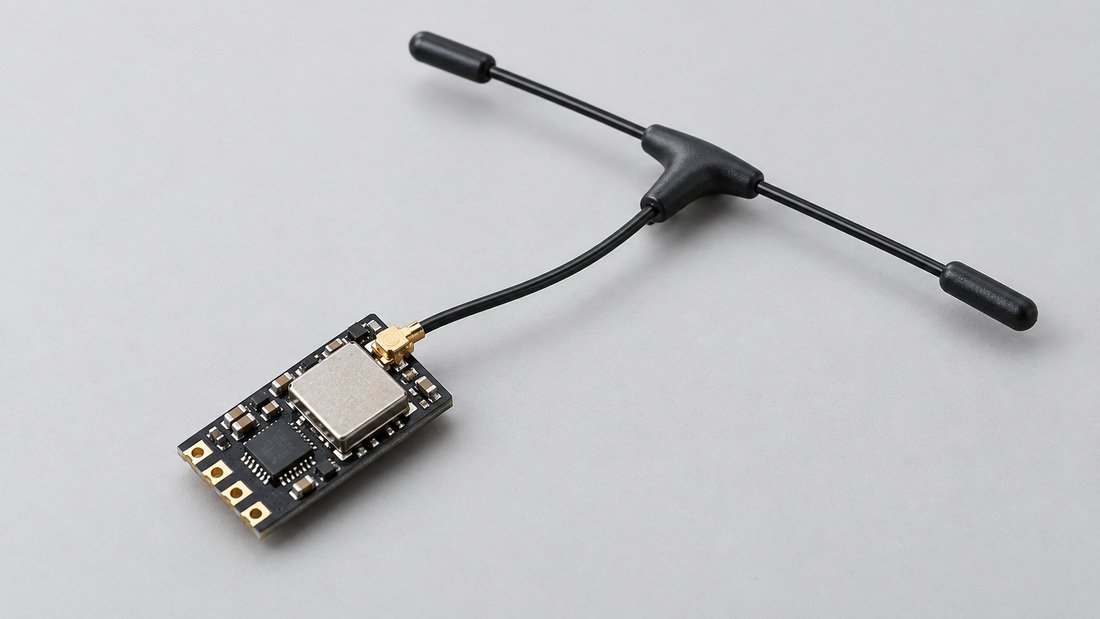
| Lowest maintenance | Single-antenna 2.4GHz receiver | Fewer parts to break and replace |
| Best crash survival | Receiver with protected/ceramic antenna | Antenna less exposed to impact |
| Longest range or obstacle-heavy sites | Diversity or 900MHz (where legal) | More link margin, better penetration |
| Easiest fleet standardization | One or two SKUs across all quads | Shared spares, firmware and training |
Common Mistakes in ELRS Receiver Selection
- Buying by brand hype instead of matching band, connector and firmware target to the build.
- Mounting the antenna against carbon fibre or next to the VTX, then blaming the receiver for failsafes.
- Mixing ELRS firmware versions across a club fleet without testing compatibility.
- Choosing diversity for a small indoor space where a single antenna would do.
- Ignoring regional RF rules when ordering in bulk.
- Forgetting spares: receivers and antennas are crash consumables for a busy team.
Practical Procurement Checklist for Clubs and Distributors
- Confirm the RF band and that it is legal in your operating region.
- Confirm the firmware target name and supported ELRS version.
- Confirm antenna connector type and what antenna is included.
- Confirm receiver input voltage range and typical current draw.
- Confirm physical dimensions and mounting hole pattern against your frames.
- Confirm weight, since 5-inch freestyle builds are weight-sensitive.
- Request a sample unit and test it on your own field before a bulk order.
- Ask about spare antennas and whether receivers are sold separately or in kits.
- Request documentation for firmware, wiring and any quality checks in writing.
- Agree on return, replacement and support terms in writing before purchase.
If you are equipping a team, club or school program, you can start a conversation and ask for a configuration review through our Get a Quote page. Bring your frame list, transmitter modules and typical flying environment so the recommendation fits your fleet.
FAQ: ELRS Receiver Selection for 5-Inch Freestyle
Is 2.4GHz or 900MHz better for 5-inch freestyle?
For most open-air freestyle, 2.4GHz is the practical default because hardware is small and light. Consider 900MHz only where it is legal and where you need better obstacle penetration at longer range, accepting larger hardware.
Do I need a diversity receiver on a 5-inch quad?
Not usually. Diversity adds weight, cost and mounting work. It can help in obstacle-heavy sites or long-range flying, but a well-mounted single antenna is often sufficient for freestyle.
Does antenna choice really matter?
Yes. Antenna type and placement often matter more than small differences between receivers. Keep the antenna clear of carbon fibre, batteries and the VTX, and protect it from crash damage.
How do I confirm receiver compatibility with my transmitter?
Match the ELRS major version and firmware target. Ask your supplier for the exact firmware target, then test one unit with your transmitter module before buying a fleet. Our ELRS receiver compatibility page can help you check details.
Can I mix receivers from different suppliers in one club fleet?
You can, but it complicates spares, firmware and training. Standardizing on one or two SKUs usually saves time over a season. If you must mix, document working firmware versions for each type.
What should I ask a supplier before ordering in bulk?
Ask for band and regional compliance, firmware target, connector type, voltage range, dimensions, weight and documentation. Request a sample and confirm replacement and support terms in writing.
Are ELRS receivers suitable for drone soccer?
ELRS is widely used in FPV generally. For drone soccer, responsiveness and predictable behaviour matter, so test packet rate and telemetry settings on your actual field before standardizing a fleet configuration.
Conclusion and Next Step
For most 5-inch freestyle drones, a 2.4GHz ELRS receiver with a single well-placed antenna is the sensible default. Choose diversity or 900MHz only when your flying environment and regional rules justify the extra weight and cost. What matters most is matching band, connector, firmware and mounting to your actual builds — and testing before you commit a club budget.
Explore our ELRS receivers, ELRS transmitter modules and RF antennas to compare options for your team. When you are ready to equip a squad, request a team kit quote so we can align receivers, antennas and spares with your frames and flying sites.