Quick summary
A drone soccer ball is the caged, ball-shaped FPV drone used in drone soccer (also called drone football or drone ball). Inside a protective outer cage sit an onboard LiPo battery, a flight controller and receiver, a 4-in-1 electronic speed controller (ESC), four motors and propellers, plus LED lighting. The cage protects the drone and people when it is bumped, and the shape lets it roll and deflect off surfaces. Teams fly these drones through rings on a netted court to score, which is why the ball itself is the focus of most repair and spare-parts planning.
Key Takeaways
- A drone soccer ball is not a shell that goes over a normal drone. It is a purpose-built caged drone whose frame, electronics, motors and lighting are chosen to work together as one unit.
- Five subsystems matter most: cage and frame, propulsion (motors, propellers, ESC), power (LiPo battery and wiring), flight control (flight controller, receiver, firmware), and structure/visibility (LEDs, mounting, fasteners).
- Teams and clubs should buy spare cages, propellers, batteries and motors before a season, because crash damage is normal and not a defect.
- Programming and flight rules are usually set by the competition body you register with, not by the parts supplier. Confirm the current rulebook before you buy a full squad of drones.
- For schools, the ball is a teaching platform as much as a game piece — battery safety, soldering, control tuning and team roles are all learnable on it.
- Ask suppliers to confirm, in writing, exact specifications, wiring conventions, firmware compatibility and spare-part availability instead of assuming cross-compatibility.
What is a drone soccer ball, exactly?
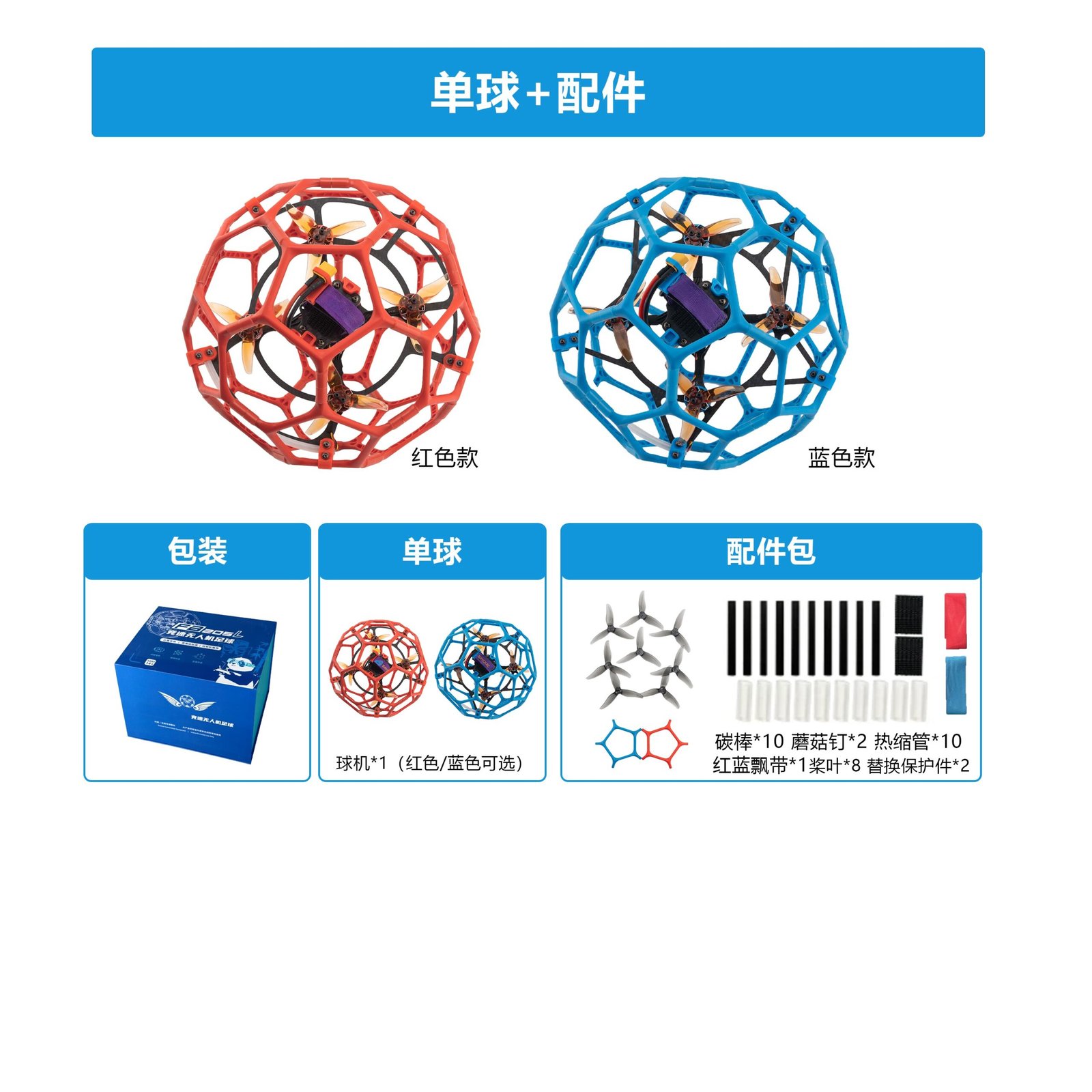
In its simplest form, a drone soccer ball is a small quadcopter wrapped in a roughly spherical, semi-rigid cage. The cage is the defining feature: it absorbs contact with other drones, the goal ring, the netting and the floor, and it lets the ball spin or roll without destroying the propellers inside.
The term “drone soccer rules and basics” usually covers both the game and the equipment. On the game side, you have teams, a court, goal rings, scoring, fouls and match timing. On the equipment side, you have the ball itself, its battery, its controller and the spare parts that keep a squad flying. This article focuses on the equipment — how the ball is built — and touches on the rules context that shapes design choices.

How is a drone soccer ball built? The five core subsystems
Builders generally think in five layers. Each one can be sourced, repaired or upgraded separately, which matters when a club is maintaining dozens of balls across a season.
1. The cage, frame and mounting structure
The cage is usually a light polymer or composite shell, often in two hemispheres or a ring-and-spoke pattern, bolted or clipped to a central frame. The frame holds the motors, the flight controller stack, the battery bay and the LED ring.
Design goals are in tension here. A stiffer cage survives harder hits but transfers more shock to the electronics. A softer cage flexes and springs back but may deform over time. Weight is the other trade-off: heavier cages are tougher but shorten flight time and reduce agility.
When comparing suppliers, ask which components are field-replaceable and whether the cage geometry is shared across the whole product family. A club that standardises on one cage design can swap parts between balls instead of scrapping whole units.
2. Propulsion: motors, propellers and the 4-in-1 ESC
Four brushless motors sit at the corners of the inner frame. Each drives a propeller that is short enough to fit inside the cage. A 4-in-1 electronic speed controller (ESC) — a single board that controls all four motors — is common because it saves weight and wiring compared with four separate ESCs.
ESC ratings are usually quoted as a continuous current figure, such as 45A or 55A. That number describes how much current the board can handle per channel, not how fast the drone flies. A higher-rated ESC gives more thermal headroom for aggressive flying or heavier cages, but it also adds weight and cost.
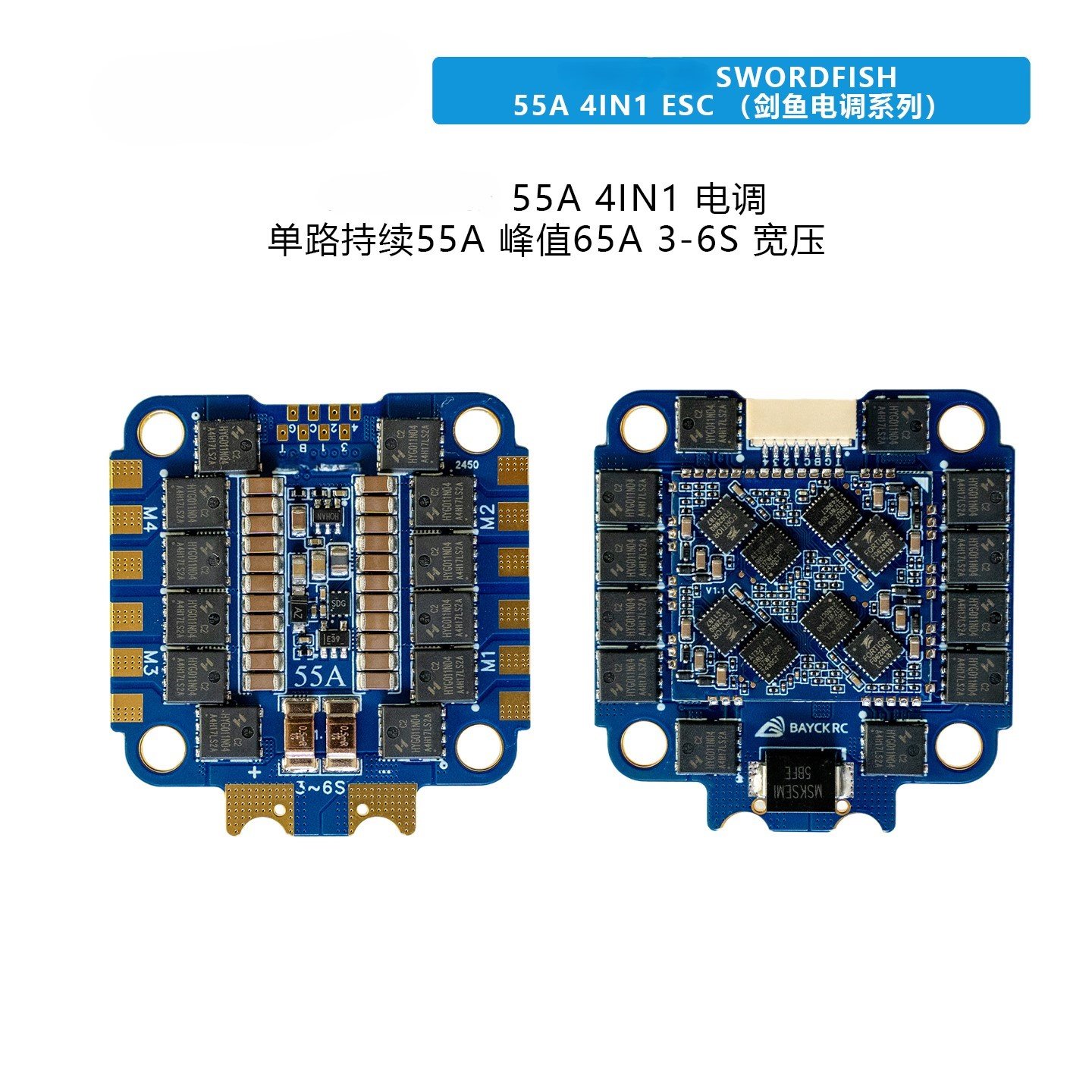
ESC firmware and protocol matter for compatibility. Before ordering, confirm which ESC protocol your flight controller expects and whether the supplier ships a known firmware version. This is one of the most common sources of “the parts arrived but nothing arms” problems.
3. Power: LiPo battery, connector and wiring
The battery is a lithium-polymer (LiPo) pack sized to fit the ball’s bay. Capacity, cell count and connector type determine flight time, thrust and how fast the ball feels on the controls.
Battery handling is where most incidents in youth programs originate, not in flight. Schools and clubs should have a written charging, storage and disposal procedure before the first session. If you are buying for an educational programme, battery safety training is part of the product, not an optional extra — see our work with STEM drone education and training.
4. Flight control: flight controller, receiver and firmware
The flight controller (FC) is the small computer that reads sensors and pilot input and tells the ESCs what to do. A radio receiver links the FC to the pilot’s transmitter. Many drone soccer programmes also use an onboard flight-controller setting or separate module to control LED colour and brightness, which signals team identity and is often mandated by competition rules.
A critical distinction for buyers: the flight controller and its firmware are usually the least interchangeable part of the system. Firmware versions, receiver protocols and configuration files are often specific to a supplier’s product family. If your club already owns a fleet, confirm that any new flight controllers are compatible with your existing transmitters and configuration.
5. Visibility and structure: LEDs, fasteners and finish
LEDs are not cosmetic in competition. Team colour is how officials, opponents and spectators tell balls apart, and lighting often has to be visible through the cage. Fasteners — screws, clips, rubber mounts — are the parts that vanish into gym floors and should be bought in bulk.
How the rules shape the build: drone soccer rules and basics that affect parts
Drone soccer is played in a netted court with circular goal rings at each end. Teams score by flying their ball through the opponent’s ring, and matches are typically short, repeated rounds. Beyond that general structure, details — ball size, weight limits, battery rules, number of active balls per team, scoring, fouls and safety procedures — vary by organising body and age category.
This is why the practical answer to “what should I buy?” is: buy to the rulebook you will actually compete under. Two consequences follow for procurement.
- Weight and size limits in a rulebook directly constrain which cage and battery you can use. A heavier, tougher ball may be perfectly legal in one category and out of spec in another.
- If your league runs two drone classes (for example a beginner and an advanced class), you may need two ball specifications. Many suppliers offer more than one class of ball — see drone soccer systems for the general product structure.
Ask your competition organiser for the current rulebook in writing, and share the relevant equipment clauses with your supplier before you order. Do not rely on a supplier’s summary of the rules, and do not rely on an old rulebook from a previous season.
Single-ball vs double-ball: what is the difference?
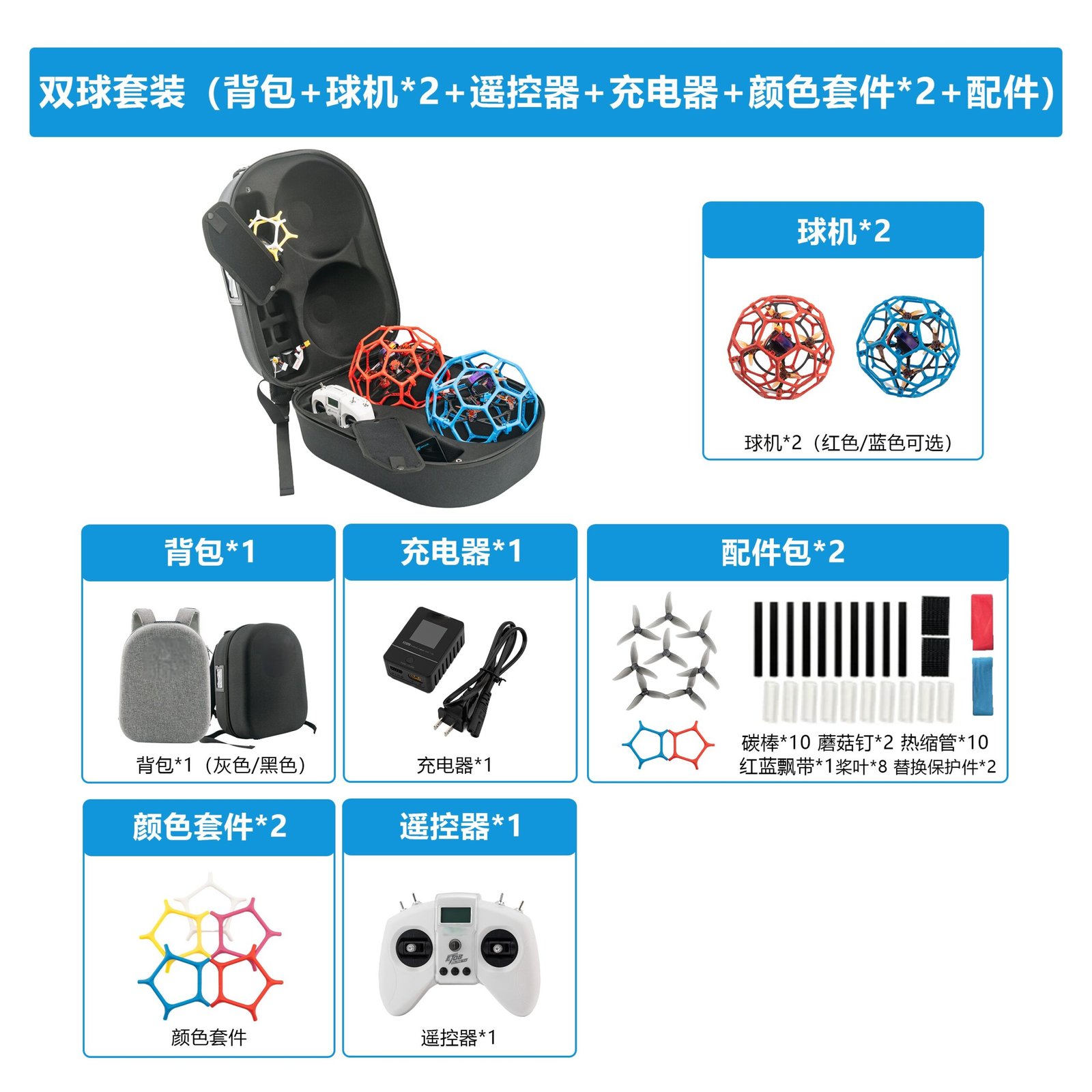
Some drone soccer programmes run one ball per team, and some run two. “Double ball” formats generally increase the number of simultaneous aircraft, which changes practice design and spares planning rather than changing the ball’s internal architecture. The build is the same; the fleet math is different.
Build comparison: what changes, and what it costs you
The table below compares the main component choices at a design level. It is general guidance for procurement discussions, not a specification for any particular model. Confirm exact figures with your supplier in writing.
| Subsystem | Choice A (lighter / faster) | Choice B (tougher / longer-lived) | What to confirm with the supplier |
|---|---|---|---|
| Cage and frame | Thinner shell, fewer spokes, lower mass | Thicker shell, more spokes, reinforced mounts | Replaceable in the field? Shared geometry across the range? Spare cage stock? |
| Motors and propellers | Smaller, higher-KV motors for agility | Larger motors for thrust with heavier cages | Propeller part numbers, motor mount pattern, bundle pricing |
| ESC | Lower continuous current rating, lighter board | Higher continuous current rating, more thermal margin | Rated continuous current, protocol, firmware version, connector type |
| Battery | Smaller capacity for lower weight | Larger capacity for longer rounds | Cell count, capacity, connector, charging and storage guidance |
| Flight controller and receiver | Minimal configuration | More tuning and telemetry options | Firmware version, receiver protocol, compatibility with existing transmitters |
| LED and signalling | Single-colour, fixed | Programmable colour and brightness | How colour is set, whether it meets your league’s rules |
Common mistakes when buying or building drone soccer balls
- Buying to a rulebook you have not read. Confirm the current equipment clauses from your league before committing to a fleet specification.
- Under-ordering consumables. Propellers, cages, fasteners and batteries fail or wear before the electronics do. Treat them as consumables, not spares.
- Mixing suppliers within one squad. Two visually similar balls from different suppliers can have different firmware, connectors and cage mounting, which slows down repairs and confuses pilots.
- Assuming cross-compatibility. ESC protocol, receiver protocol, battery connectors and propeller mounts are common mismatch points. Confirm each one.
- Skipping battery safety training. This is the single biggest risk area for school programmes and the easiest to fix with a written procedure.
- Ignoring the repair workflow. A ball that takes 20 minutes to open and 40 minutes to reassemble will spend the season on a shelf. Ask how the cage and stack are accessed.
- Forgetting transmitters and charging infrastructure. Balls are not the whole system. Budget for controllers, chargers, storage and a safe charging station.
Where the drone soccer ball fits in a STEM programme
For schools, the ball is an unusually good teaching object because every subsystem maps to a lesson: electrical safety with the LiPo pack, basic circuits with wiring and connectors, mechanical design with the cage, control theory with the flight controller, and teamwork through match play.
Organisations running drone soccer at scale typically split responsibilities: a coach or teacher for flying and safety, a technical lead for repairs and firmware, and a logistics role for batteries and consumables. Our overview for schools and training organizations covers how those roles usually map to a programme. For clubs running league play, see drone soccer clubs.
Where the drone soccer ball fits in a STEM programme
Middle and high school programmes often start with a small number of balls and grow into a full squad as the roster expands. Event organisers and distributors generally need a different mix: demo units, spare parts in bulk and a predictable, repeatable specification. See drone soccer competitions for how competitions are organised and what equipment that implies.
Planning a squad, a league season or a demo event? Tell us your format, team count and age group, and we will help you map a parts and spares list. Talk to our team.
Buyer checklist: what to confirm in writing before you order
- Current competition rulebook, including equipment clauses for your age category and class.
- Ball specification: dimensions, weight, cage material and whether the cage is field-replaceable.
- Full spare-parts availability and bundle options for cages, propellers, motors, ESCs, batteries and fasteners.
- ESC rated continuous current, protocol and shipped firmware version.
- Flight controller firmware version, receiver protocol, and whether existing transmitters will bind.
- Battery specification, connector type, charging guidance and safe-storage documentation.
- Transmitter, charger and storage recommendations for the size of fleet you are buying.
- Whether the supplier supports OEM/ODM packaging, labelling or configuration if you are a distributor.
- Written confirmation of commercial terms you care about — pricing tiers, packaging, documentation language and returns policy. Do not assume any of these.
FAQ
Is a drone soccer ball just a normal drone with a cage around it?
No. Purpose-built balls are designed as a single system: the frame, electronics, motors, battery bay and cage are chosen together to balance weight, durability and controllability. A generic drone in an aftermarket cage can be flown, but it rarely matches a purpose-built unit on weight, repair speed or parts availability.
What is inside a drone soccer ball?
A LiPo battery, a flight controller and receiver, a 4-in-1 electronic speed controller, four motors with propellers, LED lighting, and the internal frame that mounts all of it inside the protective cage.
How long does it take to build or assemble one?
Assembly time depends entirely on the design. Some cages open with a few clips and the electronics stack is reachable in minutes; others require removing motor mounts and soldering. Ask your supplier how the ball is opened and how many steps a motor or ESC replacement takes. Do not accept a general estimate without a written procedure or a demonstration.
What spare parts should a club keep in stock?
At minimum: propellers, cages, fasteners, batteries, motors, and at least one ESC and flight controller for every few aircraft. Exact quantities depend on your flying volume and how many rounds you fly per session. Base your order on your own breakage history once you have one.
Do drone soccer balls need to be registered or flown under specific rules?
Rules vary by country, and often by whether the flying is recreational, educational or commercial. In the United States, the FAA publishes guidance for educational users covering the Exception for Limited Recreational Operations and Part 107, including when qualifying educational organizations may operate under § 44809. Check the FAA’s educational users page for the current position, and confirm requirements with your national aviation authority before flying.
Can I mix drone soccer balls from different suppliers in one squad?
Physically, yes — rules permitting. Practically, it creates problems: different firmware, connectors, propeller mounts and cage geometry mean your spares bin and your pilots’ habits both fragment. If you must mix, standardise on one brand per training group and label everything clearly.
What does a drone soccer ball cost?
Pricing depends on specification, order volume and whether you are buying single units, team kits or OEM/ODM quantities. We do not publish a fixed figure because it changes with configuration and quantity. Request a written quotation that breaks out the aircraft, transmitters, chargers, spares and any customisation so you can compare offers like for like.
Conclusion
A drone soccer ball is a caged quadcopter built from five subsystems: cage and frame, propulsion, power, flight control, and structure with LEDs and fasteners. Understanding those layers is what turns a purchase decision into a maintenance plan — and maintenance is what keeps a squad flying through a full season.
The build itself is the easy part to describe. The harder part is matching a specification to your league’s current rulebook, planning consumables realistically, and confirming compatibility with any aircraft you already own. Those are questions for your supplier, and the answers should be in writing.
If you are equipping a school programme, a club or a league season, start with the rulebook and your team count, then build the parts list around it. Request a Team Kit Quote and we will help you scope the aircraft, spares and support you need.