Quick summary
Over-current protection should sit at three levels — inside the battery pack, in the power distribution or electronic speed controller (ESC), and in the charger — while over-discharge protection belongs in the battery’s protection circuit or battery management system (BMS), reinforced by a low-voltage cutoff in the flight controller. In classrooms these two are separated: over-current is an overheating and fire risk, over-discharge is a swelling, cycle-life and recharging risk. Because batteries for drone soccer are charged, stored, swapped and handled by students, product safety testing should confirm that protected packs, a compatible charger and a documented cutoff all work together, not just that each part claims a limit.
Key Takeaways
- Ask for two categories of evidence: protection devices (PCB/BMS, ESC current limiting, charger logic) and product safety testing documents that demonstrate the protection actually triggers.
- Over-discharge protection is a pack-level function; a flight controller cutoff alone leaves the cells unprotected during storage and transport.
- Over-current limits must be matched to the full system — battery, connectors, wiring, ESC and motors — not read in isolation from a data sheet.
- In many jurisdictions a rechargeable battery pack may fall under transport, safety or children’s-product rules; which ones apply depends on your destination, so confirm rather than assume.
- Written warranty terms are a separate negotiation from protection hardware. In the US, the FTC’s Magnuson-Moss guidance describes how written and implied warranties interact for consumer products — it is US-specific and not an automatic template for B2B or other countries.
Why over-current and over-discharge need to be treated differently
These two protections are often listed together in battery specifications, which hides the fact that they guard against different failure modes and live in different places in the system.
Over-current (excessive current draw) generates heat: in connectors, in wiring, in the ESC’s switching components and inside the cell. Its worst-case outcome is thermal — a hot connector, a melted solder joint, a vented or ignited cell. Over-discharge is slower. A lithium-polymer (LiPo) cell pulled below its safe minimum voltage loses capacity and can be permanently damaged, and a deeply over-discharged pack is more likely to swell or behave unpredictably on the next charge.
For a school drone soccer program, both matter, but the audience changes the emphasis. Coaches and teachers rarely control current draw — that happens in milliseconds during a match. They do control charging, storage and swap routines, which is exactly where over-discharge protection earns its keep.

What over-current protection should include
Over-current protection is layered. A well-specified drone soccer platform usually shows evidence at more than one layer, because no single layer covers every scenario.
Layer 1: the battery pack
Many hobby LiPo packs are sold “unprotected” — cells, tabs and balance leads, with no electronics inside the pack. Others include a small protection circuit module that limits current and cuts the output at a threshold. A protection circuit, where fitted, should be rated for the pack’s continuous and burst current, and the threshold should be published, not described only as “protected.”
Note the trade-off: a protection circuit that trips during a hard manoeuvre causes a mid-match power cut. A pack that is protected only on the discharge path and not on the charge path leaves the charging risk unaddressed. Ask which paths are covered.
Layer 2: ESC and power distribution
Electronic speed controllers can implement current limiting, and some flight controllers log current and voltage so a coach can review a session. These are operational protections — they reduce or stop power before a hard limit is reached. They should not be the only protection, because they depend on firmware configuration and calibration staying intact.
Layer 3: connectors, wiring and the charger
Connector rating, wire gauge and charger output limit are part of over-current protection in practice. A charger that cannot deliver more than the pack’s safe charge rate is a protection; a charger that can be set to an unsafe rate is a training risk. Confirm the allowed charge rate in writing and check whether the charger enforces it or merely permits it.
What over-discharge protection should include
Over-discharge protection is best owned by the pack, with a second line of defence in the aircraft and a third in the user routine.
- Pack-level cutoff: a protection circuit or BMS that disconnects the output when a cell or the pack reaches its minimum voltage. On multi-cell packs this should be per-cell, not only pack-total, because one weak cell can fall below the limit while the pack total still looks acceptable.
- Flight-controller low-voltage cutoff: a configurable warning and cutoff so the aircraft lands before the pack protection trips. This protects the pack and avoids an uncontrolled drop.
- Storage and transport state: packs stored at a very low state of charge can drift into over-discharge without ever being flown. Ask what the supplier’s storage guidance is and whether the pack ships in a storage-appropriate state.
- Charger behaviour: a charger that refuses to charge a pack below a threshold, or that reports an error instead of forcing current into a damaged pack, is doing safety work. Confirm whether the charger you are buying does this.
Where protection sits in a drone soccer (BKZ) setup
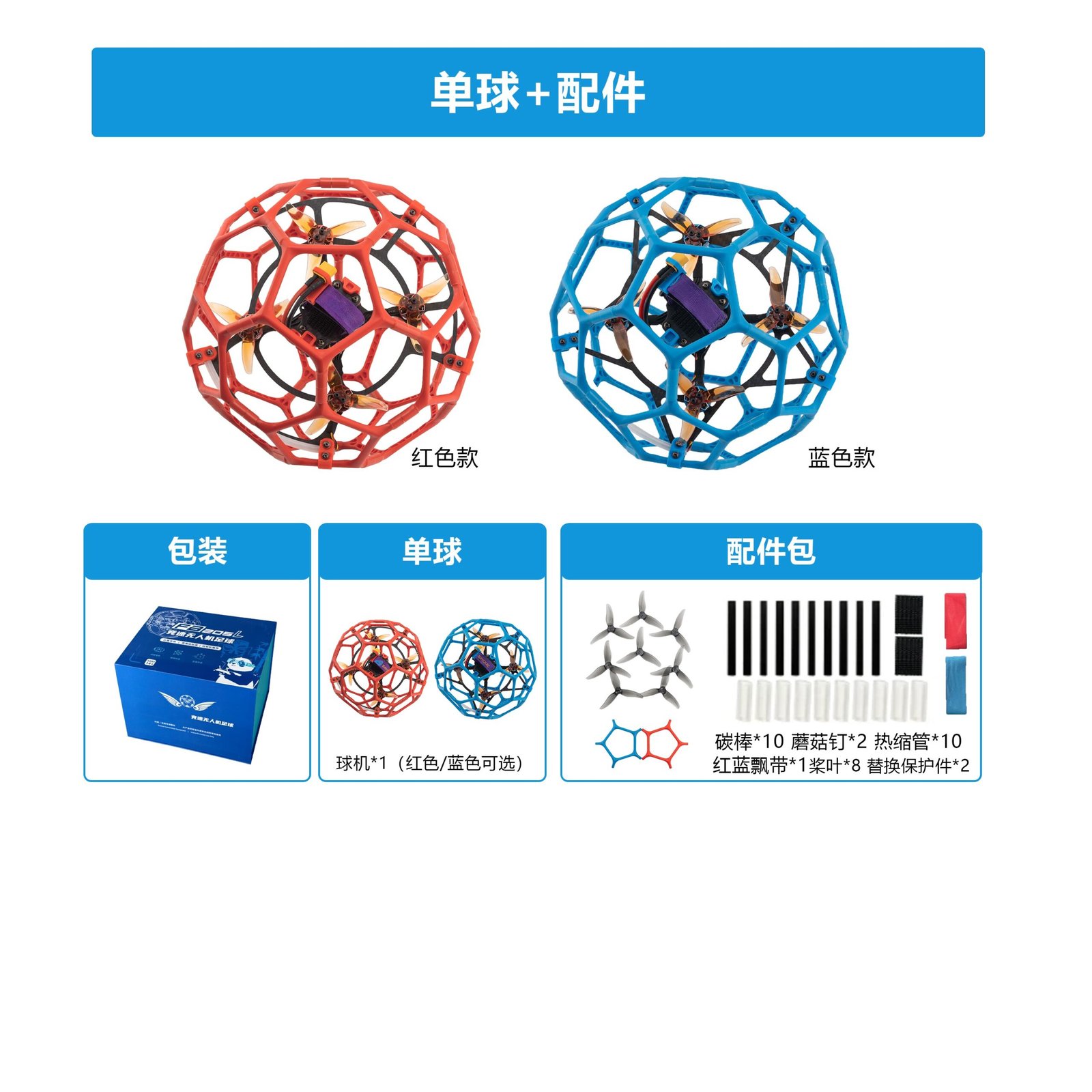
Drone soccer aircraft are small, ball-protected and flown in short, high-intensity bursts. That profile matters for protection design: current spikes during direction changes can be high, and packs are swapped frequently, so connector mating cycles and pack labelling matter as much as the threshold values.
Three practical consequences for a school program:
- Standardise the pack. If every team flies the same protected pack and connector type, protection behaviour is predictable and coaches can spot a damaged pack quickly.
- Make voltage visible. A low-cost voltage checker or a battery’s built-in indicator lets a student check state of charge before every flight without any tools.
- Design the swap routine. Protection that depends on a student remembering to check voltage is weaker than protection that trips automatically. Specify both.
Comparison: which layer protects what
| Protection layer | Over-current coverage | Over-discharge coverage | Typical limitation |
|---|---|---|---|
| Battery protection circuit / BMS | Yes, if fitted and rated | Yes, if per-cell sensing is provided | Adds cost and size; trip threshold may interrupt flight |
| ESC current limiting | Yes, configurable | No | Depends on correct firmware configuration |
| Flight controller cutoff | Rarely | Yes, configurable | Landing behaviour depends on settings; no protection when powered off |
| Charger logic | Yes, on the charge path | Yes, if low-voltage refusal is implemented | Only protects while charging |
| Connector, wire and fuse | Yes, by physical rating | No | Protects hardware, not cell health |
| User routine | Partially (pre-flight check) | Partially (voltage check, storage discipline) | Fails when rushed; needs training and simple tools |
Read the table as a specification worksheet, not a product claim. For a given drone soccer platform, ask the supplier to mark which rows are actually implemented and which are the responsibility of the school.
What product safety testing evidence should look like
“Product safety testing” is a broad term. In procurement it is more useful to separate three kinds of evidence and ask for each one explicitly.
1. Protection function tests
These demonstrate that the protection triggers. Questions worth asking: is over-current cut-off tested on the actual production build or only on a prototype? Is the over-discharge threshold verified per cell? Is the charger’s low-voltage refusal tested? What happens after a trip — does the pack recover automatically or require a deliberate reset?
2. Battery and electrical safety documents
Depending on destination and classification, relevant documents may include transport testing summaries, cell or pack safety test reports, and declarations of conformity to applicable standards. Which apply depends on your country, the battery chemistry and capacity, and how the product is sold. This is a question for your supplier and, where the stakes are high, your own compliance advisor.
3. System-level review
Protection thresholds that are safe in isolation can conflict when combined. A current limit lower than the aircraft’s legitimate burst draw causes nuisance trips; a cutoff voltage set too high shortens usable flight time and encourages users to override it. Ask for the system-level review, not just component certificates.
If you are comparing suppliers on this basis, our testing and inspection page describes how inspection stages are usually structured, and safety and compliance support covers the documentation conversation you should start before placing a bulk order.
Warranty, liability and the paperwork gap
Protection hardware and warranty wording are separate topics, but schools often discover the gap between them late: a pack is damaged by over-discharge, and it is unclear whether that is a defect or misuse.
In the United States, the Federal Trade Commission’s business guidance on the Magnuson-Moss Warranty Act explains that implied warranties are unwritten promises created by state law — including that goods will do what they are supposed to do — and that these can, in some circumstances, be disclaimed or limited if done conspicuously. The same guidance notes that implied warranties generally do not cover problems caused by abuse, misuse, ordinary wear, failure to follow directions or improper maintenance. See the FTC’s businessperson’s guide to federal warranty law.
Two cautions. First, this is US consumer-product law; it does not automatically apply to a B2B purchase, to a school buying on its own terms, or to other countries, and state law varies. Second, the practical lesson is narrower than the legal detail: the clearer your written agreement is about what counts as normal use of a protected pack, the fewer arguments there are later. Ask how the warranty and after-sales program handles a pack that has been over-discharged, and get the answer in writing.
Common mistakes in school drone soccer programs
- Buying unprotected packs because they are cheaper. The saving is real; so is the loss of automatic protection. If you choose unprotected packs, you must replace that protection with stricter routines and better training.
- Assuming the charger protects the pack. Charger logic protects during charging. It does nothing about a pack left connected to electronics, or stored flat.
- Mixing packs of different age and capacity in one fleet. Protection thresholds are set per pack type; mixed fleets make it hard to interpret a low-voltage event or a trip.
- Reading one current number as the whole answer. Continuous and burst ratings are different, and the weak link is often a connector or a wire, not the cell.
- Treating a data sheet line as evidence. “Over-discharge protection” in a specification table tells you what was designed, not what was tested on the units you received.
- No written storage rule. The most common over-discharge incident involves a pack that was never flown.
Buyer checklist for schools and program managers
Bring this list to the supplier conversation and ask for written answers. Where a supplier cannot confirm an item, record it as an open question rather than assuming compliance.
- Which over-current protections are implemented: pack-level protection circuit, ESC limiting, charger limit, fuse?
- What are the published current thresholds, and are continuous and burst values separate?
- Is over-discharge protection per-cell or pack-total? What is the cutoff voltage?
- How does a tripped pack behave — automatic recovery or reset required?
- Does the charger refuse to charge a deeply discharged or mismatched pack?
- What product safety testing documents are available for the battery, and for which markets?
- What storage state of charge is recommended, and how is it achieved in practice?
- What does the warranty cover, and is over-discharge explicitly included or excluded?
- Is replacement protection hardware (packs, connectors, chargers) available as a separate item for spares?
- Is there a written student-handling guide, and is it available in the languages your program uses?
One more item belongs on the list even though it is not a protection: consistency. A spare-parts pool that uses the same protected packs, connectors and charger across every team removes a large class of mistakes before training begins. Our quality control page explains how consistency is usually maintained across batches.
Frequently asked questions
Does over-discharge protection make a LiPo pack safe?
No. It addresses one failure mode. Over-current, physical damage, charging faults and thermal exposure are separate risks, and no single protection covers all of them.
Can a flight controller replace battery protection?
Not fully. A flight controller cutoff works only while the aircraft is powered, so it does not protect a pack in storage, in transport or on the bench.
Should schools buy protected or unprotected batteries?
Protected packs reduce reliance on routine and training, which matters in a busy program. Unprotected packs are lighter and often cheaper but shift protection onto the user. If you choose unprotected packs, plan the routine and training that replaces the electronics.
What happens if a protection circuit trips mid-flight?
The aircraft loses power. For drone soccer this is usually preferable to continuing with a failing pack, but it is still an event that needs a safe flying area, clear separation from spectators and a coach briefed on what to do. Ask the supplier how the trip behaves and how it is reset.
Which product safety testing documents should I request?
Request the documents relevant to your destination and product classification, and ask the supplier to explain which standard each document addresses. Do not accept a general certificate as evidence that over-current and over-discharge thresholds were tested on production units.
Is a longer warranty a substitute for protection?
No. Warranty terms determine who pays after a failure; protection reduces the chance of failure and of harm. Treat them as two separate purchase decisions.
How do we verify protections after delivery?
Ask for an incoming inspection plan: visual check of protection circuitry, connector and wiring condition, a charger behaviour test, and a documented low-voltage refusal test. Record results per pack so a later failure can be traced.
Conclusion: one page, two columns, in writing
Over-current protection belongs inside the pack, in the ESC and in the charger; over-discharge protection belongs in the pack and is reinforced by the flight controller and by storage discipline. Neither is proven by a data sheet line. What converts a specification into a purchasing decision is a short written response from your supplier that lists, for each layer, what is implemented, what the threshold is, how it was tested and what remains the school’s responsibility.
For a school, club or youth program preparing a drone soccer (BKZ) order, send that list to us along with your class size, pack quantity and destination country. We will tell you which items we can confirm in writing and which you should verify locally with your own compliance advisor. Request a School Program Quote.