Quick summary
Choosing antennas for an indoor arena starts with measuring the venue, not buying hardware. Identify the RF bands and transmitters that will be present, map reflective surfaces and crowd zones, then select antenna gain and pattern that concentrate coverage where pilots and teams actually fly. Plan a documented frequency coordination process, keep spare antennas and receivers, and confirm every technical specification with your supplier in writing before an event.
Key Takeaways
- Antenna choice should follow an RF plan built from a venue walk-through, not vendor marketing claims.
- RF interference at events comes from many sources: other teams, Wi-Fi, cameras, LED walls and reflected signals in halls.
- Higher-gain antennas are not automatically better indoors; narrow patterns can leave dead zones and multipath problems.
- Standardize on one receiver and transmitter ecosystem so antenna, connector and firmware choices stay consistent.
- Request written confirmation of band, gain, connector, polarization and test method from your supplier before procurement.
Why indoor arenas behave differently from outdoor fields
Short answer: indoor arenas add reflections, crowds and competing wireless devices, so the antenna plan must control coverage shape and interference sources, not just maximize range.
A metal-framed sports hall reflects radio energy. Signals arrive at the receiver from several paths, which can cancel or reinforce each other — commonly called multipath. Spectators, bodies and equipment also absorb and scatter signals. As a result, a link that works in an empty hall may degrade once the arena is full.
Indoor venues also host overlapping wireless traffic. Scoreboards, timing systems, broadcast cameras, LED walls, Wi-Fi access points and other teams’ transmitters all share limited spectrum. For event organizers, the practical question is not which antenna has the highest gain, but which combination of antenna pattern, placement and coordination keeps every heat reliable.
Start with an RF interference inventory
Direct answer: before selecting antennas, list every radio device that will be active, and ask venue staff which systems you cannot switch off.
Build a simple inventory per venue. Record the band and typical transmit power of each device where the operator can share it, and mark whether it can be moved, channel-shifted or scheduled away from competition windows. You do not need exact numbers for every device, but you do need owners and answers.
- Teams’ drone transmitters and video transmitters, including spare craft and practice units.
- Venue Wi-Fi, including access points mounted near the flight zone and spectator hotspots.
- Broadcast and streaming equipment, wireless microphones and intercom systems.
- LED walls, scoreboards and lighting controllers with wireless control links.
- Other events in the building on the same day, including non-drone activities.
Document this in a shared table and revisit it at each new venue. This record becomes the basis of the frequency plan you share with teams at registration.
Match antenna pattern and gain to the flight zone
Direct answer: choose an antenna whose coverage shape matches the arena geometry, and prefer predictable coverage over the longest possible reach.
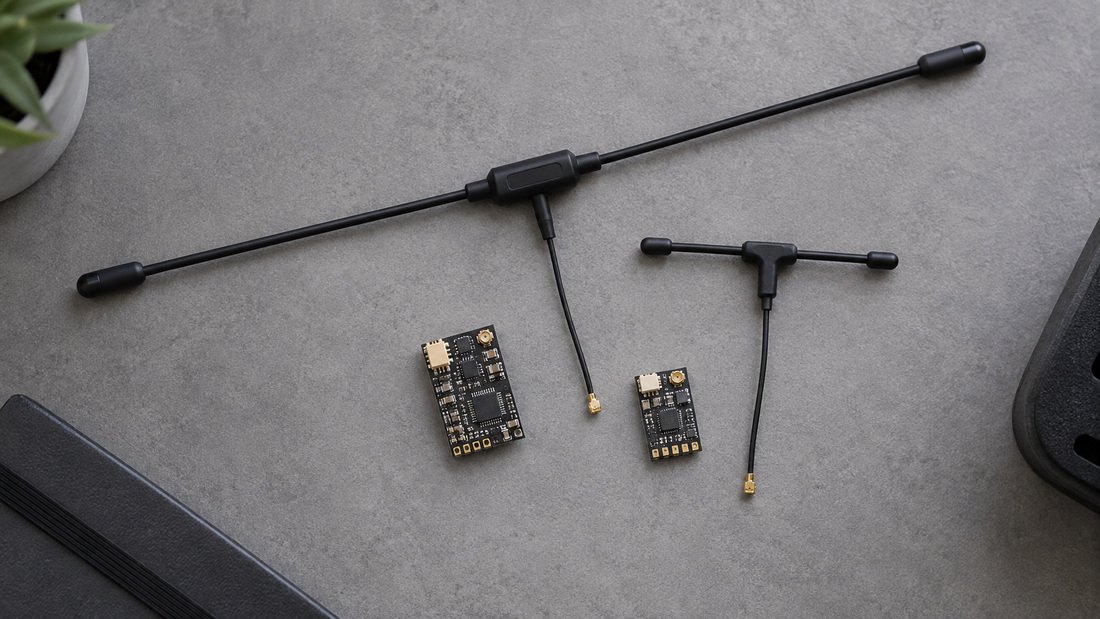
Directional antennas focus energy toward the flight area; omnidirectional antennas cover broadly but with lower gain in any direction. Indoors, many organizers find a modest-gain directional antenna aimed across the flight zone works better than a high-gain antenna whose narrow beam leaves gaps at the field edges. These are general principles, not universal recommendations — the correct choice depends on your venue and equipment.
Consider where pilots, receivers and transmitters sit. If a pilot box faces the arena across a long hall, a directional antenna may reduce energy spilling toward spectators and neighboring rooms. If receivers are mounted on moving craft across the whole floor, broad coverage usually matters more than peak gain.
Plan frequency coordination for events
Direct answer: a written frequency plan, enforced at registration, prevents more RF interference at events than any single antenna upgrade.
Drone soccer and indoor FPV events often run multiple heats with limited time. Assign channels or frequency groups per team per heat, and publish a schedule. Reserve spare channels for replacements and practice. Require pilots and team staff to follow a recorded procedure for powering up craft in the pit area, since uncontrolled transmitters in pits are a common source of interference near the arena.
Ask your equipment supplier whether receivers and transmitters you are considering support the channel plans you want to use, and how channel changes are handled in firmware. For ELRS systems, the ELRS and RF systems overview and the ELRS receiver compatibility guidance are useful starting points for these questions.
For older or multi-band fleets, raceband and other analog video bands may also be in use. Include these in the inventory even if your control links are already on ELRS.
Do not ignore the receiver antenna and mount
Direct answer: a good receiver can underperform if its antenna is poorly placed, poorly polarized or damaged, so treat receiver antennas as consumable, inspectable parts.
In drone soccer, craft are small, fast and crash often. Antennas are exposed. Bent elements, loose connectors and crushed coax change performance in ways that are hard to see. Include antenna inspection in pre-flight checks and keep spares in the pit kit.
Also think about polarization. Transmit and receive antennas should generally share the same polarization for best coupling; mismatched or constantly rotating polarization in a reflective hall can cause inconsistent results. Test your chosen combination in the real venue before tournament day.
Transmitter modules and antenna pairing
Direct answer: the transmitter module, its antenna and the receiver must be treated as one combination, and that combination should be documented per venue.
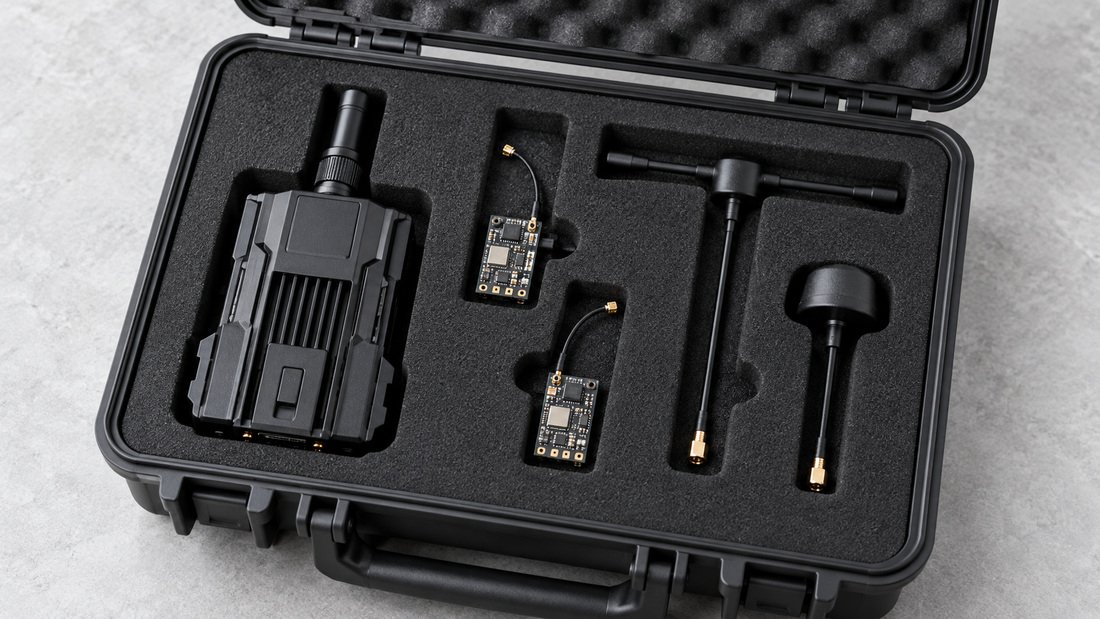
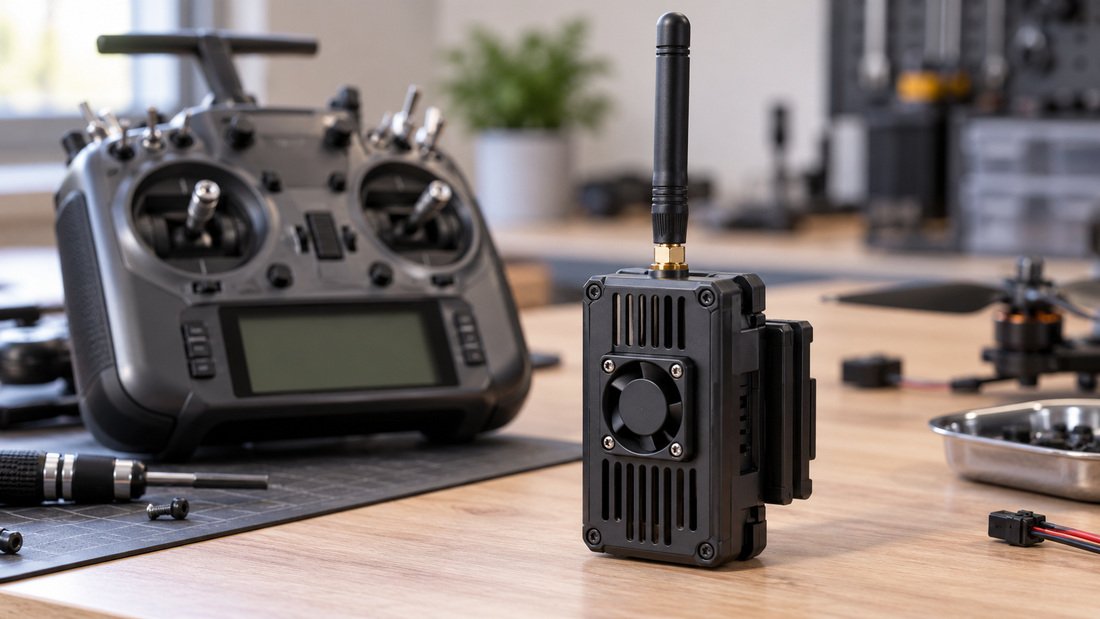
External transmitter modules can be changed between pilots and events. That flexibility is useful, but it also creates variables. If one pilot uses an external module with a directional antenna and another uses a stock setup, their link behavior can differ. For fair heats and easier troubleshooting, define allowed configurations in the event rules.
Describe antenna placement for external modules, and ask suppliers for connectors and adapter details in writing. The ELRS transmitter modules range and RF antennas pages show the categories available; specific gain, bandwidth and connector options should be confirmed with the supplier.
Test in the venue before the event
Direct answer: run a bench or walk test on site with a full crowd simulation where possible, and record the settings that work.
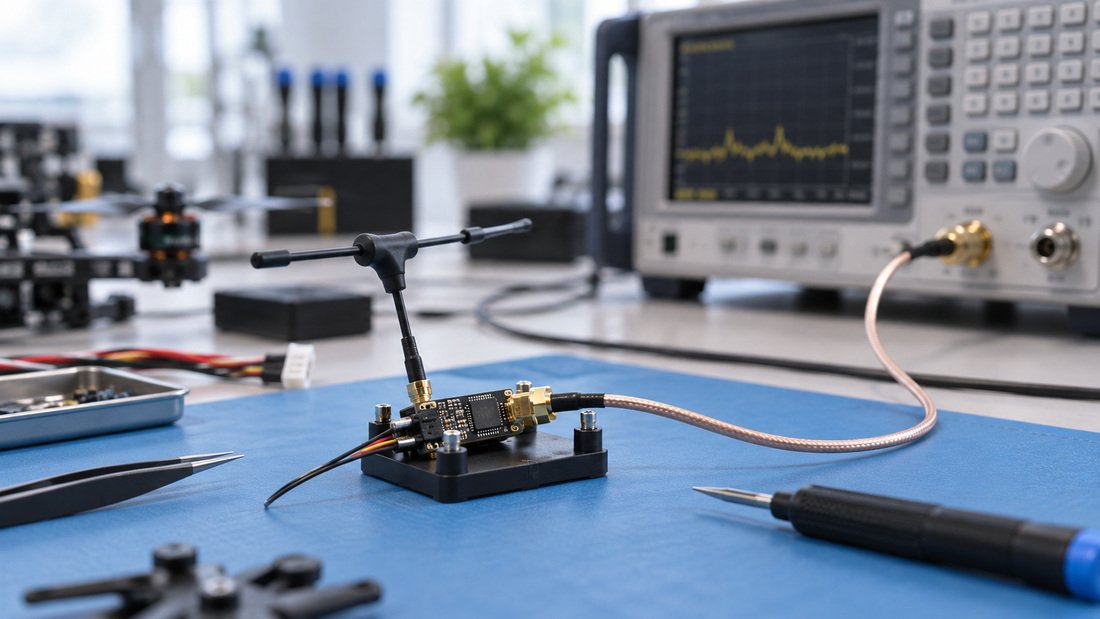
Schedule a site test during setup, with teams’ practice craft active where permitted. Walk the flight boundaries and record where link quality drops. Repeat with doors open and closed, lights on, and broadcast equipment running. If the venue cannot be tested fully, ask your supplier what test evidence they can share and what parameters to check yourself.
Keep a simple log: date, venue, antenna model, mounting position, link quality observations and actions taken. This record is the most useful document you will build for future events.
Comparing antenna approaches for indoor events
Direct answer: use a comparison table to align organizers, teams and suppliers on what each option achieves and what it costs operationally.
| Approach | Possible benefit indoors | Trade-off or risk | Verify with supplier |
|---|---|---|---|
| Omnidirectional antenna at pilot box | Broad coverage, simple setup, forgiving of craft orientation | Radiates energy toward spectators and adjacent areas | Band, gain, polarization, connector type |
| Modest-gain directional antenna aimed at flight zone | More energy where flying happens, less spill outside | Coverage gaps at field edges if aimed poorly | Beamwidth, gain, mounting options |
| High-gain directional antenna | Longer reach in large halls for some setups | Narrow pattern; multipath and alignment sensitivity | Whether indoor use is supported and how performance was measured |
| Diversity or dual-antenna receivers | May improve resilience when signals reflect | Extra hardware, mounting and spares weight | Compatibility with your receivers and antennas |
| Standardized kit per team | Predictable behavior and easier rules and troubleshooting | Less flexibility for advanced pilots | Kit contents, connector adapters, spare-part availability |
This table describes general trade-offs. It is not a product recommendation, and no performance claim should be taken as verified until the supplier confirms it in writing.
Common mistakes at indoor events
- Buying antennas before mapping the venue and its other radios.
- Assuming more gain always means better results indoors.
- Allowing pit-area transmitters to power up during heats.
- Using mismatched connectors or adapters without checking losses and fit.
- Failing to inspect receiver antennas after crashes.
- Changing antenna configurations between heats without logging it.
- Relying on equipment specs alone instead of on-site testing.
If you need support planning equipment for a specific venue, talk to our team about your event requirements.
Procurement checklist for event organizers and distributors
Direct answer: issue a clear brief that states the venue, devices, frequency plan and spares policy, and ask suppliers to confirm every technical parameter in writing.
- Venue list with dimensions, construction type and known wireless systems.
- Bands and systems in use, including control links and video.
- Number of teams, heats and spare craft per event day.
- Required antenna connector and mounting style.
- Desired polarization and antenna gain class, if already decided.
- Receiver and transmitter compatibility requirements, including firmware versions in the fleet.
- Spare antenna and receiver quantities based on your risk assessment.
- Documentation requested: datasheet, test method description, connector drawings.
- Packaging and labeling needs for distributor or OEM/ODM procurement.
- Warranty, lead time, MOQ and support terms to be confirmed in your quotation.
Unverified commercial terms such as warranty length, minimum order quantity or lead time should be requested and confirmed in writing for your specific order. The same applies to any claim about indoor performance.
For schools and youth programs, add training considerations: keep identical spares, label antennas by team, and include antenna handling in coach briefings. For distributors, ask for consistent packaging and documentation so your customers can reproduce the event setup.
Frequently asked questions
What causes RF interference at indoor drone events?
Common contributors include other teams’ transmitters, venue Wi-Fi, broadcast gear, LED walls and reflected signals. The mix varies by venue, so an inventory and on-site test are more reliable than assumptions.
Is a higher-gain antenna always better for an indoor arena?
No. Higher gain usually narrows coverage, which can create dead zones and amplify multipath sensitivity. Match the pattern to the arena and test it on site.
Should we standardize on one antenna type for all teams?
Standardizing simplifies rules, training and troubleshooting. Some organizers allow limited pilot choice with documented configurations. Either way, publish the rules and test the combinations.
How do we check whether our ELRS receivers and transmitters are compatible with a planned antenna setup?
Confirm connector type, band, polarization and firmware requirements with the supplier, and use the manufacturer’s compatibility guidance. DPF publishes ELRS receivers information as a starting reference.
How many spare antennas should an event carry?
There is no universal figure. Base spares on team count, crash frequency and whether teams bring their own equipment. Ask your supplier about ordering spare parts as part of the event kit.
Can we plan antennas without visiting the venue?
You can prepare a draft plan from venue drawings and device lists, but final settings should be confirmed on site. Ask the venue manager for construction details and fixed wireless equipment.
What should distributors request from DPF for event customers?
Request written product specifications, connector details, compatibility references and commercial terms for your order size. Our team can discuss your event support needs directly.
Conclusion and next step
Choosing antennas for indoor arenas is an event-planning task. Build an interference inventory, map the venue, select patterns that fit the flight zone, coordinate frequencies in writing, keep spares, and test before competition day. Antenna performance claims should be confirmed by the supplier and validated in your own venue.
DPF supports schools, clubs, event organizers, distributors and OEM/ODM buyers with ELRS receivers, transmitter modules and RF antennas. To move forward, prepare your venue brief and Request Event Equipment Support.