Quick summary
Yes, custom-branded ELRS receivers and transmitter modules are commonly requested as an OEM (original equipment manufacturer) or private-label arrangement. The realistic scope, though, is branding rather than reinvention: product selection, enclosure and label printing, packaging, firmware version control and accessory kits. Physical redesign, new RF layouts and custom firmware are separate engineering projects with longer timelines and their own validation needs. Before ordering, confirm in writing which of these your supplier actually covers: logo placement, print method, artwork files, packaging, firmware version locking, serial numbering and minimum order quantities.
Key Takeaways
- Custom-branded ELRS receivers are usually a private-label service layered on an existing receiver design, not a new product development.
- Branding typically covers labels, enclosures, packaging and firmware version control; RF redesign is a separate, slower project.
- Confirm the print method (pad printing, laser marking, label stock) because it affects durability on small receiver housings.
- Ask how firmware versions and binding phrases are handled, since branded units often ship to clubs and schools that expect consistent behavior.
- Get MOQs, sample terms, tooling costs and approval steps in writing before paying; these vary by supplier and are not standard.
Custom-branded ELRS modules are a procurement topic, not a marketing slogan. Schools, drone soccer clubs, distributors and integrators usually want three things: a recognizable logo on the hardware, packaging that looks professional when handed to a team, and firmware behavior they can support consistently across a season. Everything else is negotiable detail. This guide walks through the practical decisions, using ELRS receivers and ELRS transmitter modules as the working examples; the same logic applies across the wider ELRS and RF systems range.
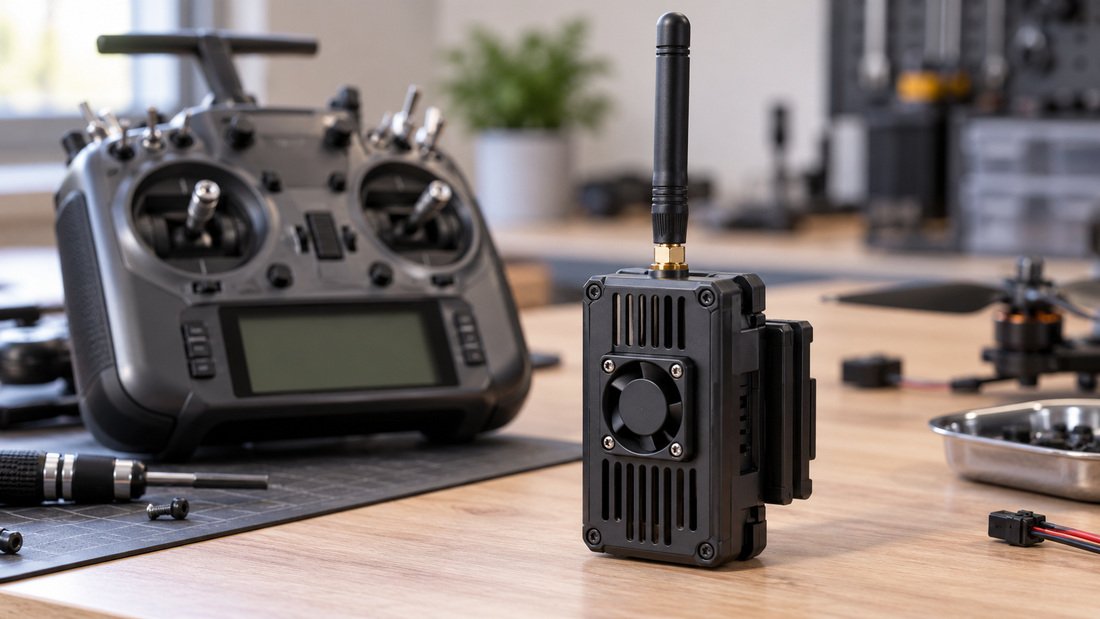
What does “custom-branded” actually mean for ELRS hardware?
In most OEM conversations, custom branding means the product stays functionally the same while the presentation changes. That covers the logo on the label or housing, the retail or club packaging, the manual or quick-start card, and sometimes the accessory set included in the box. It does not usually mean a new circuit board or a different radio frequency chain.
It helps to split the request into tiers before you contact any supplier, because suppliers quote very different things depending on tier.
- Tier 1 — Label and packaging branding. Your logo on the product label, box and documentation. Fastest and usually the lowest-cost route.
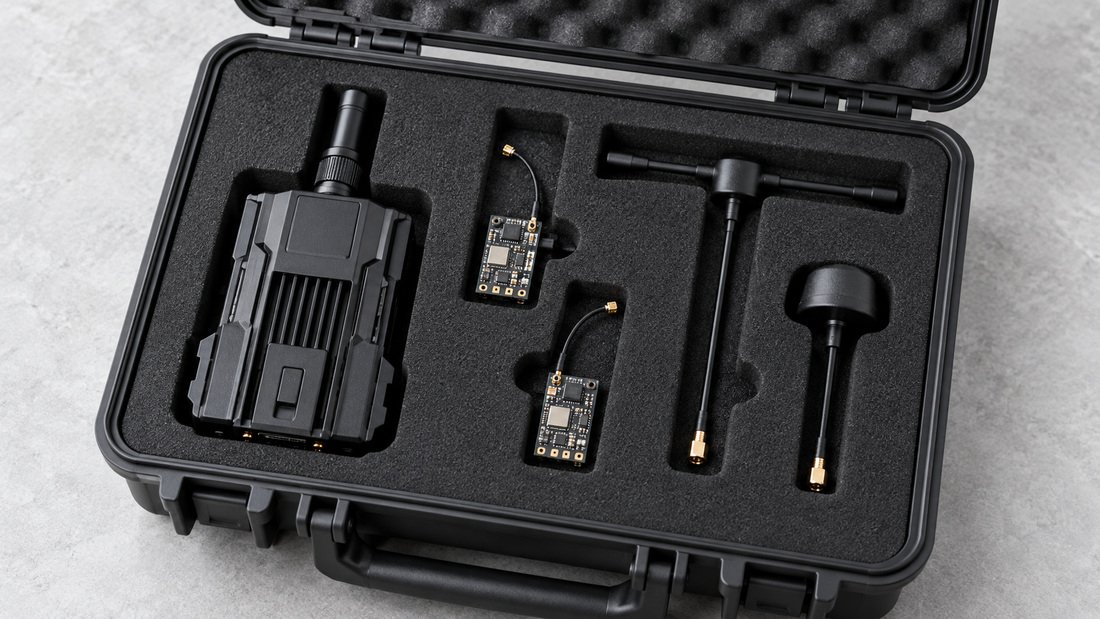
- Tier 2 — Housing and kit branding. Logo on the enclosure, custom printed shrink-wrap or sleeve, branded antenna and cable kits, branded carry case for school programs.
- Tier 3 — Firmware and configuration control. A fixed firmware version, a preset binding phrase convention, or a locked configuration so every unit in a club order behaves identically.
- Tier 4 — Hardware modification or new design. Different connector, altered layout, custom antenna tuning. This is ODM (original design manufacturer) territory and needs engineering review, prototypes and validation.
Most schools, clubs and distributors sit in Tiers 1 to 3. If a supplier describes Tier 4 as a quick add-on, treat that as a question to verify rather than a promise.
ELRS receiver vs transmitter module: what changes for branding?
Receivers and transmitter modules have different branding constraints because of their size and how they are mounted. Receivers are small, often shrink-wrapped or housed in a compact case, and frequently buried inside a frame. Transmitter modules sit in a visible bay on the back of a radio, so the branding is far more prominent.
| Factor | ELRS receivers (BKR) | ELRS TX modules (BKT) |
|---|---|---|
| Visible branding area | Small; label or housing face | Large; module face and connector bay |
| Typical branding method | Printed label, laser marking, shrink-wrap print | Laser marking or pad printing on enclosure |
| Packaging impact | High — small parts need anti-static bags and clear labeling | Higher — retail-style box is common |
| Firmware consistency priority | Very high — club fleets must bind predictably | High — one module may serve many receivers |
| Accessory kit potential | Antennas, cables, mounting hardware | Antennas, adapters, carry pouch |
| Typical buyer | Schools, clubs, integrators, distributors | Distributors, coaches, event organizers |
Neither column implies a fixed service level. Ask your supplier which methods they can actually run and request a physical sample of each before committing.
How should schools and drone soccer clubs specify branding?
Drone soccer programs have an unusual requirement: dozens of identical airframes, handled by students, repaired repeatedly, and often inventoried by a coach. Branding here is less about retail appeal and more about fleet management. A club logo on the receiver helps students and volunteers sort equipment quickly, and consistent packaging makes storage and handover easier.
When writing the brief, be specific about the operational problem. “We need 40 receivers that all bind the same way and are visually identifiable as team equipment” is a far better brief than “please put our logo on it.” The first sentence tells the supplier what to control; the second leaves them guessing.
Useful details to include: number of units per season, whether units are shared or assigned, who handles repairs, whether students re-bind receivers themselves, and how equipment is stored between sessions. These answers shape the firmware and labeling decisions more than any logo file.
What should distributors and integrators negotiate first?
Distributors and solution integrators usually need more than a logo; they need a product they can support, restock and differentiate. The first conversation should therefore be about repeatability: will the next batch match the last one in firmware, labeling and accessory content?
Integrators building systems for end clients also need to know whether a branded unit can be sold under their own name without conflicts, and whether documentation can carry their branding too. Ask directly whether the supplier offers private-label documentation, and confirm what happens if an end client asks the integrator for support.
For technical consistency, point your team at the ELRS receiver compatibility guidance so that branded units are matched to the radios and modules your customers actually use.
Branding options compared
There is no single best branding method; each has trade-offs in durability, cost and setup effort. The table below describes general characteristics you should verify against your supplier’s actual process.
| Method | Best for | Trade-offs to verify |
|---|---|---|
| Printed label / sticker | Small receivers, low-volume runs | Adhesive durability with heat and handling; alignment on curved surfaces |
| Laser marking | TX module enclosures, permanent identification | Contrast on dark plastics; setup cost per artwork |
| Pad printing | Multi-color logos on housings | Plate/tooling cost; minimum run practicality |
| Printed shrink-wrap or sleeve | Receivers with visible wrap | Print legibility at small size; wrap quality |
| Custom retail box | Distributor and retail channels | Packaging MOQ, artwork proofing, storage and shipping volume |
| Branded accessory kit | Schools and club bundles | Kit content consistency; sourcing of each accessory |
Ask for a sample of each method on the actual part you intend to order. A logo that looks crisp on a flat enclosure can smear on a small curved receiver label.
Firmware and configuration: the part buyers underestimate
For ELRS specifically, firmware behavior is part of the product experience. ExpressLRS is an open-source radio link project, and firmware versions and binding behavior matter to anyone supporting a fleet. Custom-branded units should therefore be specified with firmware in mind, not treated as a cosmetic exercise.
Decide whether you want a fixed firmware version locked for the order, a documented version your support team can reproduce, or a standard current release. Each choice has consequences: locking a version simplifies support but may need revisiting later; shipping the latest release reduces version drift but can surprise users mid-season.
Binding phrase conventions are equally important for clubs. If every receiver in a school order ships with the same phrase, students can swap units without re-binding; if each ships individually configured, the coach needs a record. Ask your supplier what they can control and how it is documented.
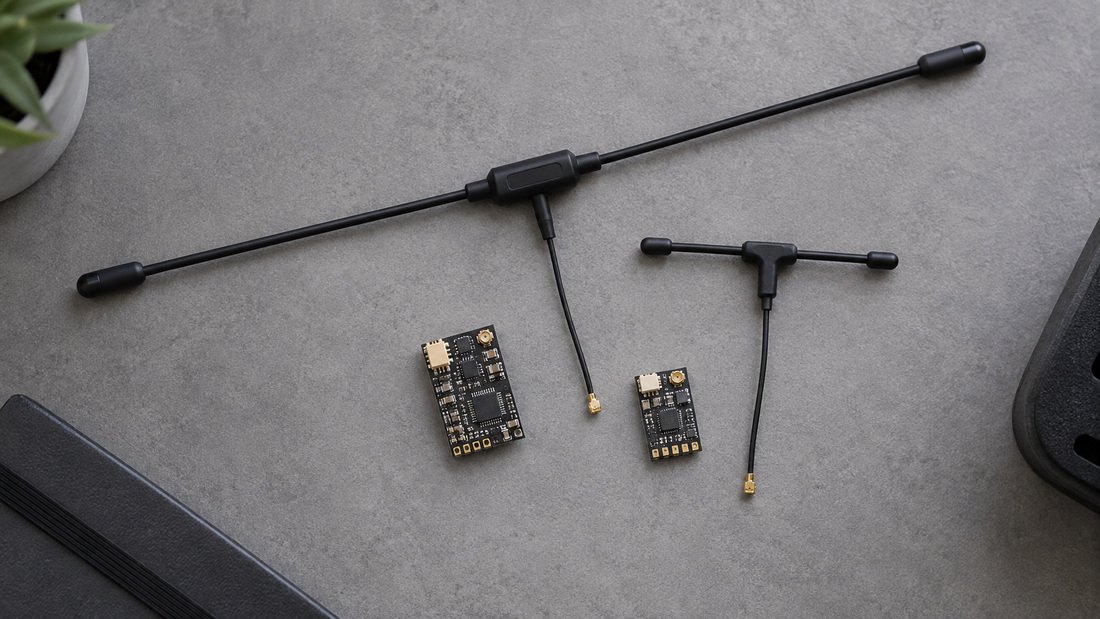
Antenna and RF choices also affect the bundle. If your branded kit includes antennas, review the RF antennas range and confirm what is packed with each unit.
Planning a branded fleet for a school, club or distribution channel? Send your logo files, target quantities and firmware requirements, and we will confirm what can be branded and what needs separate engineering review. Request an OEM / Wholesale Quote.
Common mistakes in custom ELRS orders
Most problems in branded orders are specification problems, not manufacturing problems. Buyers assume the supplier knows what “custom” means, and the supplier assumes the default. Avoid these patterns.
- Treating branding as design. Asking for a changed connector or layout in the same breath as a logo request, and expecting the same timeline.
- No artwork specification. Sending a low-resolution logo with no guidance on print size, color matching or placement.
- Ignoring firmware drift. Assuming batch two will match batch one without a written firmware commitment.
- Skipping physical samples. Approving artwork on screen only, then discovering the label is unreadable at actual size.
- Undefined packaging. Forgetting manuals, quick-start cards, anti-static bags and outer carton labeling.
- Verbal-only terms. Accepting MOQs, tooling costs or lead times in chat without a written confirmation.
Buyer checklist before you place a branded order
Use this checklist to turn a vague request into a brief a supplier can quote accurately. Items marked as verification points should be answered in writing, not assumed.
- Product scope: exact receiver and module models, quantities per SKU, and whether accessories are included.
- Branding tier: label only, housing, packaging, firmware control, or hardware modification.
- Artwork: vector file, color references, placement diagram and minimum print size for the actual part.
- Print method: which method for which part, with a physical sample requested per method.
- Firmware: fixed version or current release, binding phrase convention, and how the version is documented per batch.
- Packaging: box or bag type, manual language, anti-static protection, outer carton marks.
- Serialization: whether units can be individually numbered for school inventory.
- Commercial terms to confirm in writing: MOQ per SKU, sample cost and refundability, tooling or plate charges, payment terms, lead time, and what happens on reorders.
- Quality documentation: what inspection or test records are provided with the shipment, if any.
- Change control: how artwork or firmware changes are handled after the first order.
If any line is unclear, ask rather than infer. This article deliberately does not state DPF’s specific MOQs, lead times, tooling costs or warranty terms, because those must come from a current written quotation for your exact configuration.
How to evaluate a supplier’s OEM offer
Price per unit is the easiest number to compare and the least useful on its own. A branded ELRS program should be judged on repeatability and support: whether the second batch matches the first, whether documentation is clear, and whether the supplier answers technical questions about firmware and compatibility.
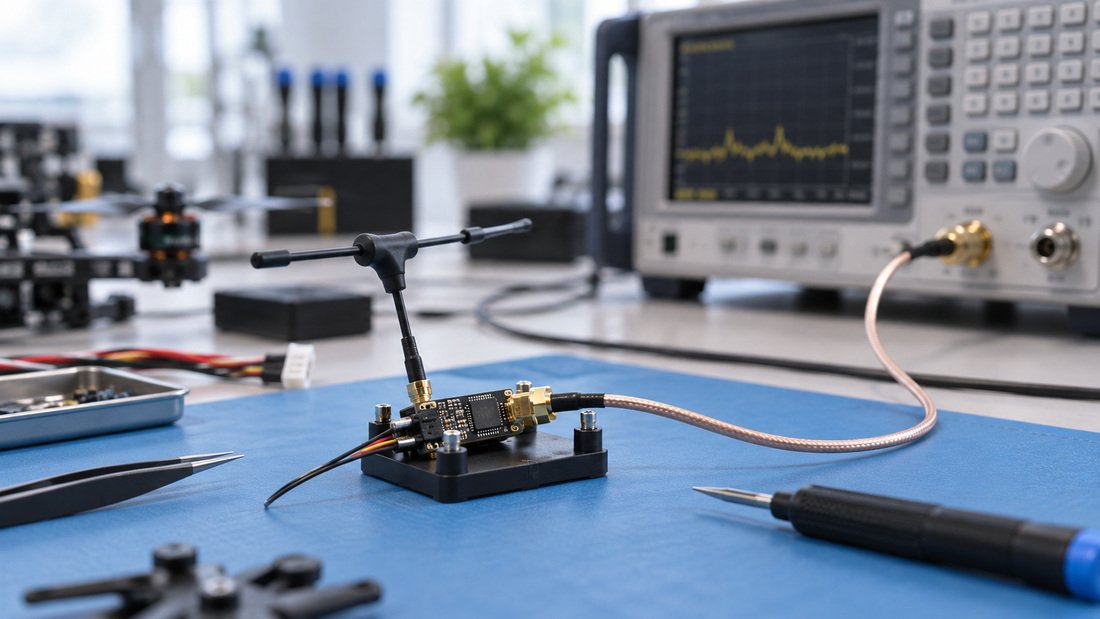
Ask for a sample of the branded unit, not just the unbranded product. Check the label or marking under normal handling, confirm the packaging protects the receiver, and test binding behavior against the radios your customers use. Where antennas are included, confirm the antenna type and connector match the intended build.
Finally, ask how the supplier handles a mixed order: several receiver variants plus modules plus antennas in one shipment. Consolidation affects packaging, carton labeling and inspection, and it is worth clarifying early.
Frequently asked questions
Can I order custom-branded ELRS receivers in small quantities?
Possibly, but small runs usually limit which branding methods are practical. Printed labels are more feasible at low volume than custom tooling or multi-color pad printing. Ask your supplier for the minimum per branding method, and confirm whether setup charges apply.
Is custom branding the same as a custom ELRS design?
No. Branding changes presentation: labels, housings, packaging and firmware configuration. A custom design changes the electronics, RF layout or mechanical interface, which requires engineering review, prototypes and validation. Be explicit about which you need.
Can the firmware be locked to a specific version?
This is a question for your supplier, and the answer should be in writing. Some buyers want a fixed version for fleet consistency; others prefer the current release. Confirm how the version is recorded and whether it can be held stable across reorders.
Can each receiver ship with the same binding phrase?
For school and club fleets, a shared binding phrase can simplify swapping units. Ask whether this is configurable, how it is documented, and what the default is if you do not specify. Do not assume a default matches your program’s workflow.
What artwork should I send?
Send a vector file where possible, plus color references and a placement diagram. Ask for the minimum legible print size on the actual part, and request a physical proof before full production.
Can packaging and manuals carry my brand?
Often requested, but confirm scope: box printing, insert cards, manual language and whether documentation is customized or standard. Clarify whether packaging has its own minimum quantity separate from the product.
Where can I check receiver compatibility before ordering?
Review the ELRS receiver compatibility guidance, then confirm the specific radio and module combinations your customers use. Compatibility questions are best answered before branding is finalized.
Conclusion and next step
Custom-branded ELRS receivers and transmitter modules are a practical OEM request when the scope is defined as branding, packaging and firmware configuration rather than hardware redesign. The work is in the specification: accurate artwork, a named branding method per part, a written firmware commitment, and a checklist that covers samples, packaging and reorder consistency.
Start with your quantities, logo files and firmware requirements, and ask for a written quotation that separates product, branding setup and packaging. That gives you a like-for-like basis to compare suppliers and a document you can hold them to. Request an OEM / Wholesale Quote to begin.