Quick summary
In the ELRS and broader FPV radio ecosystem, “Nano” and “Micro” TX modules are not one universal standard. The terms usually describe physical size classes of external transmitter modules, and the single most important difference for buyers is the RF connector: Nano modules typically use an SMA or RP-SMA connector for screw-on antennas, while Micro modules often use a small U.FL/IPEX-class connector for pigtails. Because brands apply the labels loosely, always confirm dimensions, connector type and pin layout before ordering.
Key Takeaways
- “Nano” and “Micro” are informal size labels, not a globally standardized specification.
- The antenna connector is the clearest practical difference: larger screw-on connectors versus miniature board connectors.
- External modules must match your radio’s bay and pin protocol; physical fit and electrical compatibility are separate questions.
- Smaller modules have less metal mass and surface area, so heat management and current draw deserve extra attention.
- For teams, buy one spare module and matching antenna per squad, and confirm connector, bay and pinout in writing with the supplier.
What “Nano” and “Micro” Usually Mean in Practice
There is no single standards body that defines a Nano TX module or a Micro TX module. In everyday use, these words refer to external transmitter modules that slot into a radio’s module bay, as opposed to the internal RF section built into the radio itself. The labels grew out of the FPV market, where manufacturers needed short names for different module shapes.
As a result, a “Nano” module from one brand may not share the same dimensions as a “Nano” from another. Treat the label as a starting hint, not a specification. The reliable approach is to compare the manufacturer’s dimensional drawing and connector listing against your radio’s bay documentation.
Before going further, it helps to distinguish the module from the rest of the chain. The module is the transmitter that generates the RF signal; it then feeds an antenna and talks to matching receivers on the aircraft. Related components are described in our overview of ELRS and RF systems.
Nano vs Micro TX Modules: Direct Comparison
This table summarizes the general patterns buyers encounter. It is a guide to what to verify, not a guaranteed product specification, because individual products vary by brand and generation.
| Attribute | Typical “Nano” module | Typical “Micro” module |
|---|---|---|
| Antenna connection | SMA or RP-SMA, screw-on antenna | U.FL/IPEX-class, usually via pigtail |
| Antenna swapping | Easy in the field, no case opening | Requires opening the case or using a pigtail |
| Module bay fit | Often larger JR-style bays | Often smaller, compact bays |
| Heat dissipation | More surface area for passive cooling | Less area, more reliant on airflow or firmware limits |
| Weight and balance | Heavier, can change radio balance | Lighter, less effect on handling |
| Field serviceability | Antenna and module easy to swap | Connector care matters, delicate to service |
| Typical use | Ground-station and larger radios | Compact radios and travel setups |
Notice that none of these rows describes transmit power or range. Power and range depend on the specific module design, firmware settings, antenna choice and local conditions, and they should be confirmed per product rather than inferred from the Nano or Micro label.
Why the Antenna Connector Is the Real Decision Point
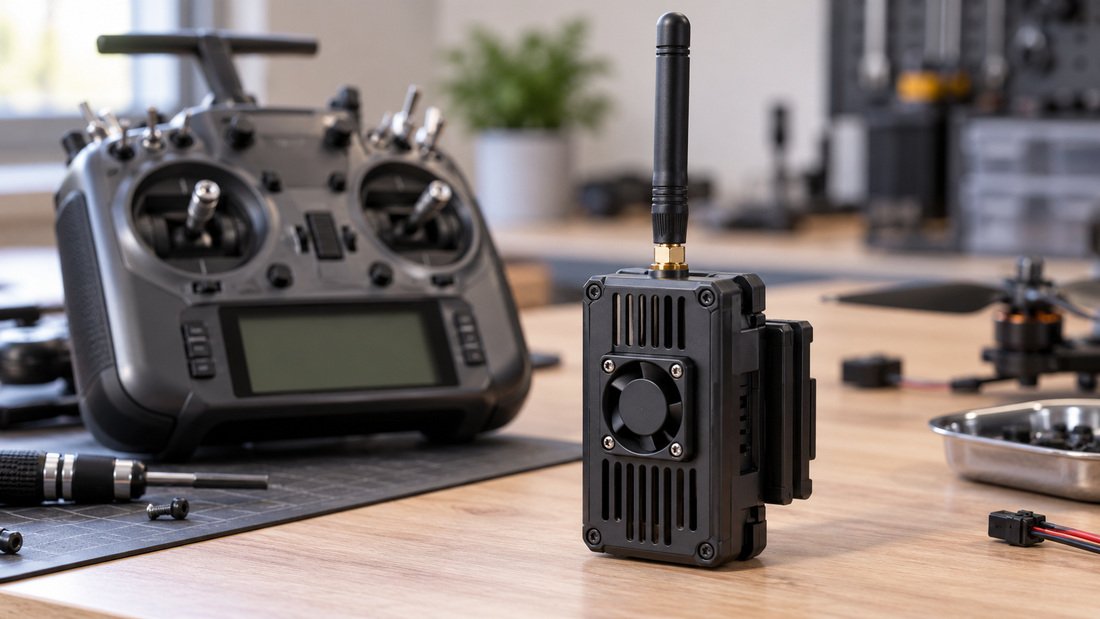
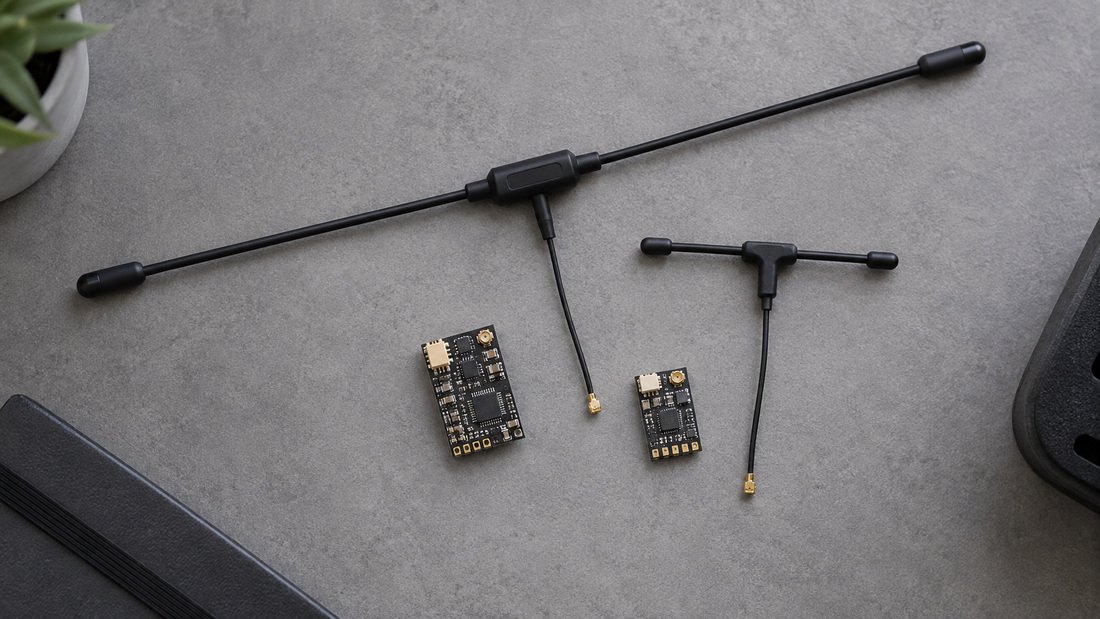
If you remember one thing from this article, make it this: the antenna connector type determines what antennas you can use, how quickly you can swap them, and how much stress the connection can take. Nano modules with SMA or RP-SMA connectors let a coach or team manager change antennas between sessions without tools. Micro modules with miniature board connectors usually need an adapter pigtail, and that pigtail becomes the weakest mechanical point in the chain.
Connector naming is also a frequent trap. SMA and RP-SMA look similar but have opposite gender on the center pin and housing. Fitting the wrong one damages the connector. Miniature board connectors have their own mating-cycle limits and are not designed for repeated plugging, so a strain-relieved pigtail is common practice.
Antenna choice also interacts with frequency band and polarization. A module that meets your connector and bay requirements but is paired with a mismatched antenna will not perform as expected. Our RF antennas category shows the range of connector and band options you may need to match.
Bay Fit and Pin Compatibility Are Two Different Checks
A module can slide into a bay and still not work. Physical fit concerns dimensions, rails and retaining screws. Electrical compatibility concerns the pin protocol the radio expects on its bay. These are separate checks, and passing one says nothing about the other.
Some radios accept external modules on a defined serial protocol; others expect a different arrangement or supply different voltages on specific pins. The safe method is to read your radio’s bay documentation and the module’s pinout, then compare them pin by pin. If a supplier cannot provide a clear pinout diagram, that is a reason to pause the purchase.
Heat, Power and Reliability in Team Use
Drone soccer practices and school sessions can run for hours with many transmitters active at once. Compact modules concentrate the same electronics into a smaller body, which reduces the area available to shed heat. Whether that matters depends on the module’s design, its power settings and the airflow around it.
Rather than assuming, verify with the supplier: what cooling approach the module uses, whether the enclosure is metal or plastic, and what the manufacturer says about continuous operation. Then test your own worst case, such as a full practice session in a warm gym, and watch for throttling, dropouts or warm connectors.
For clubs standardizing on one configuration, consistency matters more than peak numbers. A squad where every pilot uses the same module and antenna is far easier to troubleshoot than a mixed fleet. That is also easier to support over a season.
Planning a team or school fleet? Tell us your radio models, expected squad size and session length, and we can help you shortlist compatible ELRS transmitter modules and antennas. Request a Team Kit Quote.
Does Module Size Affect Range or Link Quality?
Size alone does not determine range. Link quality is a system result: transmitter output and settings, receiver sensitivity and antenna installation on the aircraft, antenna polarization on both ends, RF noise in the environment, and how the aircraft is oriented in flight. A larger module gives you more room for connectors, cooling and sometimes more RF hardware, but a well-matched small module can outperform a poorly installed large one.
This is especially relevant for drone soccer, where aircraft fly close to the ground, turn sharply and sometimes pass behind obstacles. Antenna placement on the airframe and receiver choice often matter more than the module label. If you are matching modules to airframes, our ELRS receivers range and the ELRS receiver compatibility guidance are useful starting points.

Common Mistakes When Choosing Nano or Micro Modules
- Assuming the label is a standard. Buying a “Nano” module for a friend’s “Nano” bay without checking dimensions and pinout.
- Mismatching antenna connectors. Forcing an RP-SMA antenna onto an SMA port, or the reverse, and damaging both.
- Ignoring the pigtail. On compact modules, a cheap or strained adapter pigtail can become the failure point.
- Confusing fit with function. Treating a module that physically slots in as automatically compatible.
- Overlooking cooling. Running compact modules at high settings in enclosed bays without airflow.
- Mixing configurations across a team. Making it hard to diagnose problems and to keep spares consistent.
Buyer Checklist for Clubs, Schools and Distributors
- List every radio model in your fleet, including the exact bay type and the pin protocol stated by the radio manufacturer.
- Record the antenna connector on each existing module and antenna so you can keep spares interchangeable.
- Confirm module dimensions from a manufacturer drawing, not from a product photo or the Nano/Micro label.
- Ask the supplier to state the bay type, pin compatibility, antenna connector and enclosure material in writing.
- Ask how the module manages heat and whether the manufacturer specifies any limits for continuous use.
- Decide your team standard: one module family and one antenna family across the squad.
- Order a small trial quantity first, test a full session, then scale to the fleet.
- For any commercial terms such as pricing, minimum order, lead time, samples or warranty, request a written quotation. These vary and should not be assumed.

Frequently Asked Questions
Is a Nano TX module always bigger than a Micro TX module?
Usually yes, but not by rule. These are informal labels. Compare the manufacturer’s dimensions rather than trusting the name.
Can I use the same antenna on a Nano and a Micro module?
Only if the connectors match. Nano modules commonly use SMA or RP-SMA, while Micro modules often use a U.FL/IPEX-class connector via a pigtail. Check both ends of the connection.
Will a Nano module fit my radio’s Micro bay?
Not necessarily. Bays differ in width, rails and retention. Physical fit does not guarantee electrical compatibility either, so verify the pinout as well.
Do smaller modules transmit less power?
Not automatically. Output power is a design choice confirmed per product specification, not a function of the size label. Ask the supplier for the stated configuration.
Which is better for drone soccer teams?
Neither is universally better. Choose based on your radio bays, antenna strategy, session length and how easily you can source consistent spares for the whole squad.
How should we handle heat with compact modules?
Ask the manufacturer about cooling design and any continuous-operation guidance, keep bays ventilated where possible, and test a realistic full-length session before committing the fleet.
Can Drone Parts Factory supply a mixed kit for our club?
We supply ELRS transmitter modules and related RF parts for clubs, schools and distributors. Share your radio models and squad size, and we will confirm what is available and provide a written quote.
Conclusion
The difference between Nano and Micro TX modules is mostly physical: bay size, antenna connector and how the module handles heat and servicing. Because the labels are informal, the practical buying process is to verify dimensions, bay type, pin compatibility and antenna connector for each specific product rather than choosing by name.
For clubs, schools and distributors, the winning strategy is consistency, a clear compatibility checklist and a small trial order before scaling. Start by reviewing our ELRS transmitter modules, then tell us your radio models and expected squad size so we can confirm compatibility and commercial terms in writing.