Quick summary
A stack is a separate flight controller and electronic speed controller (ESC) connected by a cable or pin header, while an all-in-one (AIO) board integrates the flight controller and ESC — and sometimes a video transmitter or receiver — on one printed circuit board. Stacks suit repair-heavy team fleets and higher current builds; AIO boards simplify wiring and reduce weight for small drones and drone soccer airframes. The right choice depends on your fleet size, repair workflow, and budget.
Key Takeaways
- A stack separates the flight controller from the ESC. You can replace one failed board without discarding the other, which matters for club repair benches.
- An AIO board combines functions on a single PCB. Fewer cables and connectors mean faster builds and less weight, but one failure can take down multiple functions at once.
- Current rating and mounting pattern are the first things to verify. A stack or AIO must match your motor current draw, frame mounting holes, and firmware target.
- For team fleets, repair logistics often outweigh initial price. Standardizing on one format and documenting firmware targets saves bench time across a season.
- Request written specifications before ordering. Continuous current, burst current, firmware target, connector types, and spare-part availability should be confirmed by the supplier, not assumed from a product photo.
Drone soccer programs, school STEM labs, and FPV racing clubs all face the same practical question when specifying a new airframe: should the electronics be a stack or an AIO board? The answer is not universal. It depends on the size and weight of the aircraft, how often students crash and repair it, and how you want to manage spare parts across a fleet.
What Is a Flight Controller Stack?
A flight controller stack is two or more separate boards mounted together, usually with silicone grommets and nylon standoffs. The flight controller runs the firmware and reads sensors such as the gyroscope and accelerometer. The ESC converts those commands into motor power. Betaflight is the software that runs on the flight controller: it “reads the sensors (gyro, accelerometer, GPS, etc…), computes the desired actions to take, sends the commands to the ESC to control the motors” (Betaflight documentation).
Because the two boards are separate, a stack gives you modular repair. If an ESC burns out after a motor stall or a crash, you replace the ESC board and keep the flight controller. If the flight controller fails, you keep the ESC. For a school or club with a busy repair schedule, that modularity can reduce total cost of ownership even when the initial stack price is higher than an AIO board.
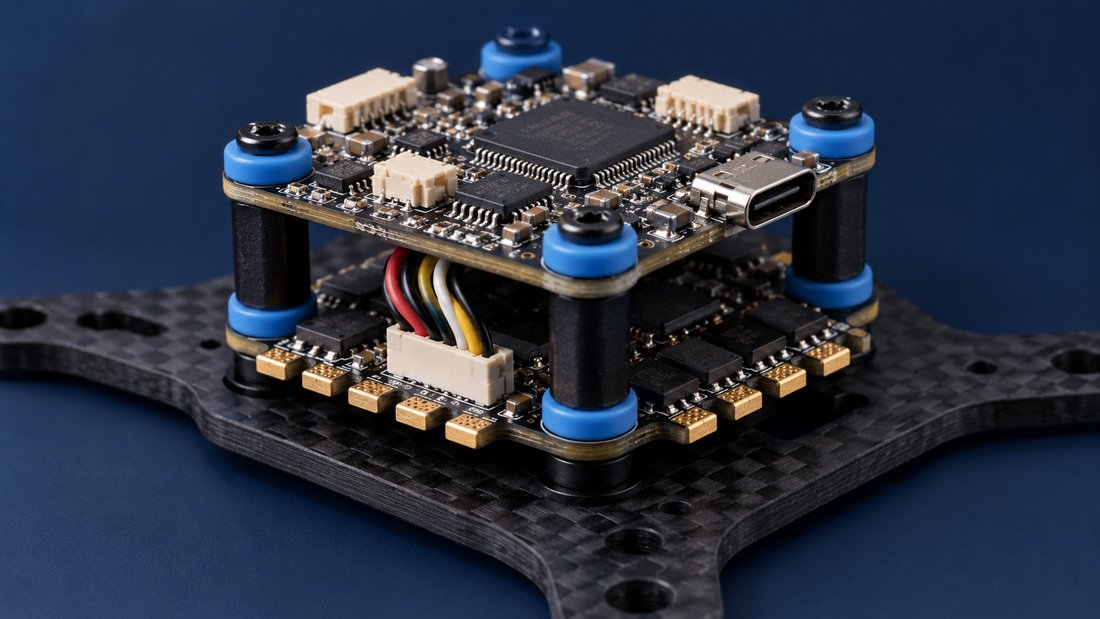
Stacks also tend to offer more headroom for higher current builds. Separate ESC boards can carry larger MOSFETs and more copper, which helps when a heavy 5-inch freestyle quad or a payload-carrying drone soccer platform pulls high current. The stack format also makes it easier to mix and match: a flight controller from one supplier with an ESC from another, as long as the pinout and firmware support match.
When a Stack Makes Sense
- Your team repairs frequently and wants to replace only the failed board.
- Your aircraft draws current above what a small AIO board can handle.
- You want to standardize on a firmware target and reuse spare ESCs across multiple airframes.
- You need to test different ESC or flight controller combinations during development.
What Is an AIO Board?
An AIO board integrates the flight controller and ESC on one printed circuit board. Many AIO boards also include a video transmitter, a receiver, or both. This reduces the number of solder joints, cables, and connectors in the build. On a small drone soccer airframe or a tiny whoop, that matters: less wiring means less weight, fewer failure points, and faster assembly.
AIO boards are popular in compact builds because they simplify the bill of materials. Instead of ordering a flight controller, an ESC, a power distribution board, and a video transmitter separately, a team can order one board and a set of motors. For schools that build many identical drones, that simplification can shorten build days and reduce inventory confusion.
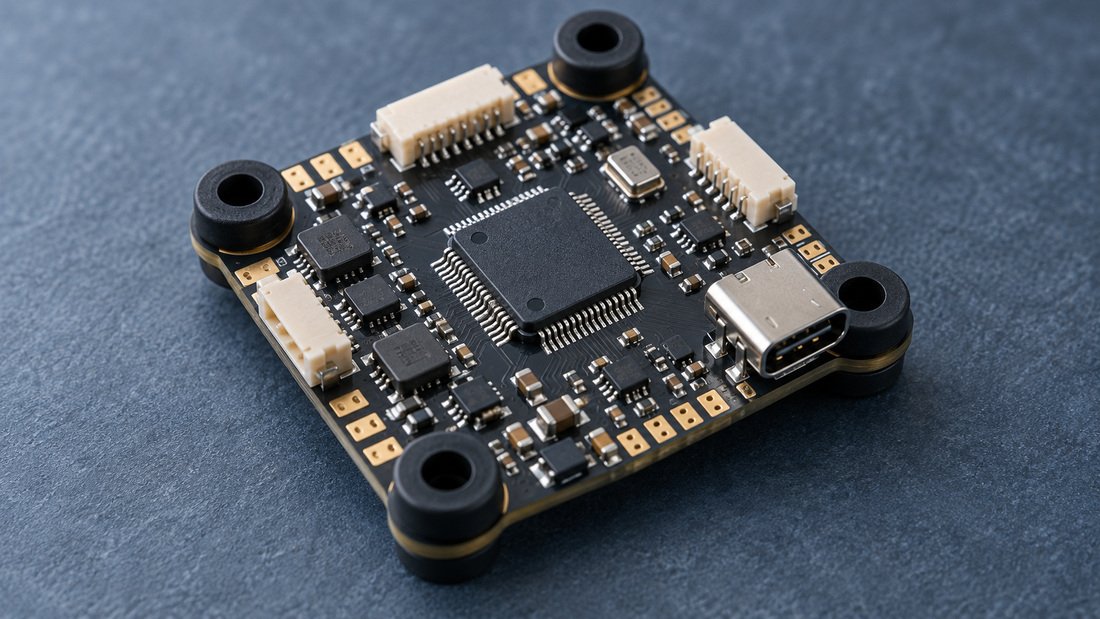
The trade-off is repairability. If one function on an AIO board fails — say, a single ESC channel — you may need to replace the entire board. That can be more expensive per repair than swapping one board in a stack. AIO boards also tend to have lower continuous current ratings than separate ESCs of similar size, because heat is concentrated on one PCB.
When an AIO Board Makes Sense
- Your airframe is small and weight-sensitive, such as a drone soccer ball or a sub-250 g trainer.
- You want the shortest possible build time for new students.
- Your current draw is within the board’s confirmed continuous rating.
- You prefer a single spare part rather than a shelf of separate boards.
If your program is standardizing spare parts across a fleet, it helps to review the full FPV electronics range before committing to one format. The same logic applies to flight controllers, electronic speed controllers, and video equipment.
Stack vs AIO Board: Comparison Table
The table below summarizes general differences. Actual specifications vary by product, so confirm every row against the supplier’s written datasheet before ordering.
| Factor | Stack (separate FC + ESC) | AIO board |
|---|---|---|
| Integration | Two or more boards; requires cable or pin header | One PCB; functions combined |
| Repair approach | Replace only the failed board | Often replace the whole board |
| Weight and build time | More wiring and mounting hardware | Fewer wires; faster assembly |
| Current headroom | Generally higher with larger separate ESCs | Generally lower due to concentrated heat |
| Spare parts | More SKUs to stock, but granular | Fewer SKUs, but each is more expensive |
| Typical use | 5-inch racing and freestyle, larger drone soccer frames | Small whoops, compact drone soccer airframes, trainers |
| Upgrade path | Swap FC or ESC independently | Replace the entire board |

How Firmware and Protocol Support Affect the Choice
Both stacks and AIO boards usually run Betaflight or a similar firmware. The documentation notes that Betaflight has become the de-facto standard, with “nearly every flight controller out there” having a Betaflight target, and it supports receiver protocols including CRSF, Ghost, FPort, SBUS, and Spektrum, plus ESC protocols such as DShot (Betaflight documentation). That broad support means a team can often standardize on one firmware and one radio protocol across a mixed fleet.
What matters for procurement is whether the specific board you buy has a maintained firmware target. A stack or AIO board without a supported target can become difficult to update. Before ordering, ask the supplier to confirm the firmware target name and the receiver and ESC protocols supported. If they cannot provide that in writing, treat it as an open question and verify with the manufacturer’s documentation.
This is also where video systems come in. If your team uses analog or digital video, the flight controller must support the relevant OSD and wiring. Review your FPV video receivers and recording options alongside the flight controller so the whole video chain is compatible.
Common Mistakes When Choosing Between a Stack and an AIO
- Buying on price alone. A cheaper AIO board that fails after one crash can cost more than a stack over a season.
- Ignoring current ratings. Always compare the board’s confirmed continuous current rating to your motor’s expected draw.
- Mixing mounting patterns. Confirm hole spacing and board dimensions before ordering, especially for 25.5 × 25.5 mm and 30.5 × 30.5 mm patterns.
- Forgetting spare parts. For a team fleet, order spares of the exact board you standardize on, not a similar-looking substitute.
- Assuming firmware compatibility. Check the target and protocol support in writing before purchase.
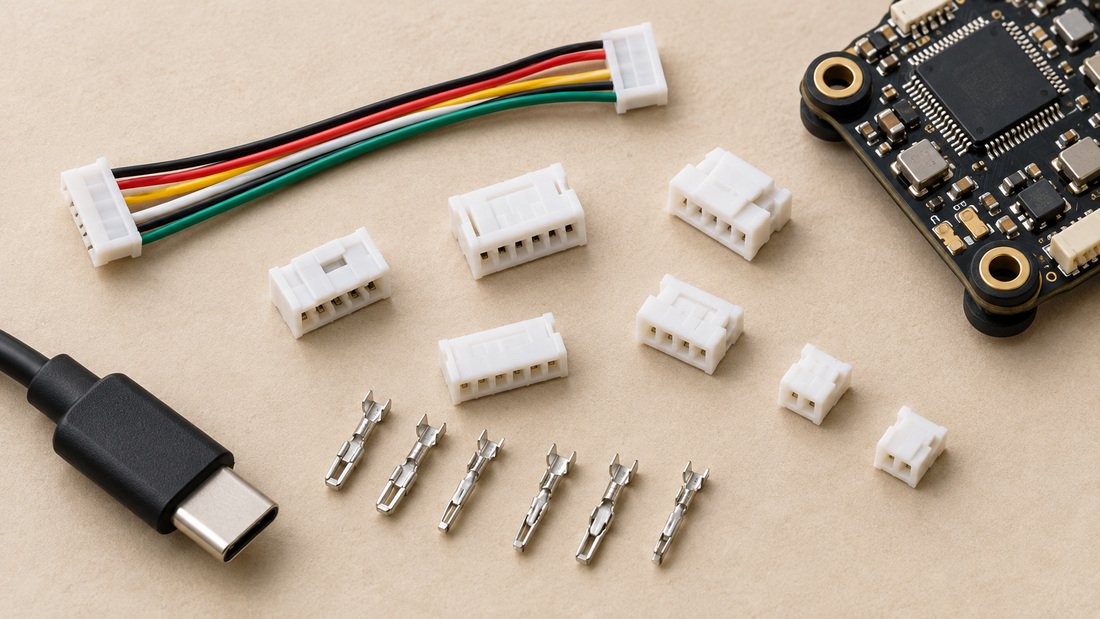
- Overlooking connector types. Motor plugs, battery leads, and receiver connectors must match your existing build.
Buyer Checklist for Teams and Schools
Use this checklist before you request a quote. It separates what you can decide internally from what you must confirm with the supplier.
- Airframe size and weight: Record the frame’s mounting pattern and target all-up weight.
- Motor current draw: Estimate continuous and burst current per motor, then multiply by four.
- Firmware target: Ask the supplier to confirm the target and supported receiver and ESC protocols.
- Connector compatibility: List motor plug type, battery connector, and receiver wiring.
- Repair workflow: Decide whether your bench can replace a single board or must replace a whole AIO.
- Spare parts plan: Decide how many spare boards per 10 aircraft you want to stock.
- Documentation: Request pinout diagrams, wiring diagrams, and firmware setup notes.
- Warranty and returns: Ask for the supplier’s written warranty terms and return process.
- Lead time and MOQ: Confirm in writing for your order quantity and destination.
- Compliance: Check any radio, battery, or shipping regulations that apply in your country; do not assume rules from another region apply to you.
For programs that record flights for coaching or insurance purposes, plan the FPV DVR or onboard recording solution at the same time as the flight controller decision, because wiring and power routing are easier to plan together.
Cost and Total Cost of Ownership
The sticker price of an AIO board is often lower than a comparable stack, but total cost of ownership depends on failure rates and repair labor. If a team replaces three AIO boards in a season but would have replaced only three separate ESCs with a stack, the stack may be cheaper overall. Conversely, if a school builds 30 identical small drones and rarely crashes them hard, the AIO board’s faster build time may dominate.
There is no universal answer. The useful exercise is to model your own season: estimate crashes, estimate which component usually fails, and ask what each repair costs in parts and bench time. Request current pricing, spare-part availability, and any volume terms in writing from your supplier before you compare.
Planning a team fleet? Talk to our team about matching flight controllers and ESCs to your drone soccer or STEM program.
Frequently Asked Questions
Is an AIO board always lighter than a stack?
Usually yes, because integration removes cables, connectors, and mounting hardware. But the difference depends on the specific boards and frame. Weigh the confirmed component weights rather than assuming.
Can I use a stack on a small drone soccer airframe?
Sometimes, if the frame has enough mounting space and the stack’s weight is acceptable. Many compact airframes favor AIO boards, but the decision should be based on confirmed dimensions and weight.
Which is better for beginners?
AIO boards are often easier to build because there are fewer solder joints. Stacks can be easier to repair, which may suit a school that wants students to learn troubleshooting. Neither is universally better.
Do stacks and AIO boards run the same firmware?
Both commonly run Betaflight or similar firmware. The key question is whether the specific board has a maintained firmware target and supports your receiver and ESC protocols. Confirm this in writing with the supplier.
How do I choose the right current rating?
Estimate the continuous and burst current your motors will draw, then choose a board with a confirmed rating above that. If the supplier does not publish a clear rating, ask for it before ordering.
Can I mix a flight controller from one brand with an ESC from another?
Often yes, if the pinout, connector type, and firmware protocols match. This is a common reason teams choose stacks. Verify wiring and protocol compatibility before purchase.
What should I ask for in a quote?
Ask for the board’s firmware target, current ratings, mounting pattern, connector types, spare-part availability, warranty terms, lead time, and minimum order quantity. Get these in writing so you can compare suppliers fairly.
Conclusion
The difference between a stack and an AIO board comes down to integration versus modularity. A stack separates the flight controller and ESC, which favors repairability and higher current builds. An AIO board combines functions on one PCB, which favors light weight, simple wiring, and fast assembly. For drone soccer teams and school programs, the best choice is the one that matches your airframe, your repair workflow, and your spare-parts plan.
Before you order, confirm firmware targets, current ratings, connector types, warranty terms, and lead times in writing. Those details matter more than a product photo. When you are ready to equip a team, Request a Team Kit Quote and our team can help you compare options against your fleet requirements.