Quick summary
Drone soccer is played on a rectangular court roughly the size of a small school hall. In the widely used competition format, the field is about 20 m (65 ft) long and 10 m (33 ft) wide, with a goal at each end. Exact dimensions vary by league and age group, so organizers should confirm the current rulebook from their governing body.
Key Takeaways
- Typical full-size drone soccer courts measure around 20 m × 10 m (about 65 ft × 33 ft), but league and age-group rules can differ.
- The field is divided by a center line and a no-fly zone near each goal; players must learn these boundaries before playing.
- Goals are usually suspended rings or hoops at each end, with height and ring diameter set by the competition rulebook.
- Schools and clubs can often start with a smaller practice layout, then scale to full competition size.
- Confirm local regulations for indoor or educational drone flight before setting up a field.
Drone soccer (also called drone ball or drone football) is a team sport where small, enclosed drones fly inside a protective cage. Teams try to score by flying through the opponent’s goal ring. Because the drones are caged, the sport is popular in schools and youth programs as a safer introduction to drone skills. For an overview of the equipment and formats, see drone soccer systems.
What are the basic drone soccer rules?
At its core, drone soccer rules and basics are simple: two teams fly caged drones in a defined court and attempt to pass through or hit a goal ring to score. The exact rules are set by the league or competition organizer, so treat the summary below as general guidance, not an official rulebook.
Teams and players
Teams are usually made up of several players, with a defined number of drones active at once. Substitutions and player roles vary by league. Age brackets often determine drone size, motor power and field size so that younger players compete safely.
Scoring and match structure
Matches are typically played in short periods, with points awarded for flying through the goal ring. Some formats use a single ball or ring; others use a double-ball format. The organizer’s rulebook defines match length, tie-breakers and penalties. Ask your league for the current written rules before your first event.
Safety and conduct rules
Players usually must stay outside the field during active play, and drones must remain within the court boundaries. Protective cages, prop guards and a clear flight area are standard. Referees enforce boundary, contact and restart rules. For event-level guidance, see drone soccer competitions.

How big is a drone soccer field?
Most competition drone soccer fields are around 20 m long and 10 m wide (about 65 ft × 33 ft). This is a general baseline used in many league formats; the exact size can change with age group, venue and rulebook. Confirm the official dimensions from your governing body before buying or marking a permanent court.
Typical field layout
A standard layout includes a center line, a center circle, and a no-fly zone in front of each goal. Goal rings are suspended at each end. The court is usually marked on a flat indoor floor, but some outdoor or temporary setups exist. A clear perimeter is important for player and spectator safety.
Age-group variations
Youth and beginner leagues sometimes use smaller courts or a shorter field to keep play manageable. Because dimensions affect drone speed, battery choice and match pace, ask the league for the field diagram that matches your players’ age group. If you are equipping a school program, see STEM drone education and training.
Drone soccer field size comparison
The table below is an illustrative planning guide, not an official rulebook. Use it to compare layout options, then verify exact numbers with your league.
| Layout type | Approximate length | Approximate width | Typical use |
|---|---|---|---|
| Full competition court | About 20 m (65 ft) | About 10 m (33 ft) | Official league and tournament play |
| Smaller youth / practice court | Shorter than full size | Narrower than full size | Beginners, younger age groups, limited venues |
| Temporary school setup | Depends on hall size | Depends on hall size | PE classes and demonstrations |
What else affects field size?
Ceiling height, floor surface, spectator space and drone size can all affect whether a court fits a venue. Before booking a hall, measure both floor and ceiling clearance. The competition rulebook may also require a minimum safety buffer around the court.
What equipment does a drone soccer field need?
A drone soccer setup usually includes the court markings, two goal rings, caged drones, controllers, batteries and charging equipment, plus safety barriers. The exact list depends on whether you are running practice sessions or official matches.
Court and goals
Goal rings and their supports are usually specified by the league. Check ring diameter, height and mounting method with the organizer. Many venues use floor tape or temporary markings rather than permanent paint, which helps schools reuse halls for other activities.
Drones and radio equipment
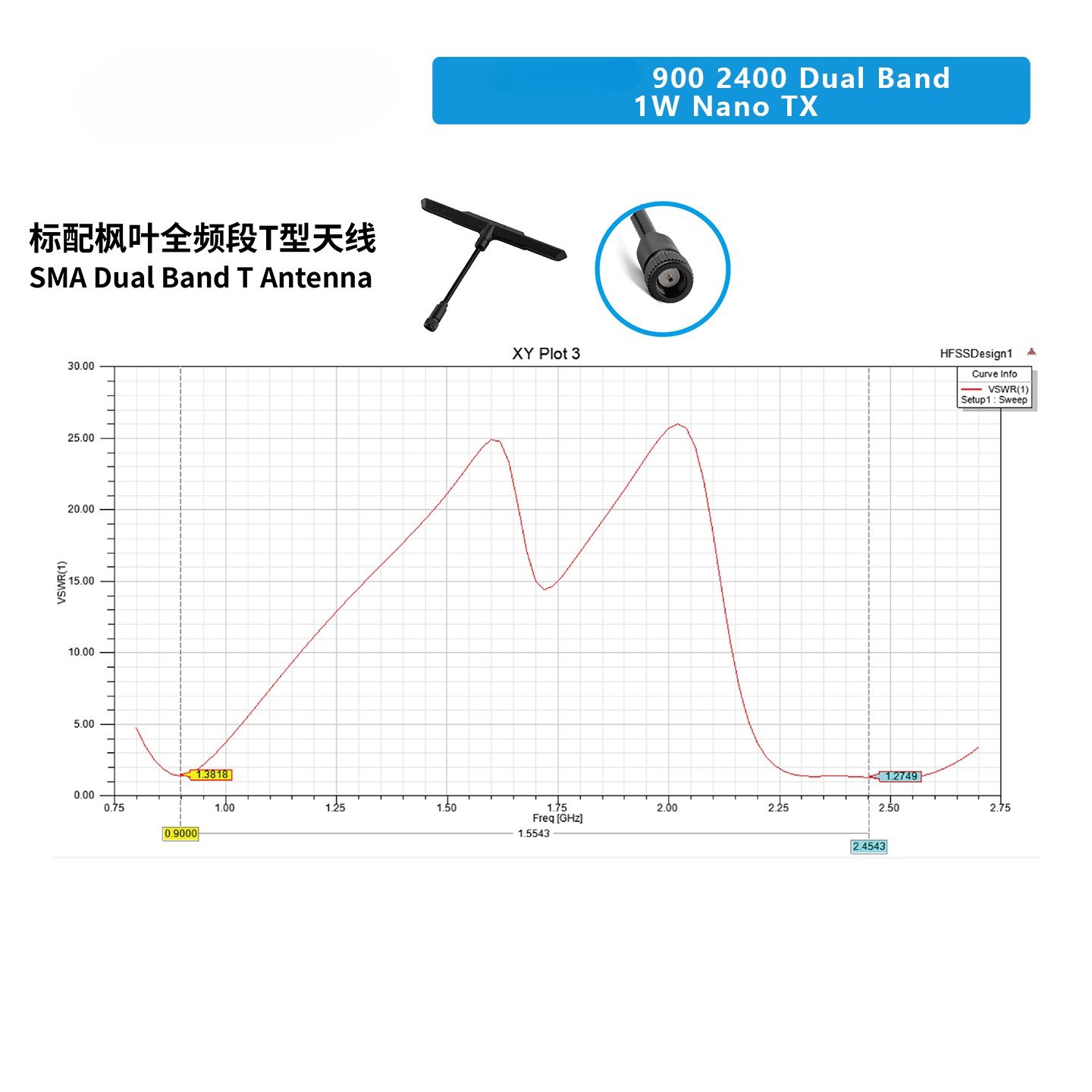
Drone soccer drones are small and enclosed in protective cages. Radio control equipment must be reliable in a crowded indoor environment. For teams and organizers, the selection of transmitters and receivers is part of the kit planning conversation. See the image of a dual-band transmitter module below as an example of the type of radio hardware involved.
Safety and spectator equipment
Barriers, signage and a first-aid point are common at events. Check with the venue and your league for specific safety requirements. Schools may also need to confirm insurance and supervision ratios.
Drone soccer rules and basics for schools and clubs
Schools and clubs often start with a practice court and a small fleet, then expand to competition formats. The main planning questions are space, supervision, equipment budget and how to store and charge batteries safely.
For program-level guidance, see schools and training organizations and drone soccer clubs.
Regulatory considerations
In the United States, the FAA notes that drones flown for educational purposes are regulated under the Exception for Limited Recreational Operations (49 U.S.C. § 44809) or under the Small Unmanned Aircraft Systems Rule (Part 107). Qualifying educational organizations include institutions of higher education, JROTC programs, and educational programs chartered by an FAA-recognized Community Based Organization. Other organizations may need to operate under Part 107. See the FAA educational users page for details.
The FAA also notes that educational institutions can request a FAA-Recognized Identification Area (FRIA), a location where drones can be flown without Remote ID. Rules differ outside the US, so confirm local requirements before setting up a field.
Procurement checklist for a drone soccer field
Use this checklist to plan your purchase and setup. Ask suppliers to confirm each item in writing.
- Court dimensions required by your league or age group, with a field diagram.
- Goal ring size, height and mounting method.
- Number of drones and controllers needed for your team size and format.
- Battery quantity, charger type and spare parts plan.
- Radio equipment compatibility and frequency planning for your venue.
- Safety barriers, signage and storage cases.
- Venue ceiling height and floor clearance.
- Regulatory and insurance requirements for your location.
- Training and support options for coaches.
- Commercial terms: pricing, shipping, payment and after-sales support in writing.
For unverified commercial terms such as pricing, lead times, minimum order quantities or warranty, ask the supplier to confirm in writing before ordering. Do not rely on general statements.
Common mistakes when setting up a drone soccer field
- Assuming one size fits all. League rules and age groups can change court dimensions.
- Forgetting ceiling height. Indoor flight needs vertical clearance as well as floor space.
- Not checking regulations. Educational and recreational flight rules vary by country and organization type.
- Underestimating charging and storage. Battery safety planning is part of field setup.
- Buying drones before confirming the rulebook. Equipment must match the format your league uses.
Frequently asked questions
What is the official size of a drone soccer field?
There is no single worldwide size. Many competition formats use a court of about 20 m by 10 m, but the official dimensions are set by the governing league or organizer. Confirm with your league’s current rulebook.
Can a drone soccer field fit in a school gym?
Often yes, but check both floor dimensions and ceiling height. A full competition court needs a large hall; schools sometimes start with a smaller practice layout.
How high are the goal rings?
Goal ring height and diameter are set by the competition rulebook. Ask the organizer for the current specification before purchasing or building goals.
Do drone soccer fields need special flooring?
A flat, clean indoor floor is typical. Some venues use temporary markings so the hall can be used for other activities. Check the league rules for any surface requirements.
Is drone soccer safe for beginners?
The caged drone design and defined court boundaries are intended to reduce risk, but safe supervision, protective equipment and venue rules still matter. Follow your league and local safety guidance.
What regulations apply to school drone soccer?
It depends on your country. In the US, the FAA explains that educational flights may fall under 49 U.S.C. § 44809 or Part 107 depending on the organization. Review the FAA educational users guidance and local rules.
How many drones does a team need?
Team size and active drone count vary by league and format. Confirm the required number with the organizer, then add spare drones and batteries for practice and repairs.
Conclusion and next step
Drone soccer rules and basics come down to a defined court, clear goals, caged drones and a rulebook from your league. Most competition fields are around 20 m by 10 m, but always confirm the exact size and equipment list with your organizer before you buy. Once you know the format, you can plan a kit that fits your venue, age group and budget.
Ready to equip your team? Request a Team Kit Quote and tell us your field size, player age group and league format so we can help you plan.