Quick summary
Yes, many drone soccer OEM and ODM suppliers can customize firmware and flight modes, but the scope and process vary widely. Customization may range from simple parameter tuning and mode presets to deeper firmware changes, depending on the supplier’s engineering capability and your order volume. For importers, distributors, and solution integrators, the key is to clarify what is truly customizable versus what is fixed by the flight controller platform. This article explains the options, trade-offs, and what to confirm in writing before committing to a drone soccer OEM and ODM project.
Key Takeaways
- Firmware and flight mode customization is common in drone soccer OEM/ODM, but depth varies from parameter presets to full code changes.
- Customization is often tied to order volume and engineering resources; request clear documentation of what is included.
- Flight modes for drone soccer typically include manual, altitude hold, and game-specific modes; customization can align with league rules.
- Always verify firmware version control, update procedures, and intellectual property terms in writing.
- Request samples and test reports to confirm that custom firmware meets your performance and safety expectations.
What Does Firmware and Flight Mode Customization Mean in Drone Soccer?
In drone soccer, firmware and flight mode customization refers to modifying the drone’s onboard software to change how it flies, responds to controls, and handles game situations. Flight modes are pre-programmed control schemes, such as manual mode for full pilot control or altitude hold for stabilized hovering. Customization can involve adjusting parameters like PID (proportional-integral-derivative) values, throttle curves, and failsafe behavior, or adding game-specific features like ball detection or team color indicators.
For OEM/ODM buyers, the goal is often to create a drone that meets specific league regulations, improves player experience, or differentiates a product line. However, not all suppliers have the engineering depth to modify firmware. Some rely on open-source platforms and only offer parameter tuning, while others develop proprietary firmware. Understanding these distinctions is essential for procurement.
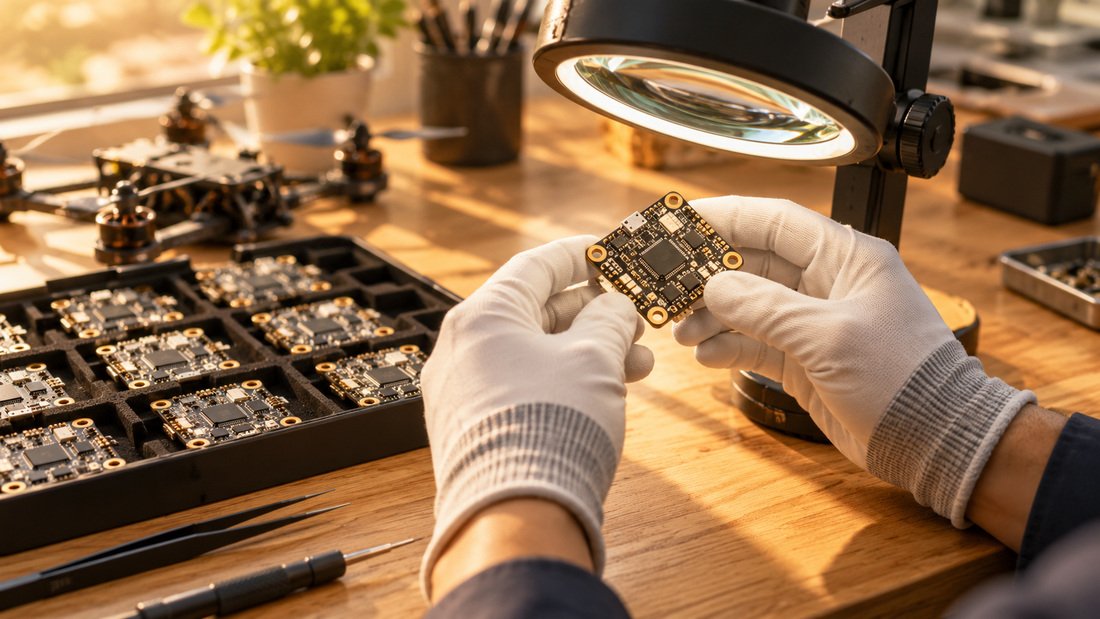
What Can Be Customized? A Breakdown of Firmware and Flight Mode Options
Customization possibilities span from user-adjustable settings to source code modifications. The table below outlines common levels of customization, what they typically involve, and considerations for drone soccer applications.
| Customization Level | Examples | Typical Effort | Considerations |
|---|---|---|---|
| Parameter Tuning | Adjust PID, rates, throttle curves, failsafe | Low | Can be done via configurator; limited differentiation |
| Flight Mode Presets | Add custom mode names, adjust mode switch behavior | Low to Medium | Requires firmware support for custom modes |
| Feature Addition | Game timers, LED patterns, ball detection logic | Medium to High | Needs engineering resources and testing |
| Firmware Fork | Modify open-source firmware (e.g., Betaflight) for specific behavior | High | Ongoing maintenance, version control, IP clarity |
| Proprietary Firmware | Develop custom firmware from scratch | Very High | Significant investment, ownership terms critical |
For most drone soccer OEM and ODM projects, parameter tuning and flight mode presets are the most accessible starting points. Deeper modifications require a supplier with in-house firmware engineers and a structured development process. When discussing with suppliers, ask for a clear list of what they can modify and what remains locked by the hardware or base firmware.
If you need guidance on the overall OEM/ODM process, see our OEM/ODM service overview.
How Does Drone Soccer Influence Firmware and Flight Mode Requirements?
Drone soccer is a fast-paced team sport where drones enclosed in protective cages navigate a field to score goals. The flight characteristics differ from casual FPV flying: pilots need precise control, quick acceleration, and reliable response. Firmware and flight modes must support these demands while adhering to league rules, which may specify maximum speed, weight, and safety features.
Common flight mode considerations for drone soccer include:
- Manual/Acro mode: Allows full pilot control for advanced maneuvers, often used in competition.
- Angle/Horizon mode: Provides self-leveling for beginners, useful in training and youth programs.
- Altitude hold: Helps maintain height, though some leagues may restrict it.
- Game-specific modes: Custom modes that limit speed, enable ball detection, or manage team identifiers.
Custom firmware can also implement safety features like geofencing (virtual boundary) or automatic landing on signal loss, which may be required by schools or event organizers. However, any modification must be tested to ensure it doesn’t compromise reliability.

What Should Buyers Verify Before Committing to Custom Firmware?
Before agreeing to custom firmware, buyers must confirm several critical aspects to avoid delays, extra costs, or compliance issues. The following checklist covers the key points to discuss and document with your supplier.
Procurement Checklist for Custom Firmware and Flight Modes
- Scope definition: Clearly define which parameters, modes, or features will be customized. Request a written specification.
- Development process: Ask about the supplier’s firmware development workflow, including testing and validation steps.
- Version control: Confirm how firmware versions are managed and how updates will be delivered to you.
- Intellectual property (IP): Clarify ownership of custom code and rights to use, modify, and distribute.
- Compatibility: Ensure custom firmware works with the selected hardware (flight controller, ESCs, receiver).
- Testing and certification: Request test reports and ask about compliance with relevant standards (e.g., radio regulations).
- Support and updates: Agree on post-sale support, bug fixes, and update policies.
- Order volume and cost: Understand minimum order quantities (MOQs) and any non-recurring engineering (NRE) fees. Confirm in writing.
Because commercial terms vary by supplier, always ask for a detailed quotation and contract that specifies these points. Do not rely on verbal assurances.
For private label options that complement firmware customization, see private label drone parts.
What Are the Trade-offs of Firmware Customization?
Custom firmware offers benefits like product differentiation and optimized performance, but it also introduces trade-offs. Understanding these helps buyers make informed decisions.
- Cost vs. Differentiation: Deeper customization increases NRE costs and may require higher order volumes to justify. Simpler parameter tuning is cheaper but less unique.
- Time to Market: Custom firmware development can extend lead times. Plan for testing and iteration.
- Complexity and Maintenance: Modified firmware requires ongoing maintenance, especially when base firmware updates. Consider long-term support.
- Compatibility and Sourcing: Custom firmware may lock you into a specific hardware platform, affecting future sourcing flexibility.
- Risk of Errors: Poorly tested firmware can lead to malfunctions. Insist on rigorous testing and pilot feedback.
For many distributors and integrators, a balanced approach is to start with parameter tuning and mode presets, then explore deeper customization as volumes grow.
Common Mistakes in Firmware Customization Projects
Buyers often encounter pitfalls that can be avoided with careful planning. Here are common mistakes:
- Assuming all suppliers can customize firmware: Verify engineering capabilities and ask for examples of past projects.
- Underestimating testing needs: Custom firmware must be tested in real game scenarios; allocate time and budget.
- Overlooking IP terms: Failing to clarify ownership can lead to disputes or inability to modify firmware later.
- Ignoring update paths: Without a clear update process, you may be stuck with outdated or buggy firmware.
- Not aligning with league rules: Ensure customizations do not violate competition regulations.
How Does Drone Parts Factory Support OEM/ODM Firmware Customization?
Drone Parts Factory (DPF) offers OEM/ODM services for drone soccer products, including firmware and flight mode customization. Our capabilities cover parameter tuning, flight mode presets, and feature additions based on project requirements. We work with clients to define specifications and provide samples for evaluation. For details on our customization process and to discuss your project, please Request an OEM / Wholesale Quote.
We also support logo and packaging customization to help build your brand. For large-scale production, see our bulk production page.
Frequently Asked Questions
1. Can all drone soccer suppliers customize firmware?
No. Customization capabilities vary widely. Some suppliers only offer parameter tuning, while others have in-house firmware engineers. Always ask for evidence of past customization projects and clarify the scope in writing.
2. What is the difference between parameter tuning and firmware modification?
Parameter tuning adjusts settings like PID values within existing firmware, while firmware modification involves changing the code itself, such as adding new features or altering flight behavior. The latter requires more engineering resources.
3. How does custom firmware affect drone soccer league compliance?
Custom firmware must comply with league rules, which may restrict certain features. For example, some leagues prohibit altitude hold or speed limits. Always check with your league and test custom firmware accordingly.
4. What is the typical order volume for firmware customization?
Order volume requirements vary by supplier and customization depth. Deeper modifications often require higher volumes to justify engineering costs. Request MOQ and NRE details from your supplier.
5. Can I get samples with custom firmware before placing a bulk order?
Many suppliers offer samples with custom firmware for evaluation. Confirm sample costs, lead times, and whether customization fees apply. Test samples thoroughly before committing.
6. Who owns the custom firmware?
Ownership depends on the agreement. It can range from supplier-owned with licensing to buyer-owned. Clarify IP terms in the contract to avoid future issues.
7. How do firmware updates work after delivery?
Suppliers may provide updates via files or tools. Confirm the update method, frequency, and support terms. Ensure you have the ability to apply updates without extensive downtime.
Conclusion
Firmware and flight mode customization is a powerful way to differentiate your drone soccer offering, but it requires careful planning and verification. By understanding the levels of customization, verifying supplier capabilities, and documenting terms, you can avoid common pitfalls and deliver a product that meets your market’s needs. Whether you are an importer, distributor, or solution integrator, start with a clear specification and request samples to validate performance.
Ready to explore custom firmware for your drone soccer line? Request an OEM / Wholesale Quote to discuss your project with our team.