Quick summary
Dual-band antennas are worth it when your team or program flies on two frequency bands and needs one antenna design to cover both — but they are not automatically better than a well-matched single-band antenna. For most school and drone soccer programs, the question is not “dual-band or nothing” but whether the added flexibility outweighs slightly lower efficiency, extra cost and tuning complexity. Confirm the radio and receiver bands, the connector type, the mounting space, and the vendor’s measured performance data in writing before you commit a season’s budget.
Key Takeaways
- Dual-band antennas let one hardware design serve two radio bands; single-band antennas are usually simpler and can be more efficient within one band.
- Worth-it depends on your fleet: if you standardize on one band, dual-band may add cost without benefit.
- Drone soccer and youth programs benefit most when they share antennas across mixed-band equipment or need field-swappable spares.
- Matching matters more than band count: connector, impedance and mounting position often decide link quality.
- Ask vendors for band-specific performance data and confirm specs in writing; do not rely on marketing labels.
What does “dual-band” actually mean for drone radio antennas?
A dual-band antenna is designed to operate reasonably well on two frequency ranges — commonly one lower band and one higher band used by radio control links. It does not mean the antenna performs identically on both. Performance depends on the antenna’s physical length, matching network and the band you actually use. Ask which bands are covered and how performance differs between them.
For context on how bands and links fit together, see our overview of ELRS and RF systems. ExpressLRS (ELRS, a long-range open-source radio link) is one common system in this space, but the antenna principle applies to other links too.
Single-band vs dual-band: the basic trade-off
A single-band antenna is tuned around one band, so it is usually simpler and can be more efficient there. A dual-band antenna spreads its design across two bands, which can reduce peak efficiency on each. That trade-off is acceptable when flexibility matters more than squeezing out the last bit of range.
Are dual-band antennas worth it for drone soccer and school programs?
Often yes, but for operational reasons rather than raw performance. Programs that run mixed equipment, share spare parts across teams, or need one antenna model stocked for several aircraft gain practical value from dual-band coverage. Programs that fly a single band on a standardized fleet usually get more value from a matched single-band antenna and better mounting.
When dual-band makes sense
- Your club or association supports multiple aircraft types on different bands.
- You want fewer SKUs in the team spares box, reducing misplacement and ordering errors.
- You need one antenna design that works across training and competition setups.
- You are an OEM/ODM buyer consolidating a bill of materials across product lines.
When single-band is the better buy
- Your entire fleet is locked to one band and one receiver type.
- You need maximum link margin in a noisy environment and can tune for that band.
- Space and weight are tight and every gram matters.
- Your budget is better spent on receiver quality, better connectors or spare antennas.
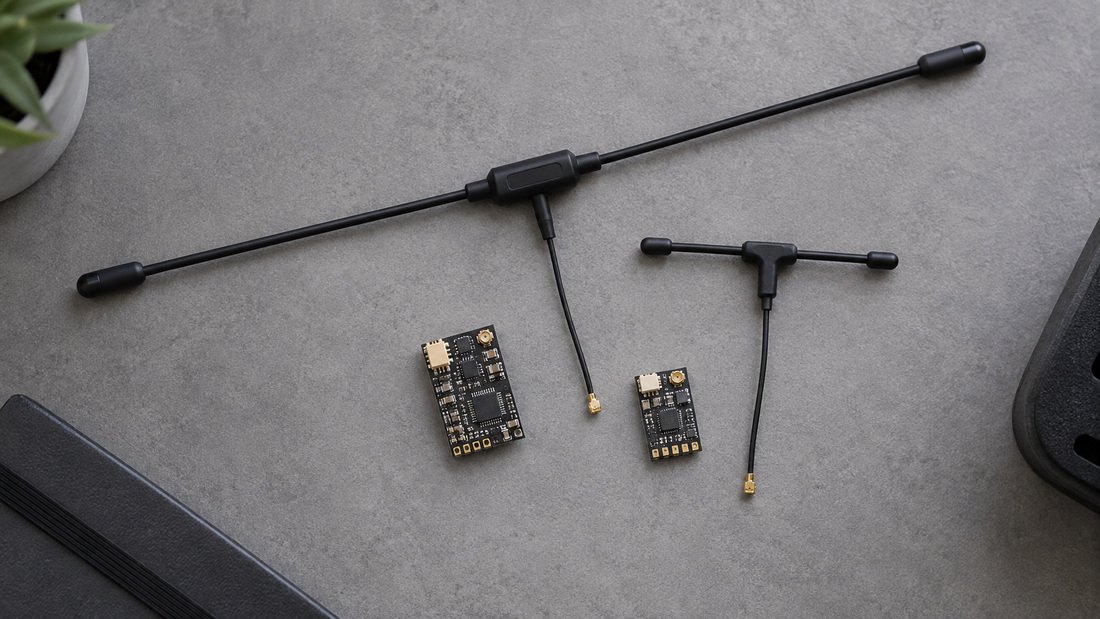
How dual-band antennas interact with receivers and transmitters
Antenna choice only helps if the radio, receiver and antenna are matched. A dual-band antenna on a receiver that only uses one band gives you no benefit. Diversity receivers, which use two antennas to improve reception, can pair well with dual-band antennas if the receiver supports the bands in question. Check ELRS receiver compatibility before assuming a dual-band antenna is usable.
On the transmitter side, the module, antenna connector and firmware settings must align. If you are reviewing transmitter options, see ELRS transmitter modules. A dual-band antenna does not make an incompatible radio compatible.
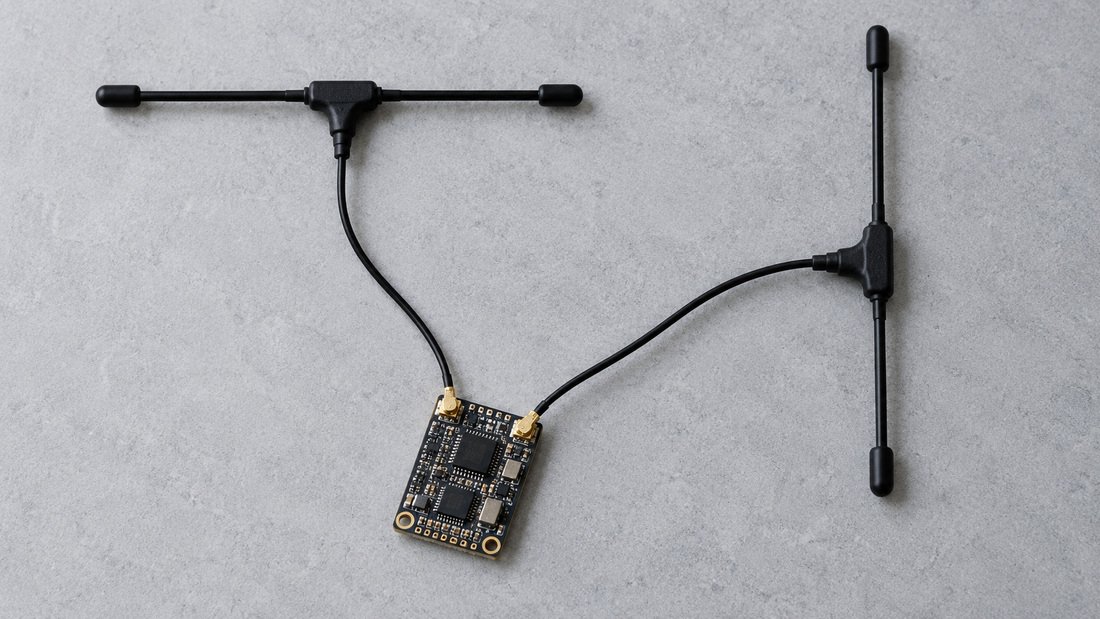
Comparison table: dual-band vs single-band antennas
| Factor | Dual-band antenna | Single-band antenna |
|---|---|---|
| Band flexibility | Covers two bands | One band |
| Peak efficiency | Can be lower per band; verify data | Usually higher within its band |
| Spares management | Fewer SKUs to stock | More SKUs, but simpler per-fleet |
| Cost | Often higher; confirm with quote | Usually lower |
| Best fit | Mixed-band fleets, shared kits | Standardized single-band fleets |
| Verification needed | Per-band data, connector, mounting | Matching to chosen band |
What should buyers verify before ordering dual-band antennas?
Verify the bands, connector, physical fit and performance evidence. Do not accept a label alone. Ask for band-specific specifications, connector type, antenna gain figures, polarization and the mounting or cable requirements. Confirm warranty, lead time and minimum order terms in writing, because these vary by supplier and order.
Procurement checklist for clubs and associations
- List every aircraft and its radio band and receiver model.
- Confirm the antenna connector type (for example, whether your setup uses an SMA or U.FL-type connector) on each aircraft.
- Check mounting space and whether the antenna must be replaceable on the field.
- Request per-band specifications, not a single generic figure.
- Ask how many spares per team are realistic for a season.
- Confirm pricing, lead time, MOQ and warranty in a written quote.
- Test one sample on your own equipment before a bulk order.
Planning a team kit? Tell us your fleet, bands and receiver models, and we will help you shortlist antennas that match. Request a Team Kit Quote.
Common mistakes with drone radio antennas
- Assuming more bands always means more range. Band count is not a performance guarantee.
- Ignoring the connector. The wrong connector can make a good antenna unusable.
- Mounting antennas inside carbon structures. Conductive materials can block signals; check placement.
- Mixing antennas across mismatched receivers. Confirm compatibility first.
- Buying in bulk before testing. Test one unit on your actual aircraft.
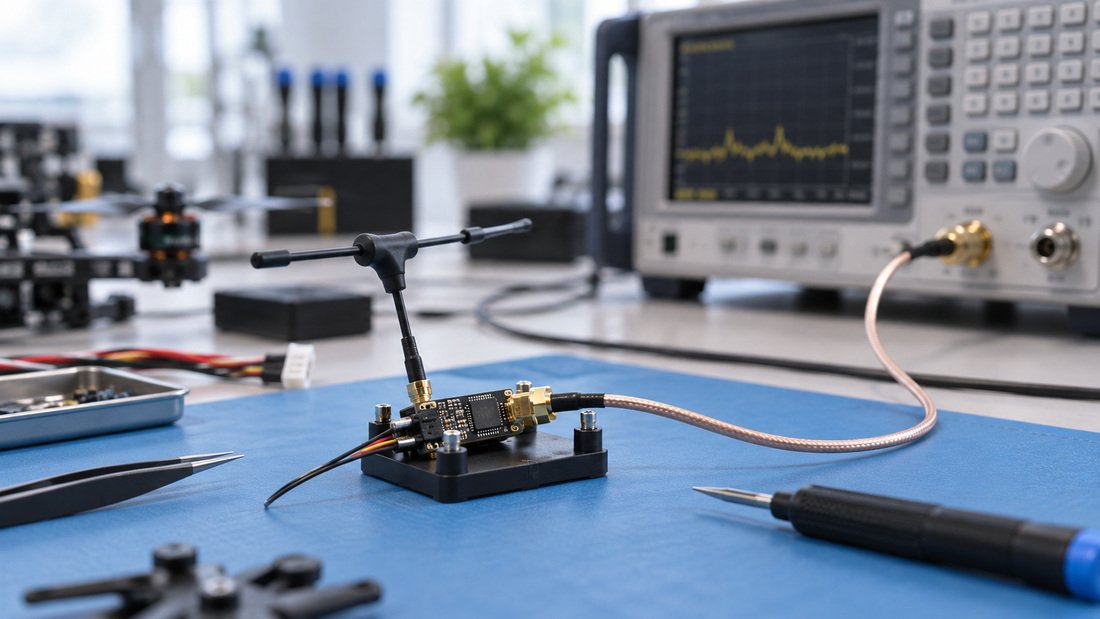
How to evaluate antennas without fabricated test data
You do not need a lab to make a sensible decision, but you do need a consistent method. Compare antennas on the same aircraft, same location and same flight path. Record link quality, failsafe events and range at which control degrades. Repeat the comparison on separate days to account for environmental variation. Ask suppliers what conditions their specifications reflect, and treat unstated conditions as unknown rather than as guarantees.
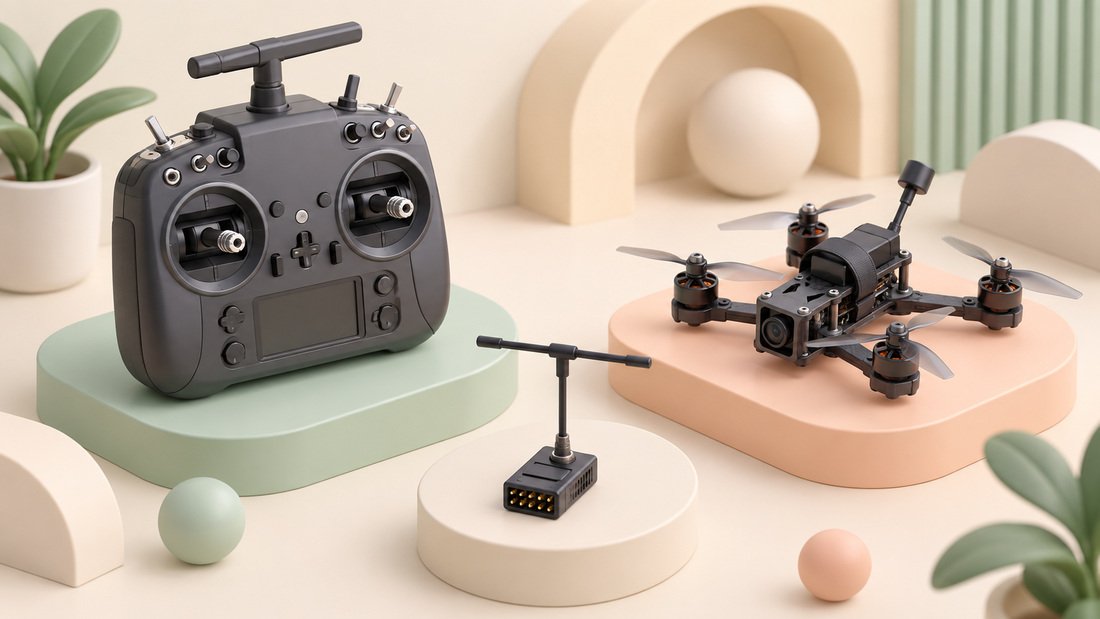
Where to source antennas and how to plan a kit
Start with our RF antennas range and our ELRS receivers if you are building or refreshing team aircraft. For a club or school, the practical approach is to decide the band strategy first, then choose antennas that match it, then order a tested sample kit.
FAQ
Are dual-band antennas worth it for a school drone soccer team?
If your team uses one band only, a matched single-band antenna is usually the simpler and better value choice. If your program shares equipment across multiple bands, dual-band antennas can reduce spare-part complexity.
Do dual-band antennas improve range?
Not automatically. Range depends on the whole link: radio power, receiver sensitivity, antenna matching, mounting and environment. Check per-band specifications and test on your own aircraft.
Can I use a dual-band antenna on any ELRS receiver?
Only if the connector and bands match the receiver’s actual operation. Check the compatibility guidance and confirm with the supplier before ordering.
Is a dual-band antenna heavier or larger?
It can be. Ask for the physical dimensions and weight of the specific unit, then check mounting space and balance on your aircraft.
What should I ask for in a written quote?
Band coverage, connector type, per-band specifications, sample pricing, MOQ, lead time and warranty terms. These vary by supplier, so confirm them in writing.
Should we buy samples before a bulk order?
Yes. Test samples on your own equipment in your usual flying environment before committing to a team-wide purchase.
How many spare antennas should a team carry?
There is no universal answer. Base it on your fleet size, how often antennas are damaged in practice and how quickly replacements can be restocked.
Conclusion
Dual-band drone radio antennas are worth it when they simplify a mixed-band fleet or a shared team kit, and less compelling when your program already flies one matched band. Decide your band strategy, verify connectors and per-band performance, then test a sample. When you are ready to equip a team, Request a Team Kit Quote and confirm every commercial term in writing.